This post is also available in: Dutch (below)
In the wild, making noise draws attention—meaning those who do so must be extra careful to avoid becoming a meal for predators, whether they be birds of prey or domesticated animals in the wild like cats. Crested Bobwhites—known as Sloke in Papiamentu on Curaçao and Cocuí in Papiamento on Aruba—are small, ground-dwelling birds, though they are also quite capable of flying over short distances. The species is found on Aruba and Curaçao, but not on Bonaire. On both islands, these little birds are becoming increasingly rare due to habitat destruction from growing development, the presence of feral cats and dogs, human hunting, and a significant rise in off-road activities that stray from established paths. While there are still areas on Curaçao where they remain relatively common, their numbers are visibly declining even there.
Mating Season
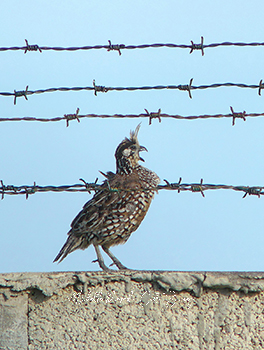
Around mid-October, the breeding season begins for these charming, colorful birds—which, despite their appearance, are exceptionally well-camouflaged within their natural environment. Males set out in search of a mate, but it is the females who ultimately decide which suitor to choose—basing their selection on the males’ vocal talents. Male Crested Bobwhites seek out a high vantage point in the landscape, perch there, and begin their characteristic call, which resonates clearly across the surrounding terrain. This attracts females, but it also poses a significant risk, as birds of prey can easily spot and capture them—thereby eliminating any chance of success. Some males choose leaf cacti or columnar cacti as a high vantage point, making it more difficult for predators to reach them and easier for them to remain hidden. Others have learned to use man-made materials for protection, such as sharp barbed wire atop a wall. If you look closely, you can see the bird standing between two strands of barbed wire—an effective security system. The animal is quite experienced in utilizing this human-made addition, though it occasionally trips over its own feet.
English name: Crested bobwhite
Papiamentu/Papiamento name: Sloke (Curaçao), Cocuí (Aruba)
Scientific name: Colinus cristatus
Family: Odontophoridae (New World Quail)
Occurrence (ABC islands): Native subspecies for Aruba and Curaçao. Does not occur on Bonaire.
Publications used:
- Boer, B. de, Newton, E. & Restall, R. 2012. Birds of Aruba, Curaçao and Bonaire. Ardea Christopher Helm, London.
- Wells, J.V. & Wells, A.C. 2017. Birds of Aruba, Bonaire, and Curaçao: a site and field guide. 474pp. Cornell University Press.
- Da Costa Gomez, M. & Pors, L. 2023. Vogels van Curaçao. 322 pp. Private publication.
- Cornell Lab – All About Birds
- Dutch Caribbean Species Register
- eBird.org

Video snippet: Veiligheid eerst voor een zingende Kuifkwartel
Wie in de natuur herrie maakt, wordt goed zichtbaar en zal dus op zijn of haar tellen moeten passen om niet een maaltje te worden voor roofdieren als roofvogels, maar ook gedomesticeerde roofdieren als katten.
Kuifkwartels, in het Papiamentu op Curaçao de Sloke en in het Papiamento op Aruba Cocuí (Crested bobwhite in het Engels) zijn kleine loopvogels die echter ook best wel goed kunnen vliegen over niet al te lange afstanden. De soort komt voor op Aruba en op curaçao, maar niet van nature op Bonaire.
De diertjes zijn op beide eilanden steeds zeldzamer aan het worden als gevolg van destructie van hun habitat foor toenemende ontwikkeling, verwilderde katten en honden, jacht door de mens en de grote toename van off road activiteiten waarbij men zich niet houdt aan bestaande paden. Op Curaçao zijn er bepaalde plekken waar ze nog enigszins veelvuldig voorkomen, maar ook daar is hun aantal zichtbaar aan het afnemen.
Paartijd
Vanaf medio oktober begint zo ongeveer de broedperiode van deze charmante en bonte uitziende vogels, die desondanks waanzinnig goed gecamoufleerd zijn in de omgevingen waar ze voorkomen. Mannetjes gaan op zoek naar een partner. Maar het zijn de vrouwtjes die uiteindelijk de keuze maken voor welke vent ze kiezen. En dat doen ze aan de hand van de zangkunsten van de mannen.
Mannetjes Kuifkwartels zoeken een hoog punt uit in het landschap en gaan daar op staan. Vervolgens beginnen ze met hun karakteristieke geroep dat op deze locaties lekker door het landschap kan galmen. Dit trekt de vrouwtjes aan, maar vormt ook een groot risico omdat roofvogels ze dan gemakkelijk kunnen zien en vangen, waardoor de kans op succes wordt geëlimineerd.
Sommige mannen kiezen voor bladcactussen of zuilcactussen als hoog punt om het moeilijker te maken voor roofdieren en zich makkelijker te verbergen. Anderen hebben geleerd om materialen die door de mens zijn gemaakt te gebruiken als bescherming, zoals scherp prikkeldraad op de top van een muur. Als je goed kijkt, zie je dat de vogel tussen 2 prikkeldraden staat, een effectief beveiligingssysteem. Het dier heeft redelijk wat ervaring met het gebruik van deze menselijke toevoeging, maar struikelt soms over zijn eigen pootjes.
Nederlandse naam: Kuifkwartel
Papiamentse naam: Sloke (Curaçao), Cocuí (Aruba)
Wetenschappelijke naam: Colinus cristatus
Familie: Odontophoridae (Amerikaanse kwartels)
Voorkomen (ABC eilanden): Inheemse ondersoort voor Aruba en Curaçao, komt op Bonaire niet voor.
Gebruikte publicaties:
- Boer, B. de, Newton, E. & Restall, R. 2012. Birds of Aruba, Curaçao and Bonaire. Ardea Christopher Helm, London.
- Wells, J.V. & Wells, A.C. 2017. Birds of Aruba, Bonaire, and Curaçao: a site and field guide. 474pp. Cornell University Press.
- Da Costa Gomez, M. & Pors, L. 2023. Vogels van Curaçao. 322 pp. Private publication.
- Cornell Lab – All About Birds
- Dutch Caribbean Species Register
- eBird.org