This post is also available in: Dutch (below)
Photographing bird nests containing chicks is a ‘big no-no’ in nature photography. If you were to submit such a photo to a photo contest, disqualification is usually the result. Online photo forums also state in their rules that this is not allowed, and you are immediately kicked out if you post such a photo anyway. And rightly so, because taking such a photo can have a huge impact on the nest. Think of parents abandoning the brood and leaving it to its fate as a result of the disturbance, or such stress on the chicks that they die.
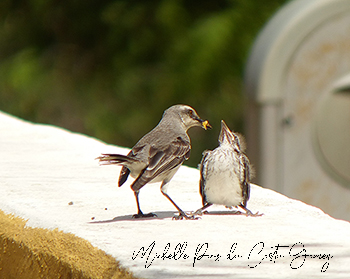
However, there are birds that experience little stress and simply walk out of the nest when they are even too small to fly. On Aruba, Bonaire, and Curaçao, the Tropical mockingbird, or Chuchubi (Mimus gilvus rostratus), is one such bird. The chicks are a type of precocial; they hatch from the egg, stay inside for a few days, and then literally go for a walk. Much to the annoyance of their parents. After all, just try finding your offspring again once they’ve walked 10 branches up or down, or tumbled out of the tree and are standing there staring for meters. Fortunately, Chuchubi chicks are blessed with a substantial mouth from which a rather irritating sound can emerge. A sound that the parents recognize as that of their offspring. Mom and Dad are busy all day long finding the right food for junior in the form of fruits, seeds, and insects. If possible, the parents take a shortcut in their search for food, for example, if they find a piece of bread or other food scraps thrown somewhere by humans. Junior, however, doesn’t let just anything be put into his mouth, and you can observe that behaviour up close often enough, as can be seen in the photo. Mom had found a piece of banana, accidentally dropped on the ground by a participant of an excursion. With a piece of banana in their beak, the parent approached the chick and tried in vain to get the piece of fruit into junior’s beak. Junior clearly didn’t like the piece, and no matter how hard Mom tried, Junior’s beak remained firmly closed. The photo speaks volumes.
English name: Tropical mockingbird
Papiamentu/Papiamento name: Chuchubi
Scientific name: Mimus gilvus rostratus
Family: Mimidae
Occurrence (ABC islands): native on Aruba, Bonaire and Curaçao
Publications used:
- Boer, B. de, Newton, E. & Restall, R. 2012. Birds of Aruba, Curaçao and Bonaire. Ardea Christopher Helm, London.
- Wells, J.V. & Wells, A.C. 2017. Birds of Aruba, Bonaire, and Curaçao: a site and field guide. 474pp. Cornell University Press.
- Da Costa Gomez, M. & Pors, L. 2021. Vogels van Curaçao. 322 pp. Private publication.
- Dutch Caribbean Species Register
- eBird.org

Jong en volwassen – Tropischa spotlijster (de avonturen van junior)
Het fotograferen van vogelnesten met daarin vogelkuikens is een ‘big no no’ in de natuurfotografie. Zou je een dergelijke foto insturen voor een fotowedstrijd dat is diskwalificatie meestal het gevolg. En ook op online foto fora staat het in de regels dat dit niet mag en wordt je er subiet uitgekukeld als je er toch een dergelijke foto in plaats. Met recht, want het maken van een dergelijke foto kan een enorme impact hebben op het nest. Denk aan ouders die het broedsel verlaten en aan hun lot overlaten als gevolg van de verstoring of een zodanige stress bij de kuikens dat ze het leven laten.
Er zijn echter van die vogels die weinig stressen en gewoon het nest uitlopen als ze zelfs nog te klein zijn om te vliegen. Op Aruba, Bonaire en Curaçao is de Caribische of Tropische spotlijster of Chuchubi (Mimus gilvus rostratus) er zo een. De kuikens zijn een soort nestvlieders, ze komen uit het ei, blijven er enkele dagen in zitten en gaan dan letterlijk aan de wandel. Tot grote ergernis van hun ouders. Want zie je kroost maar weer eens terug te vinden als ze eenmaal 10 takken omhoog of omlaag zijn gewandeld, of uit de boom zijn gedonderd en meters ver staan te kijken. Gelukkig zijn Chuchubi kuikens gezegend met een behoorlijke muil waar een redelijk irritant geluid uit kan komen. Een geluid dat de ouders herkennen als die van hun kroost. Pa en ma zijn de hele dag in de weer om het juiste voedsel te vinden voor junior in de vorm van vruchten, zaden en insecten. Als het kan, nemen de ouders even een shortcut met het zoeken van voedsel, als ze bijvoorbeeld een stuk brood vinden of andere voedselresten die door de mens ergens zijn gegooid. Junior laat zich echter niet zomaar alles in de mond stoppen, en dat gedrag kun je vaak genoeg van dichtbij observeren, zoals op de foto te zien. Ma had een stukje banaan gevonden, per ongeluk door een deelnemer van een excursie op de grond terecht gekomen. Met een stukje banaan in de snavel toog de ouder naar het jong en probeerde tevergeefs het stuk fruit in de snavel van junior te krijgen. Junior lustte het stuk overduidelijk niet, en hoe ma het ook probeerde, de snavel van junior bleef ferm gesloten. De foto spreekt boekdelen.
Nederlandse naam: Tropische/ Caribische spotlijster
Papiamentse naam: Chuchubi
Wetenschappelijke naam: Mimus gilvus rostratus
Familie: Mimidae
Voorkomen (ABC eilanden): Aruba, Bonaire en Curaçao
Gebruikte publicaties:
- Boer, B. de, Newton, E. & Restall, R. 2012. Birds of Aruba, Curaçao and Bonaire. Ardea Christopher Helm, London.
- Wells, J.V. & Wells, A.C. 2017. Birds of Aruba, Bonaire, and Curaçao: a site and field guide. 474pp. Cornell University Press.
- Da Costa Gomez, M. & Pors, L. 2021. Vogels van Curaçao. 322 pp. Private publication.
- Dutch Caribbean Species Register
- eBird.org