This post is also available in: Dutch (below)
Anyone who sometimes gets their head underwater in the clear waters of the ocean to snorkel or dive, will encounter algae in all habitats you can access. The slimy brownish or bright green algae close to the shore in front of beaches that indicate eutrophication are the ones that are more generally seen and discarded. But the sea is full of thousands of species of algae, making identification a very specialized job. In the waters around the ABC-islands there are many species of algae found, some of which even got used in several experiments and tests to find new medicinal applications. In between all the existing species some species are particularly conspicuous as they appear to be small green trees growing in calciferous substrate, consisting of deep green leaf-like structures. These belong to the family of Halimedaceae ( a family of green algae), and the genus Halimeda ( a genus of green macroalgae).
Characteristics
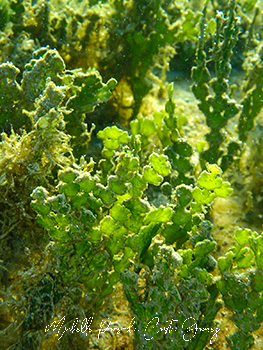
The main characteristic of the genus Halimeda is that the body of the algae consists of segments that contain plate-like calcium carbonate structures within the algae tissue that consist for 60-80 % of aragonite, a form of calcium carbonite. As such these algae are one of the main producers of the sandy calcium carbonate substrate on the bottom of the ocean in inner bays, on the beaches lining these inner bays and is also part of the sand on our beaches along the coast. If you look at sand from several local beaches under the microscope you will find complete calcium carbonate plates or parts of them from these algae. Some beaches in inner bays consist almost completely of this material. On Curaçao you can find this especially in the beach areas of Fuik and Spaanse Water, but also in Lac-bay on Bonaire. Not strange, considering that you might find this algae species in large quantities in sea grass beds and other areas in inner bays.
The algae grows on the substrate with root-like structures that are called rhizomes. These offer the grip the algae needs on the bottom but also appear to extract nutrients from it.
Sexual and asexual reproduction
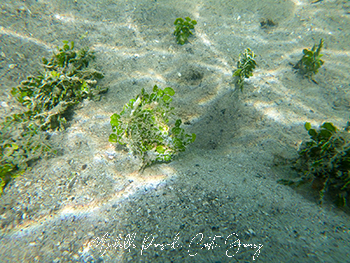
Members of the Halimeda genus appear to reproduce both sexually and asexually, with asexual reproduction maybe more abundant, as the algae propagates with the separate segments (that look like the leaves), fragmenting and regrowing in other locations facilitated by the current. Sexual reproduction does happen, with the algae growing gametes. A process which leads to the dead in the parent algae, in certain species.
Halimeda incrassata is often used in salt water aquariums because they are relatively easy to grow and look pretty. The hard calcified segments are not a favorite among fish and will not often be eaten. Whereas there are certain species that nibble from the algae in the wild, it usually remains intact and provides important hiding space and habitat for small fish and marine invertebrates.
Native
Halimeda incrassata is a native algae species for all three islands of Aruba, Bonaire and Curaçao.
English name: Three finger leaf algae
Papiamentu/Papiamento name: –
Scientific name: Halimeda incrassata
Family: Halimedaceae
Occurrence (ABC islands): Aruba, Bonaire and Curaçao (indigenous)
Publications used:
- Dutch Caribbean Species Register
- Naturalis bioportal
- World Register of Marine Species
- 5 Main Types of Algae in the Ocean – Ocean Info
- Fricke, Anna & Titlyanova, Tamara & Teichberg, Mirta & Nugues, M. & Bischof, Kai. (2018). The Chlorophytes of Curaçao (Caribbean): a revised checklist for the south-west coast. Botanica Marina. 61. 33-46. 10.1515/bot-2017-0072.
- Wikipedia
- HALIMEDA INCRASSATA
Three Finger Leaf Algae (Halimeda incrassata)
Iedereen die wel eens met zijn hoofd onder water gaat in de heldere oceaan – om te snorkelen of te duiken – zal in vrijwel elke omgeving algen tegenkomen. De slijmerige, bruinachtige of felgroene algen die dicht bij de kustlijn (vlak voor het strand) groeien en vaak wijzen op eutrofiëring (overmatige voedingsstoffen), zijn de soorten die het meest opvallen en meestal als ongewenst worden beschouwd. De zee herbergt echter duizenden verschillende algensoorten, waardoor het identificeren ervan een zeer gespecialiseerde taak is. In de wateren rond de ABC-eilanden komen talloze algensoorten voor; sommige zijn zelfs gebruikt in experimenten en tests om nieuwe medische toepassingen te ontdekken. Tussen al deze soorten vallen sommige exemplaren bijzonder op: ze zien eruit als kleine groene boompjes die uit een kalkhoudende bodem groeien en bestaan uit diepgroene, bladachtige structuren. Ze behoren tot de familie Halimedaceae (een familie van groenalgen) en het geslacht Halimeda (een geslacht van groene macroalgen).
Kenmerken
Het belangrijkste kenmerk van het geslacht Halimeda is dat het lichaam van de alg is opgebouwd uit segmenten. Deze segmenten bevatten in hun weefsel plaatvormige structuren van calciumcarbonaat, die voor 60 tot 80% bestaan uit aragoniet – een specifieke vorm van calciumcarbonaat. Hierdoor vormen deze algen een van de belangrijkste bronnen van het zanderige calciumcarbonaat-substraat op de zeebodem in binnenbaaien. Ze dragen bij aan het zand op de stranden langs deze baaien en vormen ook een bestanddeel van het zand op onze kuststranden. Als je zand van lokale stranden onder een microscoop bekijkt, kun je volledige calciumcarbonaatplaatjes of fragmenten daarvan terugvinden die afkomstig zijn van deze algen. Sommige stranden in binnenbaaien bestaan zelfs bijna volledig uit dit materiaal. Op Curaçao is dit onder meer te zien bij de stranden van Fuik en het Spaanse Water, en op Bonaire in Lac Bay. Dat is niet verwonderlijk, aangezien deze algensoorten in grote hoeveelheden voorkomen in zeegrasvelden en andere gebieden binnen deze baaien.
De alg hecht zich aan de bodem met wortelachtige structuren, de zogenaamde rhizomen. Deze bieden de alg niet alleen de nodige houvast op de zeebodem, maar lijken ook voedingsstoffen uit het substraat op te nemen. Seksuele en aseksuele voortplanting
Seksuele en aseksuele voortplanting
Soorten uit het geslacht *Halimeda* planten zich zowel seksueel als aseksueel voort, waarbij aseksuele voortplanting wellicht vaker voorkomt. De alg verspreidt zich namelijk doordat de afzonderlijke segmenten (die op blaadjes lijken) losraken en door de stroming naar andere locaties worden meegevoerd, waar ze vervolgens weer verder groeien. Seksuele voortplanting vindt ook plaats, waarbij de alg gameten vormt; een proces dat bij bepaalde soorten leidt tot het afsterven van de moederplant.
Halimeda incrassata wordt vaak in zoutwateraquaria gehouden, omdat de soort relatief eenvoudig te kweken is en een aantrekkelijk uiterlijk heeft. De harde, verkalkte segmenten zijn niet geliefd bij vissen en worden daarom zelden gegeten. Hoewel sommige diersoorten in de natuur wel eens aan de alg knabbelen, blijft deze doorgaans intact; de alg biedt zo een belangrijke schuilplaats en leefomgeving voor kleine vissen en ongewervelde zeedieren.
Inheems
Halimeda incrassata is een inheemse algensoort op de eilanden Aruba, Bonaire en Curaçao.
Nederlandse naam: –
Papiamentse naam: –
Wetenschappelijke naam: Halimeda incrassata
Family: Halimedaceae
Voorkomen (ABC eilanden): Aruba, Bonaire en Curaçao (inheems)
Gebruikte literatuur:
- Dutch Caribbean Species Register
- Naturalis bioportal
- World Register of Marine Species
- 5 Main Types of Algae in the Ocean – Ocean Info
- Fricke, Anna & Titlyanova, Tamara & Teichberg, Mirta & Nugues, M. & Bischof, Kai. (2018). The Chlorophytes of Curaçao (Caribbean): a revised checklist for the south-west coast. Botanica Marina. 61. 33-46. 10.1515/bot-2017-0072.
- Wikipedia
- HALIMEDA INCRASSATA