This post is also available in: Dutch (below)
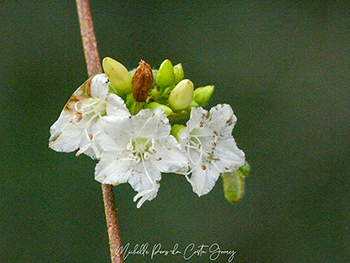
Our islands have multiple species of plants that belong to the Morning glory family in the wild. One of the most inconspicuous but also one of the most delicate of them is what we call the Yerba di sas (known as both Jacquemontia nodiflora and/or Convolvulus nodiflorus) in Papiamentu. This plant is especially visible in the rainy season when the plant can be found in more humid areas. On Curaçao Christoffelpark is one of the locations it is seen more abundantly than anywhere else on the island in the months of November and December, when rains turn the hills of the area lusciously green. This morning glory member will grow in and over other plants but never gets so spread out that it will cover other plants completely. It can be recognized first and foremost by the small 1,5 cm long, but delicately formed white flowers that grow in clusters and attract a massive number of insects. The vines of the plant are covered with hairs and the rounded small egg-shaped leaves are also covered in velvet-like hairs. Because of the hairs the leaves sometimes appear to be blue-green in their coloration.
As said before the flowers of this plant are an important food supply to a massive number of species of insects such as solitary bees, carpenter bees, honey bees, wasps, beetles, flies, butterflies and moths and also birds such as hummingbirds.
English name: Little white bell
Papiamentu/Papiamento name: Yerba di sas
Scientific name: Jacquemontia nodiflora/ Convolvulus nodiflorus
Family: Convolvulaceae (Morning glories)
Occurrence (ABC islands): native on Aruba, Bonaire and Curaçao
Publications used:
- Proosdij, A.S.J. van 2012. Arnoldo’s Zakflora: Wat in het wild groeit en bloeit op Aruba, Bonaire en Curaçao. 318 pp. Walburg Pers, Zutphen.
- Dutch Caribbean Species Register
- The Online Flora of Curaçao
- Wikipedia

Yerba di sas – Little white bell (Jacquemontia nodiflora/ Convolvulus nodiflorus)
Onze eilanden kennen in het wild meerdere plantensoorten die tot de windefamilie behoren. Een van de meest onopvallende, maar ook een van de meest delicate, is wat we in Papiamentu de Yerba di sas (bekend onder zowel de naam Jacquemontia nodiflora als Convolvulus nodiflorus) noemen. Deze plant is vooral goed zichtbaar tijdens het regenseizoen. Op Curaçao is het Christoffelpark één van de plekken waar we de plant in november en december het meest overvloedig zien, wanneer de regen de heuvels in het gebied weelderig groen kleurt. Deze winde groeit tussen en over andere planten heen, maar spreidt zich nooit zo uit dat hij andere planten volledig bedekt. De plant is vooral te herkennen aan de kleine, 1,5 cm lange, maar fijn gevormde witte bloemen die in trossen groeien en een groot aantal insecten aantrekken. De ranken van de plant zijn bedekt met haartjes en de ronde, eivormige bladeren zijn eveneens bedekt met fluweelachtige haartjes. Door de haartjes lijken de bladeren soms blauwgroen van kleur.
Zoals gezegd vormen de bloemen van deze plant een belangrijke voedselbron voor een groot aantal insectensoorten, zoals solitaire bijen, Xylocopa, honingbijen, wespen, kevers, vliegen, vlinders en motten, en ook voor vogels zoals kolibries.
Nederlandse naam: –
Papiamentse naam: Yerba di sas
Wetenschappelijke naam: Jacquemontia nodiflora/ Convolvulus nodiflorus
Familie: Convolvulaceae (Windefamilie)
Voorkomen (ABC eilanden): Aruba, Bonaire en Curaçao
Gebruikte publicaties:
- Proosdij, A.S.J. van 2012. Arnoldo’s Zakflora: Wat in het wild groeit en bloeit op Aruba, Bonaire en Curaçao. 318 pp. Walburg Pers, Zutphen.
- Dutch Caribbean Species Register
- The Online Flora of Curaçao
- Wikipedia