This post is also available in: Dutch (below)
Large, lilac to light pink flowers bloom beautifully in the early morning hours and close as soon as the daytime temperature rises and direct sunlight shines on them. The Yerba di glas as the plant is called on Aruba and Curaçao or Trompèt as it is called on Bonaire has one of the most striking flowers found in the mondi during the rainy season, from November to January. In the scientific world it is know under the name Ipomoea incarnata.
Morning Glory Family
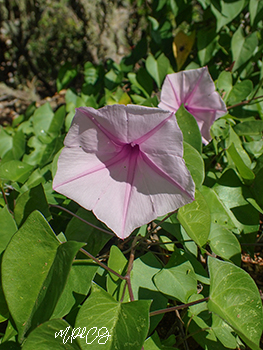
This plant belongs to the morning glory family, and its flowering behaviour, blooming in the cool morning hours, perfectly illustrates this. Like other members of the family, this plant is a climber and grows over other plants, forming long carpets of bright green foliage with heart-shaped leaves and characteristic large pink flowers, which are very delicate and glassy. Hence the name in Papiamento, Yerba di glas, which can be translated as “glass flower.” The flowers can grow to almost 7 centimeters long and, as mentioned, vary considerably in color, from lilac to lilac-pink and light pink. The flowers open only in the morning and close as soon as it gets warmer and the sun shines brighter. Sometimes you’ll even see a single flower blooming in the evening.
Confusion with the Rubber Vine
The plant is often confused with the invasive Palu di lechi, the Rubber Vine (Cryptostegia grandiflora), which also grows over other plants. However, during the dry season, the Yerba di glas will die almost completely and quickly lose its leaves, giving the vegetation it grows over a chance to survive. This is in contrast to the Palu di lechi, which can remain green year-round, permanently blocking the underlying vegetation from sunlight and thus causing its death.
Interaction with Animals
The Yerba di glas flowers are visited by butterflies and bees, and hummingbirds and Bananaquits also enjoy the nectar in the flowers. Sometimes they don’t wait for the flower to open but pierce the flower buds with their beaks to obtain the sweet liquid.
English name: Morning glory
Papiamentu/Papiamento name: Yerba di glas (Aruba, Curaçao), Trompèt (Bonaire)
Scientific name: Ipomoea incarnata
Family: Convolvulaceae (Morning glories)
Occurrence (ABC islands): Aruba, Bonaire and Curaçao
Publications used:
- Proosdij, A.S.J. van 2012. Arnoldo’s Zakflora: Wat in het wild groeit en bloeit op Aruba, Bonaire en Curaçao. 318 pp. Walburg Pers, Zutphen.
- Dutch Caribbean Species Register
- Wikipedia

Wilde bloemen: Yerba di glas – Trompèt (Ipomoea incarnata)
Grote, lila tot lichtroze bloemen die prachtig bloeien in de vroege ochtenduren en zich gaan sluiten zodra de temperatuur overdag stijgt en er direct zonlicht op gaat schijnen. De Yerba di glas, zoals de plant op Aruba en Curaçao wordt genoemd of Trompèt zoals het op Bonaire wordt genoemd, heeft één van de meest opvallende bloemen die in de regentijd, de periode van november tot en met januari, in de mondi te vinden zijn. Wetenschappelijk is de plant bekend als Ipomoea incarnata.
Morning glory-familie
De plant behoort tot de familie van de morning glories, en het ‘bloeigedrag’ van in de koele ochtenduren bloeien, illustreert dit volledig. Deze plant is net als andere familieleden een klimplant en groeit over andere planten heen waarmee het lange tapijten van heldergroene planten vormt met hartvormige bladeren en de karakteristieke grote roze bloemen, die heel teer zijn en glasachtig aandoen. Vandaar ook de naam in het Papiaments, Yerba di glas, dat vertaald kan worden als ‘glazen bloem’. De bloemen kunnen bijna 7 centimeter lang worden en, zoals gezegd, nogal varieren van kleur; van lila tot lila-roze en lichtroze. De bloemen zijn alleen ’s ochtends open en zodra het warmer wordt en de zon feller schijnt, sluiten ze zich. Soms zie je ook een enkele bloem gedurende de avonduren bloeien.
Verwarring met de Rubberliaan
Dikwijls wordt de plant verward met de invasieve Palu di lechi, de Rubberliaan (Cryptostegia grandiflora), die ook over andere planten heen groeit. In de droge tijd zal de Yerba di glas echter bijna geheel afsterven en snel bladeren verliezen waardoor de vegetatie waar het overheen groeit weer de kans krijgt om te overleven. Dat in tegenstelling tot de Palu di lechi die het hele jaar groen kan blijven en daarmee de onderliggende vegetatie permanent afsluit voor zonlicht en op deze manier het afsterven hiervan veroorzaakt.
Interactie met dieren
De Yerba di glas bloemen worden bezocht door vlinders en bijen en ook kolibries en Suikerdiefjes doen zich tegoed aan de nectar in de bloemen. Soms wachten ze niet af tot de bloem open is maar prikken al met de snavel door de bloemknoppen heen om het zoete vloeistofje te bemachtigen.
Nederlandse naam: –
Papiamentse naam: Yerba di glas (Aruba, Curaçao), Trompèt (Bonaire)
Wetenschappelijke naam: Ipomoea incarnata
Familie: Convolvulaceae (Windefamilie)
Voorkomen (ABC eilanden): Aruba, Bonaire en Curaçao
Gebruikte publicaties:
- Proosdij, A.S.J. van 2012. Arnoldo’s Zakflora: Wat in het wild groeit en bloeit op Aruba, Bonaire en Curaçao. 318 pp. Walburg Pers, Zutphen.
- Dutch Caribbean Species Register
- Wikipedia