This post is also available in: Dutch (below)
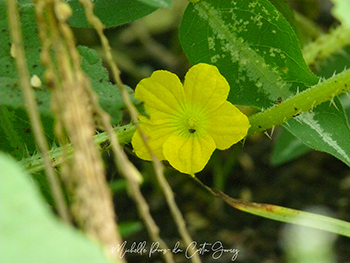
Nature explorers who regularly visit wild areas on the islands have undoubtedly come across this plant with very picturesque fruits. The Kònkòmber shimarón (B,C) or Concomber Shimaron (A), or ‘false cucumber’, is a ground-growing plant that, at first glance, looks like a cross between a watermelon and a pumpkin. The plant has small, bright yellow flowers that are usually hidden beneath the long, trailing tendrils. The flowers are very popular with insects such as bees, ants, and beetles, but the petals are also a tasty snack for lizards and rabbits.
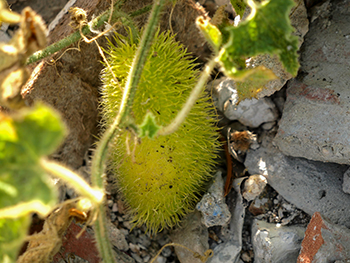
But it is the fruits that catch the eye the most. Fairly large (up to 7 centimetres long), bright yellow (or green if unripe), thick, cucumber-like fruits with very long, soft yellow hairs. At first glance, they bear some resemblance to the Kònkòmber chikí, the small, round cucumbers that play the starring role in Kònkòmber stobá, a local delicacy. However, these are two different species that do, incidentally, belong to the same family. The Kònkòmber chikí has the scientific name Cucumis anguria. Unfortunately, most stories told about the Hedgehog gourd usually do not go beyond the fact that it is inedible due to its toxicity. However, this is not entirely correct.
Cucumis dipsaceus does not originally occur in the flora of our islands, but is a plant that originates from and is native to East Africa, Sudan, Ethiopia, and Egypt. In various countries in Africa, it is even cultivated commercially due to the high nutritional value of the leaves (leafy greens) and even the medicinal applications of the fruit.
The species was therefore imported to Aruba, Bonaire and Curaçao, although it is not entirely clear when this happened and how far back in history we need to go.
The juicy-looking fruit of this climbing plant is eaten in certain cultures, where it must first be cooked. The seeds are also used as a food source. In most cases, however, the fruit is used for medicinal purposes to treat constipation and other gastrointestinal disorders. As a food product, it is primarily the leaves that are widely consumed.
English name: Arabian cucumber/ Hedgehog gourd
Papiamentu/Papiamento name: Kònkòmber shimarón (B,C) Concomber Shimaron (A)
Scientific name: Cucumis dipsaceus
Family: Cucurbitaceae (Gourd family)
Occurrence (ABC islands): Intrduced on Aruba, Bonaire & Curaçao.
Publications used:
- Proosdij, A.S.J. van 2012. Arnoldo’s Zakflora: Wat in het wild groeit en bloeit op Aruba, Bonaire en Curaçao. 318 pp. Walburg Pers, Zutphen.
- Dutch Caribbean Species Register
- Plants of the World Online
- The Online Flora of Curaçao
- Wikipedia

Wilde bloemen: Distelkomkommer (Cucumis dipsaceus)
Natuurliefhebbers die regelmatig in de vrije natuur op de eilanden komen, zijn ongetwijfeld wel eens deze plant met zijn zeer opvallende vruchten tegengekomen. De ‘Kònkòmber shimarón‘ (B, C) of ‘Concomber Shimaron‘ (A), ook wel ‘valse komkommer’ genoemd of in het Nederlands de Distelkomkommer, is een kruipende plant die op het eerste gezicht lijkt op een kruising tussen een watermeloen en een pompoen. De plant heeft kleine, felgele bloemen die meestal verborgen zitten onder de lange, uitlopende ranken. Deze bloemen zijn erg in trek bij insecten zoals bijen, mieren en kevers, terwijl de bloemblaadjes bovendien een smakelijk hapje vormen voor hagedissen en konijnen.
Het zijn echter vooral de vruchten die in het oog springen: vrij grote (tot 7 centimeter lange), felgele (of groene, indien onrijpe) en dikke, komkommerachtige vruchten, bedekt met zeer lange, zachte, gele haren. Ze lijken enigszins op de ‘Kònkòmber chikí‘, de kleine, ronde komkommertjes die de hoofdrol spelen in ‘Kònkòmber stobá’, een lokale delicatesse. Toch gaat het hier om twee verschillende soorten, die overigens wel tot dezelfde familie behoren. De ‘Kònkòmber chikí’ draagt de wetenschappelijke naam Cucumis anguria. Helaas wordt er vaak beweerd dat deze ‘Distelkomkommer‘ (Hedgehog gourd) oneetbaar zou zijn vanwege zijn giftigheid; dat klopt echter niet helemaal.
Cucumis dipsaceus behoort oorspronkelijk niet tot de flora van onze eilanden; de plant is inheems in Oost-Afrika, Soedan, Ethiopië en Egypte. In diverse Afrikaanse landen wordt de plant zelfs commercieel verbouwd, vanwege de hoge voedingswaarde van de bladeren (die als bladgroente dienen) en de medicinale toepassingen van de vrucht.
De soort is dus ooit op Aruba, Bonaire en Curaçao geïntroduceerd, al is het niet precies duidelijk wanneer dit gebeurde of hoe ver dit teruggaat in de geschiedenis.
De sappig ogende vrucht van deze klimplant wordt in bepaalde culturen gegeten, mits deze eerst wordt gekookt. Ook de zaden worden als voedselbron gebruikt. Meestal wordt de vrucht echter ingezet voor medicinale doeleinden, bijvoorbeeld bij de behandeling van verstoppingen en andere maag-darmaandoeningen. Als voedingsproduct zijn het vooral de bladeren die op grote schaal worden geconsumeerd.
Nederlandse naam: Distelkomkommer
Papiamentse naam:Kònkòmber shimarón (B,C) Concomber Shimaron (A)
Wetenschappelijke naam: Cucumis dipsaceus
Familie: Cucurbitaceae (komkommerfamilie)
Voorkomen (ABC eilanden): Geïntroduceerd op Aruba. Bonaire en Curaçao
Gebruikte publicaties:
- Proosdij, A.S.J. van 2012. Arnoldo’s Zakflora: Wat in het wild groeit en bloeit op Aruba, Bonaire en Curaçao. 318 pp. Walburg Pers, Zutphen.
- Dutch Caribbean Species Register
- Plants of the World Online
- The Online Flora of Curaçao
- Wikipedia