This post is also available in: Dutch (below)
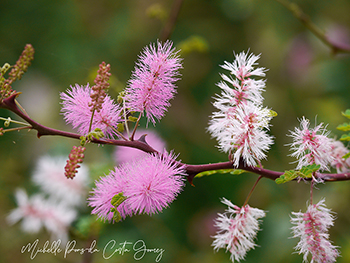
Aruba, Bonaire and Curaçao have their own Mimosa plant and it is fabulous. With light pink to intense pink flowers, this is not a plant you will easily oversee when you encounter it, especially as you will discover its very painful spiny secret when you walk passed it and get stuck with your clothes on the spines. This South American and Caribbean plant is called Uña di gatu in Papiamentu on Bonaire and Curaçao and Tarabara in Papiamento on Aruba. The name on Bonaire and Curaçao, Uña di gatu can be translated as cat’s nail and this is for a reason as the spines are similar to the nails of cats in form, as well as in ferocity.
The Mimosa distachya var. oligacantha is not a very general occurring plant, but can spread out in places where it does occur. It will remain relatively small, not more than 2 meters in height. The pollen-rich flowers flowers are visited by solitary bees, wasps, flies, mosquitoes and butterflies although these latter are very careful to visit only the flowers positioned away from the spines. Bananaquits have been observed carefully licking of the nectar from the individual flowers.
English name: Mexican mimosa / Wild mimosa
Papiamentu/Papiamento name: Uña di gatu (B,C), Tarabara (A)
Scientific name: Mimosa distachya var. oligacantha
Family: Fabaceae (Legume family)
Occurrence (ABC islands): native on Aruba, Bonaire & Curaçao.
Publications used:
- Proosdij, A.S.J. van 2012. Arnoldo’s Zakflora: Wat in het wild groeit en bloeit op Aruba, Bonaire en Curaçao. 318 pp. Walburg Pers, Zutphen.
- Dutch Caribbean Species Register
- Plants of the World Online
- The Online Flora of Curaçao
- iNaturalist
- Wikipedia

Wilde bloemen: Mexicaanse mimosa (Mimosa distachya var. oligacantha)
Aruba, Bonaire en Curaçao hebben hun eigen mimosa soort, en die is werkelijk prachtig. Met bloemen die variëren van lichtroze tot diep roze valt deze plant direct op. Maar pas op: als je erlangs loopt, ontdek je al snel zijn pijnlijke geheim – de scherpe doorns waar je kleding gemakkelijk aan kan blijven haken. Deze plant, die oorspronkelijk uit Zuid-Amerika en het Caribisch gebied komt, staat op Bonaire en Curaçao bekend als Uña di gatu (Papiaments voor ‘kattennagel’), terwijl hij op Aruba Tarabara wordt genoemd. De naam Uña di gatu is zeer treffend: de doorns lijken qua vorm én venijnigheid sterk op de nagels van een kat.
De Mimosa distachya var. oligacantha is geen algemeen voorkomende soort, maar kan op plekken waar hij wel groeit, flink uitdijen. De plant blijft relatief klein en wordt doorgaans niet hoger dan 2 meter. De stuifmeelrijke bloemen trekken solitaire bijen, wespen, vliegen, muggen en vlinders aan; vlinders zijn echter uiterst voorzichtig en bezoeken alleen de bloemen die zich op veilige afstand van de doorns bevinden. Ook is waargenomen hoe suikerdiefjes (Bananaquits) behoedzaam de nectar uit de individuele bloemen likken.
Nederlandse naam: Mexicaanse mimosa
Papiamentse naam: Uña di gatu (B,C), Tarabara (A)
Wetenschappelijke naam: Mimosa distachya var. oligacantha
Familie: Fabaceae (vlinderbloemenfamilie)
Voorkomen (ABC eilanden): Inheems op Aruba. Bonaire en Curaçao
Gebruikte publicaties:
- Proosdij, A.S.J. van 2012. Arnoldo’s Zakflora: Wat in het wild groeit en bloeit op Aruba, Bonaire en Curaçao. 318 pp. Walburg Pers, Zutphen.
- Dutch Caribbean Species Register
- Plants of the World Online
- The Online Flora of Curaçao
- iNaturalist
- Wikipedia