This post is also available in: Dutch (below)
First published in February 2012 – Adapted January 2026
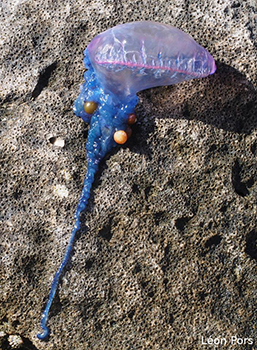
Every year, during the period in between Carnival and Easter, popularly known as Lent (temp’i kuaresma), and sometimes earlier or later in the year, the wind pattern in our region tends to be irregular. When the directions from which the winds originate shift towards the south-east, our island might receive visits from a bizarre organism, one that we often are not too happy with. This organism belongs to the order siphonophorae, and this word stands for animals ‘with hollow tubes’. We are talking about the Physalia physalis, commonly known as the Portuguese man-of-war (Pèchi Portugés in papiamentu).
A colony of organisms called hydroids
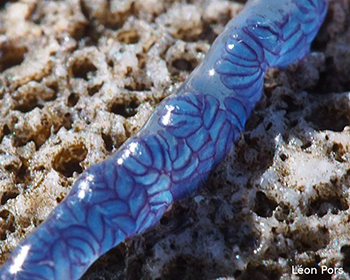
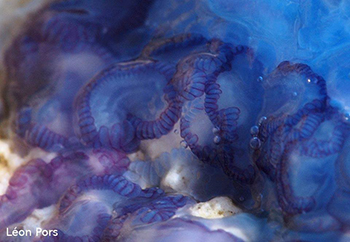
Although it seems weird, the Portuguese man-of-war is not a single animal. Biologically speaking, it is a colony of organisms called hydroids, which are organized in such a way that they all have assumed a specific task. For example, groups of cells deal with digestion of food, other cell groups take care of reproduction, another cell acts as the pink-purple, gas-filled, float (the “hollow tube”), and then there are the so-called nematocysts, the dreaded stinging cells arranged in long tentacles hanging below the floating bladder. These tentacles are retractable, but while stretched out below a sizable colony, they can reach lengths of 30 meters. And that makes the man-of-war dangerous to swimmers, of course. The colony uses the stinging cells for defense and paralyzing prey. Yet there is one species that has adapted in such way that it has become impervious to the poison. The Banded man-of-war fish, Nomeus gronovii, live among the tentacles of the Portuguese man-of-war and feed on scraps from the prey captured by the colony.
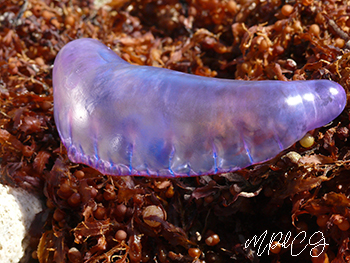
The float allows the colony to be propelled by the wind, and that’s the reason that during southerly winds we might encounter groups of colonies along the south coast of our islands, along exactly those coastlines where all the swimming beaches are located. We might occasionally encounter Portuguese man-of-war along the north coast lines year around. It is not that they just occur during Lent in our region.
A nematocyst, the dreaded stinging cell, consists of a microscopically small bag filled with a rolled up thread terminating in a needle with barbs. This cell is pressurized. If a prey animal or a swimmer touches the trigger-hook of the cell, it will burst open, and the needle with attached thread will be shot in the direction of the victim with considerable speed. On contact a potent poison is injected into the victim. Touching the tentacles of a Portuguese man-of-war will trigger tens to hundreds of cells, causing intense pain and considerable blistering.
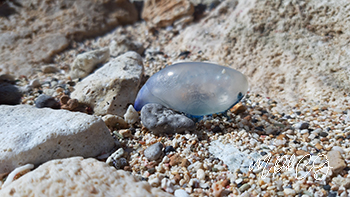
Despite the bad reputation of these bizarre, but also very special colony-forming hydroids, their floating lifestyle is a benefit to beach guests. They are clearly visible. The advice is simple: if you observe a pink-purple balloon floating on the water, make sure to get out of the water right away. Better safe than sorry! If you do come into contact with the stinging cells, then a trip to a first aid clinic is recommended, especially in severe cases. By the way, never touch a stranded man-of-war, especially keep away from the stringy mass. The stinging cells may remain active for days, although the colony itself looks completely dead and dried out.’
What to do if you are stung
If by chance you encounter this organism while swimming or snorkelling you will feel the encounter immediately due to the pain the stinging cells induce. The pain can last up to 3 hours or more and the strings of the organism will cause visible marks on the skin that can lead to scarring. Allergic reaction may occur including heart palpitations and shortness of breath. Severe cases can include fever and shock. It is important to get out of the water immediately and take of any of the remaining tentacles of the skin without using bare hands. Rinse the affected area with warm water or sea water for at least 20 minutes and immediately ask for medical attention if any allergic reactions occur.
English name: Portuguese man-of-war
Papiamentu name: Pèchi portugés
Scientific name: Physalia physalis
Family: Physaliidae
Occurrence (ABC islands): Aruba, Bonaire and Curaçao
Publications used:
- Humann, Paul. 1993. Reef creature identification – Florida- Caribbean- Bahamas.
- World Register of Marine Species
- Wikipedia
- Colaço Martins, Lara (2024). “Unravelling environmental drivers and patterns of Portuguese man o’ war (Physalia physalis) blooms in two ocean regions: North Atlantic and the Southeast Pacific”. Marine Pollution Bulletin.
- https://oceanservice.noaa.gov/facts/portuguese-man-o-war.html
- https://biologyinsights.com/what-is-physalia-physalis-and-how-to-treat-its-sting/
- Munro, Catriona. Vue, Zer. Behringer, Richard R. Dunn, Casey W. Morphology and development of the portuguese man of war, Physalia physalis. https://www.nature.com/articles/s41598-019-51842-1.pdf

Zeedieren: Portugees oorlogsschip (Physalia physalis)
Ieder jaar, gedurende de periode tussen Carnaval en Pasen, in de volksmond bekend staand als de vastentijd (temp’i kuaresma), en soms al eerder of later in het jaar, heeft het windpatroon in onze regio de neiging onregelmatig te worden. Het wat meer naar het zuiden draaien van de richting van waaruit de wind komt zorgt voor bezoek aan ons eiland van een bizar organisme, bezoek waar we vaak niet al te blij mee zijn. Dit organisme hoort thuis onder de orde siphonophora, en dit woord staat voor dieren ‘die holle buizen bezitten’. We hebben het over de Physalia physalis, beter bekend als het Portugese oorlogsschip (Pèchi portugés).
Een kolonie van organismen die hydroïden worden genoemd
In feite is het Portugese oorlogsschip niet één enkel dier. Biologisch gezien is het een kolonie van organismen die hydroïden worden genoemd, en die op zo\’n manier georganiseerd zijn dat ze allemaal een specifieke taak toebedeeld hebben gekregen. Zo zijn er cellen die zich met de voedselvertering bezighouden, cellen die voor de voortplanting zorgen, een cel die de roze-paarse, met gas gevulde, drijfblaas vormt (de ‘holle buis’), en de zogenaamde nematocysten, de gevreesde netelcellen die in lange tentakels onder de drijfblaas hangen. Deze tentakels kunnen ingetrokken worden, maar in uitgerekte stand kunnen ze bij een redelijk uit de kluiten gewassen kolonie wel 30 meter lang worden. En dat maakt het oorlogsschip natuurlijk een gevaar voor zwemmers. De cellen gebruikt de kolonie voor verdediging en het verlammen van prooidieren. Toch is er een vissoort die zich zo heeft aangepast dat ze ongevoelig is geworden voor het gif. De Gestreepte oorlogschip-visjes, Nomeus gronovii, leven tussen de tentakels van de Portugese oorlogsschepen en voeden zich met restjes van de door de kolonie gevangen prooien.
De op het wateroppervlak drijvende drijfblaas maakt de kolonie gevoelig voor wind, en dat is dus de reden dat bij wat zuidelijke winden we ze langs de zuidkust van onze eilanden tegen kunnen komen, de kust waarlangs de zwemstranden liggen. Normaliter zullen we ze af en toe langs de noordkant tegenkomen. Het is dus niet zo dat ze alleen in de vastentijd in onze buurt zijn. Een nematocyst, zo’n netelcel, bestaat uit een microscopisch klein zakje met daarin een opgerolde draad eindigend in een naald met weerhaken. Deze cel staat onder spanning. Als een prooidier of een zwemmer tegen het trekker-haakje van de cel aankomt, dan knapt die open en met een flinke snelheid wordt de draad met naald in de richting van het slachtoffer geschoten. Bij contact wordt een potent gif geïnjecteerd. Aanraking van de tentakels van een Portugees oorlogsschip zal tientallen tot honderden cellen activeren, met als gevolg een intense pijn en flinke blaarvorming.
Ondanks de kwalijke reputatie van deze bizarre, maar toch ook wel bijzondere kolonie-vormende hydroïden is hun drijvende levensstijl voor strandgasten een voordeel. Ze zijn goed te zien. Het advies is dan ook simpel: mocht je een roze-paars ballonnetje op het wateroppervlak zien drijven, maak dan dat je het water uitkomt. Better safe than sorry! Mocht je toch in aanraking komen met de netelcellen, dan is een gang naar de poli aan te bevelen. Overigens, raak een aangespoeld oorlogsschip nooit aan, vooral de draderige massa niet. De netelcellen kunnen dagenlang actief blijven, alhoewel de kolonie zelf er volledig dood en uitgedroogd uit ziet.’
Wat te doen als je in aanraking komt met een Portugees oorlogsschip
Als je dit organisme per ongeluk tegenkomt tijdens het zwemmen of snorkelen, is de aanraking onmiddellijk te voelen door de pijn die de netelcellen veroorzaken. De pijn kan tot wel 3 uur of langer aanhouden en de tentakels van het organisme laten zichtbare sporen achter op de huid die littekens kunnen veroorzaken. Allergische reacties kunnen ook optreden, waaronder hartkloppingen en kortademigheid. In ernstige gevallen kunnen koorts en shock optreden. Het is belangrijk om onmiddellijk uit het water te gaan en eventuele resterende tentakels van de huid te verwijderen zonder de handen te gebruiken. Spoel het getroffen deel van de huid minstens 20 minuten af met warm water of zeewater en raadpleeg onmiddellijk een arts als er allergische reacties optreden.
Nederlandse naam: Portugees oorlogsschip
Papiamentse naam: Pèchi portugés
Wetenschappelijke naam: Physalia physalis
Familie: Physaliidae
Voorkomen (ABC eilanden): Aruba, Bonaire en Curaçao
Gebruikte publicaties:
- Humann, Paul. 1993. Reef creature identification – Florida- Caribbean- Bahamas.
- World Register of Marine Species
- Wikipedia
- Colaço Martins, Lara (2024). “Unravelling environmental drivers and patterns of Portuguese man o’ war (Physalia physalis) blooms in two ocean regions: North Atlantic and the Southeast Pacific”. Marine Pollution Bulletin.
- https://oceanservice.noaa.gov/facts/portuguese-man-o-war.html
- https://biologyinsights.com/what-is-physalia-physalis-and-how-to-treat-its-sting/
- Munro, Catriona. Vue, Zer. Behringer, Richard R. Dunn, Casey W. Morphology and development of the portuguese man of war, Physalia physalis. https://www.nature.com/articles/s41598-019-51842-1.pdf