This post is also available in: Dutch (below)
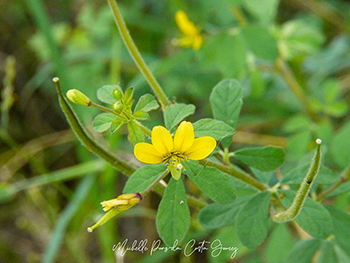
On the island of Curaçao this wild plant and its flowers is called Kaya-kaya, most probably because it can often be found along streets and other urbanized areas where the original vegetation has been disturbed. It also occurs on sister islands Aruba and Bonaire but has no specific recorded local name on both these islands. The plant itself originates from tropical Africa and Asia and has been introduced in the Caribbean in the early 20th century. It is a plant that grows like a herb up to 120 cm in height and is covered in sticky hairs. The bright yellow flowers are only about 1 cm in diameter and can easily be recognized by the 4 flower petals that grow on only one side of the flowers, making it appear as if the flower has lost part of its petals. The seedpods are long and sticky and will stick to shoes and socks.
Uses
In its native range the herb is used in traditional medicine against infections and microbial growth as it appears to have antibiotic features. The seeds are also used as an alternative for mustard or cumin seeds in pickling and other cooking applications in Asia. Young shoots and leaves are eaten as a vegetable. However these uses are not known from the island of Curaçao, nor from Aruba or Bonaire.
The flowers in urban areas are often visited by ants and beetles, as well as honey bees if present.
English name: Wild massamby / Asian spiderflower
Papiamentu/Papiamento name: Kaya-kaya
Scientific name: Cleome viscosa/ Arivela viscosa
Family: Cleomaceae
Occurrence (ABC islands): Aruba, Bonaire and Curaçao (introduced on all three
Publications used:
- Proosdij, A.S.J. van 2012. Arnoldo’s Zakflora: Wat in het wild groeit en bloeit op Aruba, Bonaire en Curaçao. 318 pp. Walburg Pers, Zutphen.
- Burg, W.J. van der, Freitas, J. de, Debrot, A.O. & Lotz, L.A.P. 2012. Naturalised and invasive alien plant species in the Caribbean Netherlands: status, distribution, threats, priorities and recommendations. 1-82. Plant Research International, Wageningen UR. PRI report 437, Imares report C185/11.
- Research, J & Pharmacognosy, & Lenkalapally, Matsyagiri & Kommu, Sudhakar. (2012). A Review on Medicinal Uses and Pharmacological Effects of Cleome viscosa. 4. 44-48.
- Veeris, Dinah. 1991. Remedi i kustumbernan di nos bieunan.
- Useful Tropical Plants (https://tropical.theferns.info/viewtropical.php?id=Cleome%20viscosa)
- Dutch Caribbean Species Register
- Plants of The World Online
- Wikipedia
Wilde bloemen: Kayaka-kaya (Cleome viscosa)
Op het eiland Curaçao wordt deze wilde plant met de gele bloemen Kaya-kaya genoemd, waarschijnlijk omdat het vaak langs straten en andere verstedelijkte gebieden te vinden is waar de oorspronkelijke vegetatie verstoord is. De plant komt ook voor op zustereilanden Aruba en Bonaire maar daar zijn vooralsnog geen lokale namen ervoor bekend.
De plant zelf is afkomstig uit tropisch Afrika en Azië en werd begin 20e eeuw in het Caribisch gebied geïntroduceerd. Het is een plant die als een kruid groeit tot 120 cm hoog en bedekt is met kleverige haartjes. De felgele bloemen hebben een diameter van slechts ongeveer 1 cm en zijn gemakkelijk te herkennen aan de vier bloemblaadjes die zich aan slechts één kant van de bloem bevinden, waardoor het lijkt alsof de bloem een deel van zijn bloemblaadjes heeft verloren. De zaaddozen zijn lang en kleverig en blijven aan schoenen en sokken plakken.
Gebruik
In het oorspronkelijke verspreidingsgebied wordt het kruid in de traditionele geneeskunde gebruikt tegen infecties en microbiële groei, omdat het antibiotische eigenschappen lijkt te hebben. De zaden worden in Azië ook gebruikt als alternatief voor mosterd- of komijnzaad bij het inmaken en andere culinaire toepassingen. Jonge scheuten en bladeren worden als groente gegeten. Deze toepassingen zijn echter niet bekend van het eiland Curaçao, noch van Aruba en Bonaire.
De bloemen in stedelijke gebieden worden vaak bezocht door mieren en kevers, en ook door honingbijen als die aanwezig zijn.
Nederlandse naam: –
Papiamentse naam: Kaya-kaya
Wetenschappelijke naam: Cleome viscosa/ Arivela viscosa
Familie: Cleomaceae
Voorkomen (ABC eilanden): Aruba, Bonaire en Curaçao
Gebruikte publicaties:
- Proosdij, A.S.J. van 2012. Arnoldo’s Zakflora: Wat in het wild groeit en bloeit op Aruba, Bonaire en Curaçao. 318 pp. Walburg Pers, Zutphen.
- Burg, W.J. van der, Freitas, J. de, Debrot, A.O. & Lotz, L.A.P. 2012. Naturalised and invasive alien plant species in the Caribbean Netherlands: status, distribution, threats, priorities and recommendations. 1-82. Plant Research International, Wageningen UR. PRI report 437, Imares report C185/11.
- Research, J & Pharmacognosy, & Lenkalapally, Matsyagiri & Kommu, Sudhakar. (2012). A Review on Medicinal Uses and Pharmacological Effects of Cleome viscosa. 4. 44-48.
- Veeris, Dinah. 1991. Remedi i kustumbernan di nos bieunan.
- Useful Tropical Plants (https://tropical.theferns.info/viewtropical.php?id=Cleome%20viscosa)
- Dutch Caribbean Species Register
- Plants of the World Online
- Wikipedia