This post is also available in: Dutch (below)
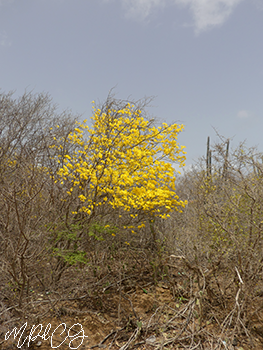
There is no plant that indicates the state of the weather as well as the Kibrahacha. Every year, it is a big question when these trees will ‘feel’ enough rainwater to reveal themselves in an explosion of yellow flowers within a few days. In some years, it is not until well into June that we can really admire the beautiful flowers of this tree. And that, too, varies from location to location, depending on where the rain showers fall during the so-called ‘small rainy season’. Sometimes a heavy rain shower falls as early as March, causing the ‘Kibrahacha month’ to fall in March. In some years, a real life carpet of yellow develops spread across the entire island, while in other years, only a few flowering trees can be found sporadically and sparingly here and there. And then you can find Kibrahachas in bloom scattered across the island for more than two weeks. On Curaçao one week in Wechi, the next on Knip or on Ser’i Domi, on Bonaire one week in Washington Slagbaai National Park and the next on Seru Largu and on Aruba one week in the Arikok National Park and in another week scattered along the island. These special flowering trees are always a joy to look at, and especially to observe what happens in and around them. As soon as a Kibrahacha blooms, its photo appears somewhere on social media, and no compliment is too lavish for its admirers. However, just as admiring as we are for this blossom-filled tree, society treats it with equal disrespect when large tracts of nature areas are cleared by loaders, whether legal or illegal. That is the bitter irony of this beauty: only when the tree is in bloom does the average islander recognize the tree in question. If the tree is dormant due to drought, few people know which species it is, and it is mercilessly destroyed. Only for people to weep the following year that there are so few flowering Kibrahachas left to be found.
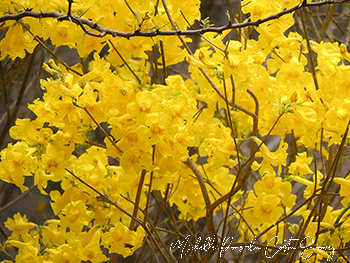
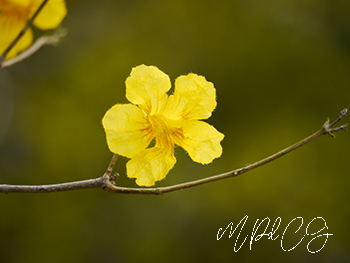
A flowering Kibrahacha is and remains an oasis in the dry and grey forest (mondi). Liquid gold for all nectar-eaters, such as hummingbirds, Bananaquits, orioles and trupials, bees, wasps, and other sweet tooths. However, the flowers themselves are also readily eaten by iguanas, lizards, and even birds such as the Scaly-naped pigeon. Additionally, the fallen flowers are a delicacy for Cottontails, crabs, and other animals.
The Kibrahacha (Handroanthus billbergii, formerly Tabebuia billbergii) is a very popular tree on the island of Curaçao due to its short but overwhelming bloom. The name Kibrahacha is the local Papiamento name for ‘axe breaker’, because the wood of the tree is said to be so hard that an axe would break on it. Because the local native Yellow Poui, as the tree is often called in English, blooms predominantly only in the first half of the year with short bursts of flowering, and usually flowers no more than once a year, non-native Yellow Poui trees (often the species Handroanthus serratifolius) have been introduced into landscaping along streets and in parks. These can be recognized as the trees that have flowers and leaves at the same time. Local Kibrahacha trees are completely bare during the dry season and have only (!) the beginnings of flower buds at the ends of the twigs.
English name: –
Papiamentu/Papiamento name: Kibrahacha (A, B, C)
Scientific name: Handroanthus billbergii, formerly Tabebuia billbergii
Family: Bignoniaceae (bignonias or trumpet vines)
Occurrence (ABC islands): native on Aruba, Bonaire and Curaçao
Publications used:
- Proosdij, A.S.J. van 2012. Arnoldo’s Zakflora: Wat in het wild groeit en bloeit op Aruba, Bonaire en Curaçao. 318 pp. Walburg Pers, Zutphen.
- Dutch Caribbean Species Register
- The Online Flora of Curaçao
- Plants of the World Online
- Useful Tropical Plants
- Wikipedia

Wilde bloemen: Kibrahacha (Handroanthus billbergii)
Er is geen plant die zo goed aangeeft hoe het gesteld is met het weer als de Kibrahacha. Elk jaar weer is het een grote vraag wanneer deze bomen genoeg regenwater voelen om zich binnen enkele dagen in een explosie van gele bloemen te laten zien. Het ene jaar is het pas dik in juni dat we de prachtige bloemen van deze boom echt goed kunnen aanschouwen. En ook dat varieert van locatie tot locatie, afhankelijk van de plekken waar de regenbuien neervallen in de zogenaamde ‘kleine regentijd’. Soms regent het al in maart een stevige regenbui waardoor de ‘Kibrahacha maand’ in maart valt. In sommige jaren ontwikkelt zicht een waar tapijt van geel verspreid over het hele eiland, en andere jaren zijn er maar sporadisch en mondjesmaat een paar bloeiende bomen hier, en een paar bloeiende bomen daar te vinden. En dan kun je verspreid over het eiland meer dan 2 weken lang Kibrahacha’s in bloei vinden. De ene week op Curaçao in Wechi, de andere keer op Knip of op Ser’i Domi, op Bonaire de ene week in het Washington Slagbaai Nationaal Park en de week erna op Seru Largu, en op Aruba de ene week in Arikok National Park en de week erop verspreid over het eiland.
Deze bijzondere bloeiende bomen zijn altijd een genot om naar te kijken en vooral ook te observeren wat er allemaal in en eromheen gebeurt. Zodra er een Kibrahacha bloeit staat het wel ergens op social media en is geen compliment te uitgebreid van de bewonderaars. Echter, net zo bewonderend als we zijn voor deze boom vol bloesem, zo respectloos gaat de maatschappij er mee om als er met loaders grote stukken natuurgebied worden kaal geschaafd, legaal of illegaal. Dat is het wrange van deze schoonheid, alleen met bloemen herkent het gemiddelde eilandskind de boom in kwestie. Staat de boom in droogteslaap dan zijn er maar weinig mensen die weten om welke soort het gaat en wordt het genadeloos kapot gemaakt. Waarna men wel weer het jaar erop weent dat er nog maar zo weinig bloeiende Kibrahacha’s te vinden zijn.
Een bloeiende Kibrahacha is en blijft een oase in het droge en grijze bos (mondi). Vloeibaar goud voor alle nectareters, zoals kolibries, suikerdiefjes, troepialen, bijen, wespen en andere zoetekauwen. Maar de bloemen worden ook graag gegeten door leguanen, hagedissen en zelfs vogels zoals de Blouduif. Daarnaast zijn de afgevallen bloemen een lekkernij voor Cottontails, krabben en andere dieren.
De Kibrahacha (Handroanthus billbergii, dit was Tabebuia billbergii) is een zeer populaire boom op het eiland Curaçao vanwege de kortstondige maar overweldigende bloei. De naam Kibrahacha is de lokale Papiamentse-naam voor ‘bijl breker’, omdat het hout van de boom zo hard zou zijn dat een bijl erop zou breken. Omdat de lokale Yellow Poui, zoals de boom vaak in het Engels wordt genoemd, overwegend alleen in de eerste helft van het jaar bloeit met korte bloei uitbarstingen, en meestal niet meer dan één keer per jaar bloeit, zijn er niet-inheemse Yellow Poui-bomen geïntroduceerd in de landschapsarchitectuur langs straten en in parken. Deze kunnen worden herkend als de bomen die tegelijkertijd bloemen en bladeren hebben. Lokale Kibrahacha bomen zijn volledig kaal in het droge seizoen en hebben alleen (!) het begin van bloemknoppen aan het einde van de takjes.
Nederlandse naam: –
Papiamentse naam: Kibrahacha (A, B, C)
Wetenschappelijke naam: Handroanthus billbergii, ( was Tabebuia billbergii)
Familie: Bignoniaceae (trompetboomfamilie)
Voorkomen (ABC eilanden): Aruba, Bonaire en Curaçao (inheems)