This post is also available in: Dutch (below)
August, September, October and November are yearly high seasons for migratory birds on the islands of Aruba, Curaçao and Bonaire. Many species visit the islands for a short time, some of them staying over for the winter months, on their way to South America to overwinter. The islands provide a much needed location to rest, feed and rebuild fat reserves for the rest of the journey. In this series we illustrate a few of the many species visiting the islands.
Identifying plovers
Plovers can sometimes be quite tricky to identify. It starts with distinguishing them from sandpipers, which is actually the easiest part. Sandpipers are restless little walkers that almost never stand still; they pace back and forth along the water’s edge, constantly pecking at the mud in search of food. Plovers behave quite differently; they usually stand very still—so still, in fact, that you only really notice them when they take a few steps, causing their pattern to stand out against the background. If you get too close, they will sprint a short distance at high speed and then freeze again. Once you have determined that the bird is a plover, the challenge lies in identifying the specific species. During migration, we see various smaller plover species and at least two larger ones: the Black-bellied Plover and the Golden Plover (specifically the American Golden Plover). Distinguishing between these two can be difficult, especially when the birds have completely lost their breeding plumage. Identification is fairly easy if they are still in breeding plumage: the Golden Plover has a black belly that extends all the way to the tail, whereas the Black-bellied Plover has black plumage only down to about the middle of the belly, followed by white. However, you usually see them in their “dull” winter plumage, so you have to pay close attention to the bill. The Golden Plover has a smaller bill. It also sports a golden “toupee” and a striking stripe above the eye—features the Black-bellied Plover lacks.
Varieties in plumage
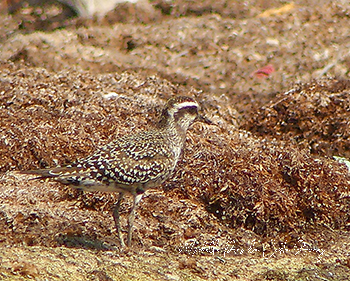
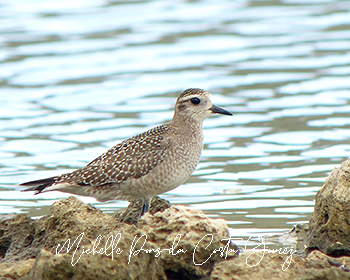
Plovers feed on invertebrates, such as small crustaceans found among the stones along the water’s edge of saliñas (salt pans) and inland waters. They tend to be quite wary of humans and maintain a fairly large flight distance. The number of golden plovers found on the islands varies from year to year. Sometimes you have to make an effort to spot one, while in other years you might encounter several together in the same location. Usually, the birds have already fully transitioned to their winter plumage by the time they arrive on the islands, though in rare instances, they appear while still retaining part of their summer breeding plumage. The photo shows an American Golden Plover (Pluvialis dominica), still partly in breeding plumage. Note the beautiful patterning on its back—providing perfect camouflage against the carpet of sargassum—as well as the black spots on the belly and the bright white stripe above the eye. A look at the underside of the wings, revealing characteristic markings, confirmed that we had identified the right species.
English name: American Golden Plover
Papiamentu/Papiamento name: Lopi dorá (Bonaire & Curaçao), Lopi dorado (Aruba)
Scientific name: Pluvialis dominica
Family: Charadriidae (plovers, dotterels, lapwings)
Occurrence (ABC islands): regular migratory bird on Aruba, Bonaire and Curaçao from North America. Never in large numbers.
Publications used:
- Boer, B. de, Newton, E. & Restall, R. 2012. Birds of Aruba, Curaçao and Bonaire. Ardea Christopher Helm, London.
- Wells, J.V. & Wells, A.C. 2017. Birds of Aruba, Bonaire, and Curaçao: a site and field guide. 474pp. Cornell University Press.
- Da Costa Gomez, M. & Pors, L. 2023. Vogels van Curaçao. 322 pp. Private publication.
- Cornell Lab – All About Birds
- Dutch Caribbean Species Register
- eBird.org

Trekvogels – De Goudplevier (Pluvialis dominica)
Augustus, september, oktober en november vormen op de eilanden Aruba, Curaçao en Bonaire het hoogseizoen voor trekvogels. Veel soorten doen de eilanden kortstondig aan; sommige blijven er de wintermaanden doorbrengen, terwijl andere er slechts halt houden op weg naar Zuid-Amerika om daar te overwinteren. De eilanden bieden een broodnodige plek om uit te rusten, te foerageren en vetreserves op te bouwen voor het vervolg van de reis. In deze reeks belichten we enkele van de vele vogelsoorten die de eilanden bezoeken.
Plevieren identificeren
Plevieren zijn soms best lastig te identificeren. Het begint met ze te onderscheiden van de strandlopertjes, en dat is op sich het minst lastige. Strandlopers of sandpipers zijn driftige lopertjes die bijna nooit even stilstaan. Ze wandelen heen en weer langs de waterkant en pikken continue in de modder op zoek naar voedsel. Plevieren zijn geheel anders in gedrag, deze vogels staan namelijk meestal heel stil, zo stil dat je ze pas echt ziet als ze even een paar stappen zetten, waardoor hun patroon even opvalt tegen de achtergrond. Kom je te dicht in te buurt dan rennen ze even heel hard een klein stukje en staan dan weer stokstijf stil. Ben je zover dat je weet dat het om een plevier gaat, dan wordt het de kunst om ze op soort te onderscheiden. In de trektijd hebben we verschillende soorten kleinere pleviertjes en in ieder geval 2 grotere soorten, de Zilverplevier of the Black-bellied Plover en de American Golden Plover of Amerikaanse Goudplevier. En tussen deze twee is het moeilijk onderscheid maken, zeker als de vogels hun broedkleed geheel kwijt zijn. Hebben ze het broedkleed nog wel dan is het identificeren redelijk makkelijk. De Goudplevier heeft namelijk een zwarte buik dat geheel doorloopt tot de staart en de Zilverplevier heeft zwart tor ongeveer het midden van zijn buik, waarna wit volgt. Maar meestal zie je de dieren in hun ‘saaiere’ winterkleed en dan is het vooral opletten op de snavel. De snavel is kleiner bij de Goudplevier. En tevens heeft de Goudplevier een gouden toupetje met opvallende streep boven het oog, en dat heeft de Zilverplevier nou weer niet.
Verschil in verenkleed
Plevieren eten ongewervelde dieren als kleine crustaceeen die langs de waterkant van saliñas en binnenwateren tussen de stenen te vinden zijn. Ze zijn meestal redelijk voorzichtig naar mensen toen en hebben een redelijke grote angstcirkel.
Niet elk jaar zijn er evenveel Goudplevieren te vinden op de eilanden. Soms moet je moeite doen om er een te vinden en in andere jaren kom je er verschillende samen tegen op dezelfde plek. Meestal hebben de vogels al geheel hun winterkleed als ze op de eilanden arriveren, maar in een zeldzaam geval zijn ze er al als ze nog gedeeltelijk hun zomerbroedkleed hebben. Op de foto is een Amerikaanse goudplevier (Pluvialis dominica) te zien, deels nog steeds in het broedkleed. De prachtige tekening op de rug, waardoor het perfect gecamoufleerd is in het tapijt van sargassum, de zwarte stippen op de buik en de fel witte streep boven het oog. Met een kijkje onder de vleugels, met de daaronder karakteristieke markeringen wisten we het zeker dat we de juiste soort te pakken hadden.
Nederlandse naam: Amerikaanse goudplevier
Papiamentse naam: Lopi dorá (Bonaire & Curaçao), Lopi dorado (Aruba)
Wetenschappelijke naam: Pluvialis dominica
Familie: Charadriidae (kieviten en plevieren)
Voorkomen (ABC eilanden): Trekvogels uit Noord Amerika op Aruba, Bonaire en Curaçao. Nooit in grote aantallen.
Gebruikte publicaties:
- Boer, B. de, Newton, E. & Restall, R. 2012. Birds of Aruba, Curaçao and Bonaire. Ardea Christopher Helm, London.
- Wells, J.V. & Wells, A.C. 2017. Birds of Aruba, Bonaire, and Curaçao: a site and field guide. 474pp. Cornell University Press.
- Da Costa Gomez, M. & Pors, L. 2023. Vogels van Curaçao. 322 pp. Private publication.
- Cornell Lab – All About Birds
- Dutch Caribbean Species Register
- eBird.org