This post is also available in: Dutch (below)
Fasciolated Graphic (Melipotis fasciolaris)
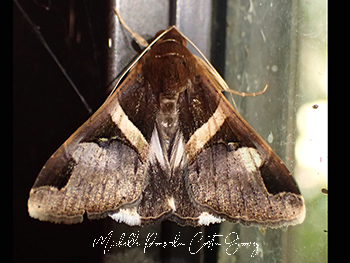
When a good downpour finally arrives after a dry spell, it is as if insects—which had been patiently waiting for more favourable conditions—emerge from every nook and cranny. This is no coincidence; a period of rain quickly provides an abundance of food for various insect species (as well as other members of our local fauna). Among the insects that appear during such times are the Lepidoptera—specifically those commonly referred to as moths. Near artificial lights around the house, all sorts of moths appear, coming in a wide variety of shapes and colours. At first glance, they may all look somewhat greyish or brownish, but taking a closer look reveals a whole world of intricate patterns and colours. A striking example of a particularly beautiful moth is Melipotis fasciolaris (also called the “Fasciolated Graphic“). There is no official Dutch common name for this species, which belongs to the family Erebidae. With a wingspan ranging from 33 to 43 millimeters, Melipotis fasciolaris is classified as a “macromoth”—a term for larger-sized moths. It is found throughout the Caribbean, South and Central America, and parts of North America; across this vast range, the patterns and color variations can differ significantly. On Aruba, Bonaire and Curaçao, the specimens typically encountered—like the one shown in the photograph—feature a deep, velvety dark-brown base color, accented by patterns in shades of beige, white, and near-gold. The two diagonal golden stripes on the forewings are particularly striking. When at rest, these moths characteristically fold their forewings back over their hindwings, giving them a triangular appearance. Their antennae, which are quite long, are also folded back along the body while at rest. The moth in the photograph has its wings partially open, revealing a small portion of the pattern on the hindwings. Each hindwing features a large white spot, which only becomes visible when the moth is in flight or resting with its wings spread. The caterpillars of this moth feed on plants belonging to the Prosopis genus—the host plants upon which the female lays her eggs and from which the caterpillars derive their nourishment before pupating. On Curaçao, one such relative is the well-known Indju tree, formerly classified as Prosopis juliflora and now known as Neltuma juliflora.
English name: Fasciolated Graphic
Papiamentu name: –
Scientific name: Melipotis fasciolaris
Family: Erebidae
Occurrence (ABC islands): Aruba, Curaçao, Bonaire
Publications used:
- Debrot, A.O. & Miller, J.Y. 2004. Butterflies and moths of Curaçao, Aruba and Bonaire. 1-100. CARMABI Foundation, Willemstad.
- Groenen, F. 2025. The moths of Bonaire, with a preliminary checklist for the Dutch ABC islands (Lepidoptera). Nederlandse Faunistische Mededelingen 64: 301-332.
- Arnoldo Broeders, M. Fr. 1967. Handleiding tot het gebruik van inheemse en ingevoerde planten op Aruba, Bonaire en Curaçao. Uitgave Boekhandel ,,St.-Augustinus” – Curaçao.
- Proosdij, A.S.J. van 2012. Arnoldo’s Zakflora: Wat in het wild groeit en bloeit op Aruba, Bonaire en Curaçao. 318 pp. Walburg Pers, Zutphen.
- iNaturalist
- Dutch Caribbean Species Register
- Wikipedia
- Species Melipotis fasciolaris – Fasciolated Melipotis – Hodges#8599 – BugGuide.Net

Mottensoort: Fasciolated Graphic (Melipotis fasciolaris)
Als er na een periode van droogte weer eens een mooie bui valt, is het net alsof er uit alle hoeken en gaten insecten kruipen die geduldig hebben gewacht tot het weer wat gunstiger werd. Dat klopt ook, want na een periode van regen is er in korte tijd een behoorlijke hoeveelheid voedsel aanwezig voor diverse insectensoorten (en andere leden van onze fauna). Eén van de ordes binnen de klasse van de insecten die zich in een dergelijke periode laten zien is de orde van de vlinders en dan vooral de vlinders die we vaak aanduiden als nachtvlinders of motten. Bij kunstlicht in huis verschijnen allerlei motjes in allerlei vormen en kleuren. In eerste instantie zien ze er bijna allemaal grijzig of bruinig uit, maar het loont de moeite om de dieren van dichtbij te bekijken. Er gaat een wereld open van patronen en kleuren.
Een mooi voorbeeld van een mottensoort die buitengewoon mooi is, is de Fasciolated Graphic of Melipotis fasciolaris. Er is geen officiële Nederlandse naam voor deze mottensoort die horen bij de familie van de Erebidae of Spinneruilen, zoals deze familie in het Nederlands wordt genoemd.
De Fasciolated Graphic is een mot dat een spanwijdte van tussen de 33 en 43 millimeter kan krijgen en wordt daarmee gerekend tot de zogenaamde macromotten, oftewel grote motten. Het komt voor in zowel het Caribisch gebied als in Zuid en Midden Amerika en delen van Noord Amerika en in deze hele regio kunnen de patronen en kleurvariaties redelijk verschillen. Op Curaçao hebben de doorgaans de variant zoals op de foto gevonden met een diep fluweelachtige donkerbruine basiskleur en patronen in tinten van beige, wit en bijna goud. Vooral de twee diagonale gouden strepen op de voorvleugel zijn opvallend
De motten zitten karakteristiek met de voorvleugels naar achteren gevouwen over de achter vleugels heen en zien er dan uit als een driehoek. Ook de antennes, die behoorlijk lang zijn, zijn in rust langs het lijf naar achteren gevouwen.
De mot op de foto heeft zijn vleugels deel geopend waardoor een klein deel van het patroon van de achter vleugels zichtbaar wordt. Op iedere achter vleugel hebben de dieren een grote witte stip die pas zichtbaar is als de dieren vliegen of met de vleugels open zitten.
De rupsen van deze mot hebben als waardplant, de plant waar de moeder de eieren op legt en waar de rupsen zich rolrond van eten voor ze verpoppen, leden van de Prosopis familie. Op Curaçao is een familielid de welbekende Indju dat eerst Prosopis juliflora heette en nu Neltuma juliflora wordt genoemd.
Nederlandse naam: –
Papiamentse naam: –
Wetenschappelijke naam: Melipotis fasciolaris
Familie: Erebidae (spinneruilen)
Voorkomen (ABC eilanden): Aruba, Curaçao, Bonaire
Gebruikte publicaties:
- Debrot, A.O. & Miller, J.Y. 2004. Butterflies and moths of Curaçao, Aruba and Bonaire. 1-100. CARMABI Foundation, Willemstad.
- Groenen, F. 2025. The moths of Bonaire, with a preliminary checklist for the Dutch ABC islands (Lepidoptera). Nederlandse Faunistische Mededelingen 64: 301-332.
- Arnoldo Broeders, M. Fr. 1967. Handleiding tot het gebruik van inheemse en ingevoerde planten op Aruba, Bonaire en Curaçao. Uitgave Boekhandel ,,St.-Augustinus” – Curaçao.
- Proosdij, A.S.J. van 2012. Arnoldo’s Zakflora: Wat in het wild groeit en bloeit op Aruba, Bonaire en Curaçao. 318 pp. Walburg Pers, Zutphen.
- iNaturalist
- Dutch Caribbean Species Register
- Wikipedia
- Species Melipotis fasciolaris – Fasciolated Melipotis – Hodges#8599 – BugGuide.Net