This post is also available in: Dutch (below)
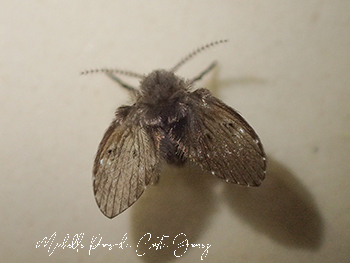
Almost everyone is familiar with them: those small, brownish-grey, moth-like insects that suddenly appear out of nowhere in the bathroom and quickly end up inside your shower cubicle. No matter how clean you keep things, they simply appear and are notoriously difficult to get rid of. Few people take a closer look at these remarkable insects; usually, they pay for their presence with their lives—often dispatched by a slipper or a can of insecticide. The little creatures on your shower wall belong to the species known in English as the White-spotted moth fly or Bathroom moth fly (Clogmia albipunctata). This species belongs to the Psychodidae family—also known as moth flies and sand flies—a vast family comprising at least 2,600 species. They are also called drain flies or sewer flies because they frequent the damp areas around household drains, where organic waste inevitably accumulates. However, they also occur in the wild, particularly in shady spots containing moist, decaying organic matter. The larvae of these insects play a crucial role in the breakdown of organic waste, including sewage. It is difficult to determine the species’ exact place of origin, as they are now found worldwide—predominantly in tropical regions, but increasingly in temperate zones as well.
The species measures approximately 2.5 to 4 millimetres in length and features broad, pointed wings covered in brown hairs; the body is hairy as well. Adult flies live for about 12 days, while the larvae take two and a half weeks to develop into adults. In the wild, the adult animals also drink nectar to survive; in a domestic setting, they survive on water found, for instance, in the shower drain. They are barely active. The larvae feed on decaying organic matter and break it down.
English name: White-spotted moth fly or Bathroom moth fly
Papiamentu name: –
Scientific name: Clogmia albipunctata
Family: Psychodidae (moth flies)
Occurrence (ABC islands): Aruba, Bonaire, Curaçao
Publications used:
- Moth Fly – Clogmia albipunctata – BugGuide.Net
- Smit, J.T., Beek, J.G. van der, d’Oliveira, M.C., Bree, E. de, Wieringa, J.J., Boeken, M., Fernhout, T., Mekkes, J.J., Reinboud, W., Steenis, W. van & Zeegers, T. 2025. Flies recorded on Bonaire in 2022-2023 (Diptera). Nederlandse Faunistische Mededelingen 64: 259-299.
- Dutch Caribbean Species Register
- iNaturalist

Kleine beestjes: Wc-mot mug / Bathroom moth fly (Clogmia albipunctata)
We kennen het bijna allemaal wel, die kleine bruingrijze motachtige insecten die zomaar uit het niets ineens in de badkamer verschijnen en binnen de kortste keren in je douchecabine zitten. Het maakt niet uit hoe schoon je bent, ze zijn er gewoon ineens en nauwelijks meer weg te krijgen. Weinig mensen kijken iets beter naar deze bijzondere insecten en meestal moeten de dieren hun aanwezigheid met de dood bekopen, zij het met een pantoffel of met een bus met insecticide. De diertjes op je douchewand behoren tot de soort die in het Engels White-spotted moth fly wordt genoemd en ook wel bekendstaat als de Bathroom moth fly (Clogmia albipunctata) en in het Nederlands als de Wc-motmug. Deze soort behoort tot de familie van de Psychodidae, ook wel Moth flies and sand flies genoemd, een familie die bijzonder groot is en bestaat uit minstens 2600 soorten. Ze worden ook wel drain flies of sewer flies genoemd vanwege het feit dat ze in de nabijheid van afvoerputten in huizen vertoeven waar het vochtig is en er altijd wel organisch afval te vinden is in de afvoerputten. Ze komen echter ook in de natuur voor, vooral op plekken waar er schaduw is en er vochtig, rottend organisch afval te vinden is. De larven van deze insecten spelen dan ook een bijzonder belangrijke rol in de verwerking van organisch afval en ook bij de verwerking van rioolafval. Het is niet goed meer te achterhalen waar de soort van oorsprong vandaan komt, omdat deze dieren nu over de hele wereld, vooral in tropische omgevingen, maar ook steeds meer in de gematigde luchtstreek, voorkomen.
De soort wordt ongeveer 2,5 tot 4 millimeter lang en heeft brede, in een punt toelopende vleugels die bedekt zijn met bruine haren. Ook het lijfje is behaard. De volwassen dieren worden ongeveer 12 dagen oud en de larven doen er 2,5 week over om zich te ontwikkelen tot volwassen dieren. In de natuur drinken de volwassen dieren ook nectar om te overleven; in een huiselijke omgeving overleven ze van water in bijvoorbeeld de doucheput. Ze zijn nauwelijks actief. De larven leven van organisch materiaal dat aan het rotten is en zorgen voor de verwerking hiervan.
Nederlandse naam: Wc-motmug
Papiamentse naam: –
Wetenschappelijke naam: Clogmia albipunctata
Familie: Psychodidae (motmuggen)
Voorkomen (ABC eilanden): Aruba, Bonaire en Curaçao
Gebruikte literatuur:
- Moth Fly – Clogmia albipunctata – BugGuide.Net
- Smit, J.T., Beek, J.G. van der, d’Oliveira, M.C., Bree, E. de, Wieringa, J.J., Boeken, M., Fernhout, T., Mekkes, J.J., Reinboud, W., Steenis, W. van & Zeegers, T. 2025. Flies recorded on Bonaire in 2022-2023 (Diptera). Nederlandse Faunistische Mededelingen 64: 259-299.
- Dutch Caribbean Species Register
- iNaturalist