This post is also available in: Dutch (below)
Marine gastropods often lead a mysterious life outside of the direct eye of humankind, except maybe for some close observing divers and snorkelers that occasionally find these species in the sea. Some species of Gastropods live in the marine area that is called the intertidal zone, where they are more visible to people visiting the shores as they can be found on or under rocks, in limestone crevices and such. The West Indian Topsnail, also called the Wilk, and locally known as the Kiwa is one of these species.
Popular
The word Kiwa on the islands often lead to people salivating as the species is one of the known species of sea snail eaten as a local delicacy. You will not find it on the menu of restaurants, but in the dishes made at home by inhabitants that know how and when to find the snails and is as such an important source of protein in some local households. In the Caribbean the species is listed as the third economically important sea invertebrate after the Spiny lobster and the Queen conch, both also popular as food on the islands of Aruba, Bonaire and Curaçao. The popularity of the West Indian Topsnail as a food source, have made them locally extinct in certain areas on the islands and it can be significantly hard to find them.
Biology
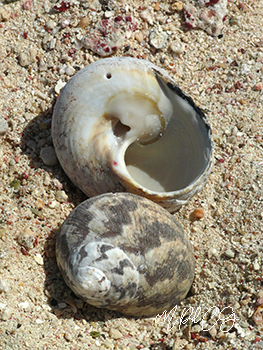
The West Indian Topsnail is a large Gastropod species, its shell growing up to a diameter of about 13 centimeters. The shell itself, which is what you usually see, has a black and white pattern that differs per individual and has a rounded shape with about 6 whorls. (A whorl is a single, complete 360° revolution or turn in the spiral or whorled growth of a mollusc shell. A spiral configuration is found in the shells of numerous gastropods, and in shelled cephalopods including Nautilus, Spirula and the large extinct subclass of cephalopods known as the ammonites. – WIKIPEDIA)
Individuals of the species are either male or female and reproduce externally in seawater. Females and males respectively release eggs and sperm in the water column during the breeding season. Fertilized eggs develop into larva that will form part of marine plankton for a couple of days before settling. According to the literature sexual maturity of the snail is established at shell lengths of about 34 millimetres.
Feeding habits and bio-erosion
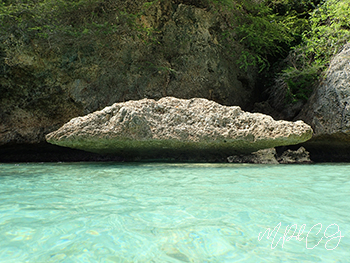
The species is herbivorous, eating all kinds of algae on rocks along the shore. Individuals will slowly move with the tide, moving to more profitable eating grounds when necessary. To eat the algae of the rocks they scrape it of with their mouth sections, also scraping off tiny bits of limestone from the rocks causing so called bio-eriosion. On the islands of Aruba, Bonaire and Curaçao the tidal differences are not as dramatic as in many other locations in the world. Marine organisms such as the West Indian Topsnail and many others, will collect food at more or less the same level, just above the edge of where the seawater reaches the limestone rocks. As they continue feeding and scraping of limestone bits and pieces the bio-erosion on this location will become very visible over time as the deep indentations that are visible in the limestone along the edge of the water. Called ‘brandingsnis’ in Dutch and ‘surf zone’ in English, for a long time the raining theory was that these were caused by the surf of the Caribbean sea. However, the seawater in itself has no erosive materials to ‘attack’ the limestone and erode it, as our waters are clean in that respect. Scientists discovered that these surf zones were caused by the constant scraping of marine organisms looking for algae and eroding the limestone by accident with this bio-erosion and characteristic formation as a result.
Hermit crabs and West Indian Topsnails
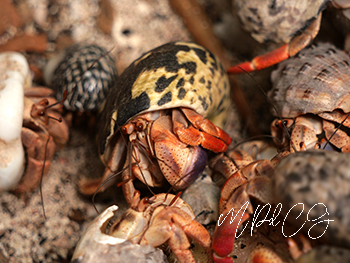
There are many records of marine invertebrates that have close relationships with the West Indian Topsnail. The most visible is the dependence of the hermit crabs on the islands on the shells of the snail for housing. Hermit crabs do not make their own shells to protect the soft tissue of their bodies and depend on shells of both dead land snails and marine snails for protection and housing. When hermits grow they need to find bigger shells to transfer into. The shells of particularly the larger West Indian topsnails are therefor very important for the larger individuals of hermits. But these are increasingly scarce, as shells of the snails are smashed by collectors to extract the snail in an easier manner.
English name: West Indian Topsnail/ Wilk
Papiamentu/Papiamento name: Kiwa
Scientific name: Cittarium pica
Family: Tegulidae
Occurrence (ABC islands): Aruba, Bonaire and Curaçao (indigenous)
Publications used:
- De Jong, K.M., Coomans, H.E. Marine Gastropods from Curaçao, Aruba and Bonaire.
- Dutch Caribbean Species Register
- Naturalis bioportal
- World Register of Marine Species
- Carpenter, K.E. (ed.)The living marine resources of the Western Central Atlantic. Volume 1: Introduction,molluscs, crustaceans, hagfishes, sharks, batoid fishes, and chimaeras.FAO Species Identification Guide for Fishery Purposes and American Society of Ichthyologistsand Herpetologists Special Publication No. 5.Rome, FAO. 2002. pp. 1-600.
- Marine Invertebrates of Bermuda (https://www.thecephalopodpage.org/MarineInvertebrateZoology/index.html)
- Wikipedia

Schelpen: Alikruik (Cittarium pica)
Mariene slakken leiden vaak een mysterieus leven, buiten het directe zicht van de mens, afgezien misschien van enkele oplettende duikers en snorkelaars die deze soorten af en toe in zee tegenkomen. Sommige soorten mariene slakken leven in de zogeheten intergetijdenzone; waar ze beter zichtbaar zijn voor strandbezoekers, omdat ze te vinden zijn op of onder rotsen, in spleten in kalksteen en dergelijke. De Alikruik, ook wel ‘Wilk‘ genoemd in het Engels en lokaal bekend als ‘Kiwa‘, is een van deze soorten.
Populair
Op de eilanden loopt menig inwoner het water in de mond bij het horen van de naam ‘Kiwa‘, aangezien deze zeeslak als lokale delicatesse wordt gegeten. Je zult hem niet snel op de menukaart van restaurants vinden, maar wel in gerechten die thuis worden bereid door mensen die weten hoe en wanneer ze de slakken kunnen vinden; voor sommige lokale huishoudens vormt de slak dan ook een belangrijke eiwitbron. In het Caribisch gebied staat de soort op de derde plaats van economisch belangrijke mariene ongewervelden, na de kreeft en de Roze vleugelhoorn (Queen conch); beide zijn eveneens populair als voedsel op Aruba, Bonaire en Curaçao. Door de populariteit van de Alikruik als voedselbron is de soort in bepaalde gebieden op de eilanden lokaal uitgestorven en is het soms erg lastig om ze nog te vinden.
Biologie
De Kiwa is een grote soort, waarvan de schelp een diameter van ongeveer 13 centimeter kan bereiken. De schelp zelf, het deel dat doorgaans zichtbaar is, heeft een zwart-witpatroon dat per individu verschilt en een ronde vorm met ongeveer zes windingen. (Een winding is een volledige draai van 360 graden in de spiraalvormige groei van een weekdierschelp. Een spiraalvormige structuur komt voor bij de schelpen van talloze gastropoden en bij inktvissen met een uitwendige schelp, zoals de Nautilus, Spirula en de grote, uitgestorven onderklasse van inktvissen die bekendstaat als de ammonieten. – WIKIPEDIA)
Individuen van deze soort zijn mannelijk of vrouwelijk en planten zich voort via uitwendige bevruchting in het zeewater. Tijdens het voortplantingsseizoen laten vrouwtjes en mannetjes respectievelijk eicellen en sperma vrij in de waterkolom. Bevruchte eitjes ontwikkelen zich tot larven die enkele dagen deel uitmaken van het mariene plankton, voordat ze zich ergens vestigen. Volgens de literatuur bereikt de slak geslachtsrijpheid bij een schelplengte van ongeveer 34 millimeter.
Voedingsgewoonten en bio-erosie
De soort is herbivoor en voedt zich met allerlei soorten algen op rotsen langs de kust. De dieren bewegen langzaam mee met het getij en verplaatsen zich indien nodig naar betere voedselgronden. Om de algen van de rotsen te eten, schrapen ze deze los met hun monddelen; daarbij schrapen ze ook kleine stukjes kalksteen van de rotsen, wat leidt tot zogenaamde bio-erosie. Op de eilanden Aruba, Bonaire en Curaçao zijn de verschillen tussen eb en vloed niet zo groot als op veel andere plaatsen in de wereld. Mariene organismen, zoals de Kiwa en vele andere, zoeken voedsel op min of meer hetzelfde niveau: net op het randje waar het zeewater de kalksteenrotsen raakt. Door het voortdurende eten en afschrapen van kalksteenfragmenten wordt de bio-erosie op deze plek na verloop van tijd duidelijk zichtbaar in de vorm van diepe inkepingen in de kalksteen langs de waterlijn. Lange tijd werd aangenomen dat deze inkepingen, in het Nederlands ‘brandingsnis’ genoemd en in het Engels ‘surf zone’, werden veroorzaakt door de branding van de Caribische Zee. Het zeewater zelf bevat echter geen erosieve materialen om de kalksteen aan te tasten en te eroderen; in dat opzicht is het water schoon. Wetenschappers ontdekten dat deze inkepingen ontstonden door het voortdurende schrapen van mariene organismen die op zoek waren naar algen. Daarbij schraapten ze onbedoeld kalksteen weg, wat resulteerde in bio-erosie en de vorming van deze kenmerkende structuren.
Heremietkreeften en Kiwa
Er zijn veel waarnemingen bekend van mariene ongewervelden die een nauwe relatie hebben met de Kiwa. Het meest zichtbare voorbeeld is de afhankelijkheid van heremietkreeften op de eilanden van de slakkenhuizen als behuizing. Heremietkreeften maken zelf geen schelpen aan om hun zachte lichaamsweefsel te beschermen; voor bescherming en huisvesting zijn ze afhankelijk van de schelpen van dode land- en zeeslakken. Wanneer heremietkreeften groeien, moeten ze grotere schelpen vinden om naar te verhuizen. De schelpen van met name de grotere Kiwas zijn daarom van groot belang voor de grotere exemplaren. Deze schelpen worden echter steeds schaarser, doordat verzamelaars ze kapotslaan om de slak er gemakkelijker uit te kunnen halen.
Nederlandse naam: Alikruik
Papiamentse naam: Kiwa
Wetenschappelijke naam: Cittarium pica
Family: Tegulidae
Voorkomen (ABC eilanden): Aruba, Bonaire en Curaçao (inheems)
Gebruikte literatuur:
- De Jong, K.M., Coomans, H.E. Marine Gastropods from Curaçao, Aruba and Bonaire.
- Dutch Caribbean Species Register
- Naturalis bioportal
- World Register of Marine Species
- Carpenter, K.E. (ed.)The living marine resources of the Western Central Atlantic. Volume 1: Introduction,molluscs, crustaceans, hagfishes, sharks, batoid fishes, and chimaeras.FAO Species Identification Guide for Fishery Purposes and American Society of Ichthyologistsand Herpetologists Special Publication No. 5.Rome, FAO. 2002. pp. 1-600.
- Marine Invertebrates of Bermuda (https://www.thecephalopodpage.org/MarineInvertebrateZoology/index.html)
- Wikipedia