This post is also available in: Dutch (below)
Suddenly, overnight, it appeared: a small, yellowish, sponge-like growth attached to a piece of decaying wood. By keeping the garden as natural as possible—incorporating plenty of native vegetation, ranging from large trees to small herbaceous plants, and leaving space for fallen leaves and dead branches—the soil remains moist. As the wood and leaves decompose, they provide an ideal breeding ground for fungi, which, at this time of year, enthusiastically reveal their reproductive structures in the form of mushrooms.
A slime mold
The yellow, sponge-like growth hadn’t been there the day before, so it stood out immediately against the dark, wet wood. It looked rather like a bit of regurgitated egg—oddly shaped, with a dark red droplet in the center. It bore a striking resemblance to a fungus, and, camera in hand, we managed to capture an entire series of photographs. Curious to identify the specific type of fungus, we delved into our collection of nature books. The very first book on mushrooms we opened provided an answer on the first page: the organism—or at least a close relative—was listed there as a “slime mold.” A quick search online revealed that the book’s classification was outdated—hardly surprising, given that it was published in 1973. While this sponge-like growth was once categorised within the kingdom Fungi, it is no longer considered a fungus; it is now officially classified as a member of the kingdom Amoebozoa.
Amoebozoa
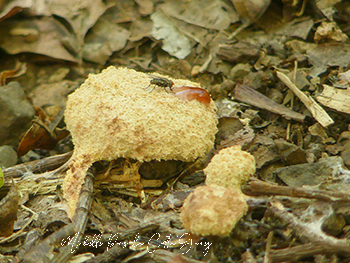
Fungi are eukaryotic organisms, meaning their cells contain complex structures enclosed within a cell wall—essentially, each tiny cell is wrapped in a thin layer. Amoebozoa, as the name suggests, are amoeba-like organisms whose individual cells are not clearly distinct from one another. In nature, they exist as a “plasmodium”—a blob of fluid, or, to use a more technical term, protoplasm lacking cell walls, held together only by a membrane. You could compare it to a plastic bag filled with water: the membrane (the plastic) keeps everything contained.
Incidentally, it is said that the cult film *The Blob* was inspired by these organisms. In the horror movie, “The Blob” arrives on Earth from outer space and proceeds to consume humans.
So-called “slime molds” feed on bacteria, doing so in an amoeba-like fashion: they engulf their prey—draping themselves over it—and digest it within the plasmodium. “True” fungi, by contrast, digest their food externally by secreting enzymes that chemically break it down into a liquid form, which the fungus can then absorb.
In the photograph on top and below, you can see two components of the slime mold: a yellow, sponge-like structure and, beneath it, a whitish substance. This whitish, “egg-white-like” material is the organism’s plasmodium—the active, living phase—while the yellow, sponge-like structure is the fruiting body, where spores are formed. In fact, the slime mold had likely been present for quite some time without being noticed, until it formed its yellowish fruiting body. When looking up photographs of the species from other countries, it became apparent that the fruiting body of our particular slime mold was quite modest in size. There are known instances of slime molds covering an area of a square meter—or even more, as the photograph illustrates. Incidentally, it is difficult to determine exactly what the red droplet is; it appears to be the organism’s own tissue, which has broken down and liquefied.
Dog Vomit Slime Mold
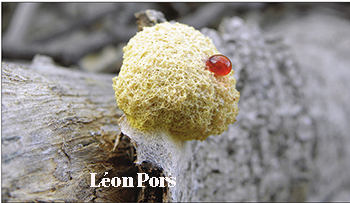
Research across various websites run by fungal experts, combined with the use of iNaturalist, indicates that the species in the photograph can be identified as *Fuligo septica*—known in English by the rather unappealing name “Dog Vomit Slime Mold,” as some think it resembles a dog’s vomit or as ‘Scrambled egg slime’. In Dutch, it has been given a somewhat more charming name: *Heksenboter* (“Witch’s Butter”). This species is found worldwide and tends to settle among decaying wood, provided the environment is sufficiently damp and contains enough bacteria to serve as a food source. In tropical regions, they are also frequently discovered high up in trees, including fruit-bearing ones.
The most bizarre aspect of the Dog Vomit Slime Mold is the way the organism moves, using a slimy, white, translucent structure called a plasmodium. If you watch the organism for a minute, you can actually witness this movement; it can reach speeds of up to 1.35 millimeters per second. This motion is driven by the continuous shifting of the cytoplasm—the fluid within the organism—back and forth.
The fungi and slime molds on the ABC-islands have by no means been fully documented. Regardless of whether these slime molds strictly belong to the kingdom Fungi or qualify as “true” mushrooms, they remain mysterious organisms that seem to emerge from nowhere, only to vanish from sight just as quickly. In any case, it is well worth keeping your eyes peeled and taking a moment to admire them whenever you come across one.
There is still no report for registrations of this species on the islands of Bonaire and Aruba. On Curaçao the species has been recorded and photographed in areas such as Bloemhof, Julianadorp and Christoffelpark.
English name: Dog vomit slime mold / Scrambled egg slime
Papiamentu name: –
Scientific name: Fuligo septica
Family: Physaraceae
Occurrence (ABC islands): Curaçao
Publications used:
- Dog Vomit Slime Mold: Comprehensive Identification Guide – Mushroom Appreciation
- Dog Vomit Slime Mold (Scrambled Egg Slime Mold) | Missouri Department of Conservation
- Dutch Caribbean Species Register
- iNaturalist
- Wikipedia

Een kwakje slijmzwam: Heksenboter (Fuligo septica)
Ineens, van de ene dag op de andere, was het er. Een klein gelig sponsje dat vast zat aan een stukje rottend hout. Door de tuin zo natuurlijk mogelijk te houden met veel inheems groen, zowel grote bomen als kleine kruiden, ruimte voor bladeren en dode takken van bomen. Met regenval blijft de grond vochtig, het hout en de bladeren gaan rotten en zorgen voor een ideale voedingsbodem voor schimmels die enthousiast in deze tijd hun voortplantingsorganen tonen in de vorm van paddenstoelen.
Een Slijmzwam
Het gele sponsje was er de vorige dag nog niet, en het viel dan ook meteen op in het donkerbruine natte hout. Het zag er uit als een uitgekotst stukje ei, vreemd gevormd en met een donkerrode druppel in het midden. Het leek verdacht veel op een schimmel en met de camera in de hand hebben we er dan ook een hele foto serie van kunnen maken. Nieuwsgierig om te weten wat voor soort schimmel dit zou kunnen zijn, doken we in een collectie met natuur boeken. Het eerste boek over paddenstoelen dat we opensloegen was meteen op de eerste bladzijde raak, het schimmeltje, of in ieder geval een familielid ervan stond er gewoon in en het stond te boek als een Slijmzwam. Met internet erbij werd al snel duidelijk dat de beschrijving in het boekje verouderd was, geen wonder aangezien het boek was geschreven in 1973. Werd het sponsje eerst nog tot het rijk van de paddenstoelen gerekend, in het Latijns Fungae, nu hoort het daar niet meer bij maar is het officieel een lid van het rijk van de Amoebozoa.
Amoebozoa
Fungae zijn eukaryote organismen, wat betekend dat de cellen van deze organismen complexe structuren bevatten die ingesloten zitten in een celwand. Er zit dus in wezen een velletje om elk celletje. Amoebozoa zijn, wat het woord al aangeeft, amoebe-achtige organismen waarvan de individuele cellen juist niet te onderscheiden zijn. Ze leven in de natuur als een plasmode, een blop vocht, of met een moeilijk woord, protoplasma zonder celwanden en alleen een membraan om alles binnenboord te houden. Je kunt het vergelijken met een plastic zak gevuld met water. Het membraan, in dit geval het plastic, houdt alles bij elkaar.
Het schijnt trouwens dat de cult film ‘The Blob’ op deze organismen is gebaseerd. In de horrorfilm komt The Blob op aarde terecht uit het heelal waarna het ding mensen verorberd.
De zogenaamde Slime Molds, oftewel Slijmzwammen, voeden zich met bacteriën en doen dat zelfs op een amoebe-achtige manier, door ze te omvatten (er zich overheen te draperen) en binnen de plasmode te verteren. ‘Echte’ paddenstoelen verteren hun voedsel extern door er eerst enzymen over heen af te scheiden die het voedsel chemisch voorbewerken zodat het in vloeibare vorm door de paddestoel opgenomen kan worden.
Op de foto hierboven en tevens beneden zie je de twee onderdelen van de Slijmzwam, het gele sponsje en daaronder een wittige substantie. Het wittige ‘eiwit’ op de foto is de plasmode (plasmodium) van de soort, het deel wat leeft totdat het zich gaat voortplanten, en het gele sponsje is niets anders dan het vruchtlichaam waar de sporen zich in vormen. In feite zat de Slijmzwam er waarschijnlijk al een hele tijd maar viel het niet op, totdat het het gelige vruchtlichaam vormde. Bij het opzoeken van foto’s van de soort in andere landen, viel op dat het vruchtlichaam van ons slijmzwammetje een bescheiden omvang had. Er zijn gevallen bekend van slijmzwammen die een oppervlakte van een vierkante meter besloegen, en zelfs meer, zoals de foto laat zien. Het is overigens moeilijk te achterhalen wat de rode druppel is, het schijnt het vloeibaar geworden afgebroken weefsel van het organisme zelf te zijn.
Dog Vomit Slime Mold of Heksenboter
Nazoeken op verschillende websites van schimmel experts en de inzet van iNaturalist geeft aam dat de soort op de foto geïdentificeerd kan worden met de naam Fuligo septica oftewel in grof Engels ‘Dog Vomit Slime Mold‘ omdat het volgens sommigen lijkt op honden kots. In het Nederlands is er een iets lieftalligere naam voor verzonnen en wordt het Heksenboter genoemd. De soort komt over de hele wereld voor en nestelt zich graag tussen rottend hout waar het vochtig genoeg is en waar genoeg bacteriën zijn die als voedsel kunnen dienen. In tropische gebieden worden ze ook regelmatig hoog in bomen gevonden, waaronder vruchtbomen.
Het meest bizarre aan de Dog Vomit Slime Mold is het feit dat het organisme zich voortbeweegt middels de slijmerige witte doorzichtige plasmode. Als je een minuutje naar het organisme zou kijken kun je de beweging aanschouwen, aangezien het snelheden kan bereiken tot maar liefst 1.35 mm per seconde. Het bewegen wordt veroorzaakt door het telkens verplaatsen van het cytoplasma, het vocht in het organisme, van voren naar achteren en terug.
De schimmels en slijmzwammen op de ABC-eilanden zijn nog lang niet volledig in kaart gebracht. Of deze slijmzwammen nu strikt genomen tot het rijk van de schimmels (Fungi) behoren of als ‘echte’ paddenstoelen worden beschouwd: het blijven mysterieuze organismen die uit het niets lijken op te duiken, om vervolgens net zo snel weer uit het zicht te verdwijnen. Hoe dan ook is het de moeite waard om je ogen goed de kost te geven en even stil te staan bij zo’n exemplaar wanneer je er een tegenkomt.
Er zijn vooralsnog geen waarnemingen bekend van deze soort op de eilanden Bonaire en Aruba. Op Curaçao is de soort wel vastgelegd en gefotografeerd, onder meer in gebieden als Bloemhof, Julianadorp en het Christoffelpark.
Nederlandse naam: Heksenboter
Papiamentse naam: –
Wetenschappelijke naam: Fuligo septica
Familie: Physaraceae
Voorkomen (ABC eilanden): Curaçao
Gebruikte publicaties:
- Dog Vomit Slime Mold: Comprehensive Identification Guide – Mushroom Appreciation
- Dog Vomit Slime Mold (Scrambled Egg Slime Mold) | Missouri Department of Conservation
- Dutch Caribbean Species Register
- iNaturalist
- Wikipedia