This post is also available in: Dutch (below)
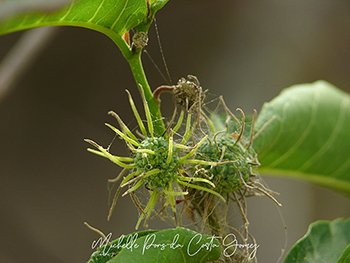
Many of the local fruits that were once popular are now hardly known. An example of such a forgotten plant is the Dushi kabei also called Palu di mora or Palu dushi di kabei. I often drop the names of local fruits like the Dushi kabei when talking to people about the island nature. In eight out of ten cases, I am stared at with incomprehension, and people do not know what I am talking about. Now, the fruit in question is not exactly a striking sight, in the sense that it is greenish in color and therefore usually does not stand out against the green foliage. Once the fruit is viewed up close, it immediately becomes apparent that it is a very hairy fruit that looks very coarse and actually does not look very edible at all. But it is exactly what it is. As the fruit ripens, it swells and takes on the appearance of a blackberry, but with the subdued milky-green color instead of the deep purple of a blackberry. In Spanish, the fruit and the tree are called the mora. The ripe fruit tastes incredibly sweet. It is actually a compound fruit, consisting of multiple small fruitlets that together give the impression of being a single, large fruit.
Flowering style
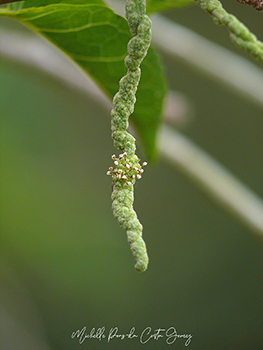
This species has a dioecious inflorescence, meaning each tree is unisexual. Therefore, there are trees that produce male flowers that look like elongated strands producing the pollen. The others are trees that produce female flowers that look like the fruit itself, with long, thick hairs that can sometimes grow up to 6 centimetres long.
The Dushi kabei is found throughout Latin America, from Mexico through Argentina and the Caribbean, and is used in many locations for its wood, which has a beautiful warm yellow sheen and is strong and resistant. This is likely because the plant’s sap contains antifungal compounds that prevent it from rotting quickly. The yellow dye extracted from the wood was and still is used as a dye for both yellow pigments and in the production of brown and green pigments. The dye was widely used during the First World War, among others, to colour clothing khaki, and was exported on a large scale from Jamaica and Trinidad for this application. Of the ABC-islands the tree has only be registered for Curaçao.
Anyone with a trained eye driving past stretches of mondi will immediately recognize the tree due to its growth pattern and the characteristic way in which the leaves look and grow on the branches. On Curaçao it can be found mainly along the road to Bullenbaai, in Veeris, and along the road between Betèsda and the university, these trees grew in large quantities, as well as at Blue Bay, Klein Hofje, Den Dunki, and Bándabou. Large trees also stood at Zuurzak, but they were bulldozed down a few years ago. It might be an idea to include this tree species in the replanting of new roads and roundabouts, for shade but certainly also for the historical value it holds for the island and its inhabitants, besides its edible and vitamin-rich fruits.
English name: Dyer’s Mulberry
Papiamentu/Papiamento name: Palu dushi (di kabei), Palu di mora, Dushi kabei
Scientific name: Maclura tinctoria
Family: Moraceae (Mulberry/ Fig family)
Occurrence (ABC islands): native on Curaçao
Publications used:
- Proosdij, A.S.J. van 2012. Arnoldo’s Zakflora: Wat in het wild groeit en bloeit op Aruba, Bonaire en Curaçao. 318 pp. Walburg Pers, Zutphen.
- van Buurt, Gerard. 2014. Caquetío words in Papiamentu/ Some names of animals and plants in Papiamentu. (download here: Book to download: Caquetío words in Papiamentu/ Some names of animals and plants in Papiamentu – Gerard van Buurt – Caribbean Footprint
- Dutch Caribbean Species Register
- The Online Flora of Curaçao
- Plants of the World Online
- Useful Tropical Plants
- Wikipedia

Wilde bloemen: Dushi kabei (Maclura tinctoria)
Veel lokale fruitsoorten die ooit populair waren, zijn nu nauwelijks nog bekend. Een voorbeeld van zo’n vergeten plant is de Dushi kabei, ook wel de Palu di mora genoemd of Palu dushi di kabei. Ik noem vaak lokale fruitsoorten zoals de Dushi kabei als ik met mensen over de natuur van de eilanden praat. In acht van de tien gevallen word ik onbegripvol aangekeken en weten mensen niet waar ik het over heb. Nu is de vrucht in kwestie niet bepaald een opvallende verschijning, in de zin dat hij groenachtig van kleur is en daardoor meestal niet opvalt tegen het groene blad. Van dichtbij bekeken, wordt meteen duidelijk dat het een zeer harige vrucht is die er erg ruw uitziet en er eigenlijk helemaal niet eetbaar uitziet. Maar het is precies wat het is. Naarmate de vrucht rijpt, zwelt hij op en krijgt hij het uiterlijk van een braam, maar dan met de gedempte melkgroene kleur in plaats van het dieppaars van een braam. In het Spaans worden de vrucht en de boom mora genoemd. De rijpe vrucht smaakt ongelooflijk zoet. Het is eigenlijk een samengestelde vrucht, bestaande uit meerdere kleine vruchtjes die samen de indruk wekken één grote vrucht te zijn.
Bloeiwijze
Deze soort heeft een tweehuizige bloeiwijze, wat betekent dat elke boom eenslachtig is. Er zijn dus bomen die mannelijke bloemen produceren die eruitzien als langwerpige strengen met stuifmeel. Andere bomen produceren vrouwelijke bloemen die lijken op de vrucht zelf, met lange, dikke haren die soms wel 6 centimeter lang kunnen worden.
De Dushi kabei komt voor in heel Latijns-Amerika, van Mexico tot Argentinië en het Caribisch gebied, en wordt op veel plaatsen gebruikt vanwege het hout, dat een prachtige warme gele glans heeft en sterk en resistent is. Dit komt waarschijnlijk doordat het sap van de plant schimmelwerende stoffen bevat die voorkomen dat het snel rot. De gele kleurstof die uit het hout wordt gewonnen, werd en wordt nog steeds gebruikt als kleurstof voor zowel gele pigmenten als voor de productie van bruine en groene pigmenten. De kleurstof werd onder andere tijdens de Eerste Wereldoorlog veel gebruikt om kaki kleding te kleuren en werd op grote schaal vanuit Jamaica en Trinidad geëxporteerd voor dit doel. Van de ABC-eilanden is de boomsoort alleen op Curaçao geregistreerd.
Iedereen met een geoefend oog die langs stukken mondi rijdt, zal de boom onmiddellijk herkennen aan zijn groeipatroon en de karakteristieke manier waarop de bladeren eruitzien en aan de takken groeien. Op Curaçao vooral langs de weg naar Bullenbaai, in Veeris en langs de weg tussen Betèsda en de universiteit groeiden deze bomen in grote aantallen, evenals in Blue Bay, Klein Hofje, Den Dunki en Bándabou. Grote bomen stonden ook in Zuurzak, maar die zijn een paar jaar geleden met bulldozers gekapt. Het zou een goed idee kunnen zijn om deze boomsoort op te nemen in de herbeplanting van nieuwe wegen en rotondes, voor de schaduw, maar zeker ook vanwege de historische waarde die de boom heeft voor het eiland en zijn inwoners, naast de eetbare en vitaminerijke vruchten.
Nederlandse naam: –
Papiamentse naam: Palu dushi (di kabei), Palu di mora, Dushi kabei
Wetenschappelijke naam: Maclura tinctoria
Familie: Moraceae (moerbeifamilie)
Voorkomen (ABC eilanden): Curaçao (inheems)
Gebruikte literatuur:
- Proosdij, A.S.J. van 2012. Arnoldo’s Zakflora: Wat in het wild groeit en bloeit op Aruba, Bonaire en Curaçao. 318 pp. Walburg Pers, Zutphen.
- van Buurt, Gerard. 2014. Caquetío words in Papiamentu/ Some names of animals and plants in Papiamentu. (download here: Book to download: Caquetío words in Papiamentu/ Some names of animals and plants in Papiamentu – Gerard van Buurt – Caribbean Footprint
- Dutch Caribbean Species Register
- The Online Flora of Curaçao
- Plants of the World Online
- Useful Tropical Plants
- Wikipedia