This post is also available in: Dutch (below)
Social media can be both very annoying or very handy. Everyone who scans social media posts especially on Facebook will regularly find posts with a photo of a very colourful caterpillar with black and yellow stripes and and a red head and legs. The animals is so colourful that it is impossible not to notice it and people will often find it crawling over the porch, in the garden or even more ‘horrific’, in the Frangipani trees eating every last bit of leaf the tree has. Often this fact is the real reason for the questions on social media as people want to know if the animal in itself is toxic to humans, if the tree will suffer dire consequences from the eating frenzy and will die, and also what they can do to kill as much of the caterpillars as possible. The posts and questions, often multiple times a week, in several social media groups by different people causes a great deal of frenzy and often irritation, especially as these questions come by over and over every single year and sometimes multiple times a year. To give commentators a handy tool to answer these repetitive question with, we made a photo composite to answer questions on species as well as a text to illustrate and answer all the questions there are about the animals. This article is based on that answer-post and composite, and gives more information. To go back to when the same questions irrevocably will surface again on Facebook, Instagram or other locations. Just copy and paste the URL of this post as an extensive answer!
Is it a Frangipani or an Oleander tree?
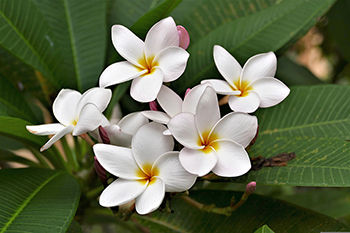
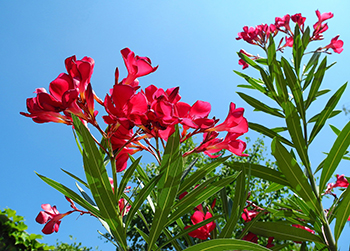
First of all we want to give a little insight in the names of these trees, as there is much discussion about these plants and their names as well. There’s some confusion about the naming conventions because of all the languages used on Curaçao with some popular plant names in English, some in Dutch and others in Papiamentu. We have seen big fights starting online because of this which is not necessary at all. Let’s clear it up:
The photo on the left is of a tree that belongs to the genus Plumeria with several species of which many are native to the Caribbean, Central and South America. Flower van be white, white-yellow, yellow, pink, reddish and every shade in Between. In English we call these trees Frangipani. In Papiamentu the name often used for these trees is Oleander. There is also a tree, much used in landscaping, that is called the Oleander di Boneiru, a plant that grows tall and has massive amounts of white flowers in the top. Its scientific name is Plumeria pudica.
Now there is another very popular garden plant that can often be found in tropical garden which also carries the word oleander. The plant that is called Oleander or Rosebay in English has the scientific name Nerium oleander and is usually called Franse bloem in Papiamentu. Sometimes the name Oleander is also used, which maximized the confusion. A photo of the Franse bloem can be seen on the right.
What are those large colorful catterpillars eating the Oleander or Frangipani trees?

So what are the large colourful caterpillars that are eating the Oleander (Papiamentu) trees, called Frangipani in English (Plumeria) or the Oleander di Boneiru (with the white flowers) . More often than not we have seen the wrong identification of these caterpillars, where they are being attributed to be the larval stage of the Monarch butterflies. To set the record straight we decided to make a small poster depicting the Monarch Butterfly (Danaus plexippus) in its caterpillar stage, with a picture of its host plant the Katuna di Seda (milkweed, Calotropis procera) and also the adult butterfly stage, the beautiful orange and black butterfly we all now. (On the poster the 3 pictures on the left side!).
The Frangipani ‘monster’, everyone is ready to kill by the thousands because they are so monstrous to their trees, is the one depicted on the right side of the poster; the Giant Gray Sphinx Moth (Pseudosphinx tetrio). Its caterpillar black with orange/red markings and some yellow, its host plant the Frangipani and of course the adult stage which appears to be a very boring Gray Sphinx moth. But which has beautiful details if you look at it closely.
These caterpillars and moths play a crucial part in the ecological system of the island providing food for birds and bats.
Is my Frangipani tree going to die?
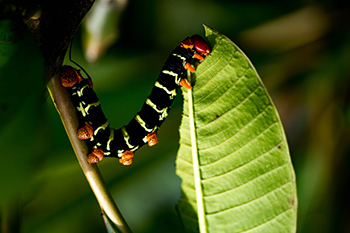
And than the million dollar question: Are these caterpillars killing the Frangipani trees? NO they are NOT!
They will indeed eat all the leaves, but the tree will regrow every single one of them, even creating more leaves in the end. Once the caterpillars transform into the moth stage, they are gone for the year and the tree will get its chance to regrow.
So should you kill these caterpillars?
NO definitely NOT!
English name: Giant Gray Sphinx moth
Papiamentu name: Barbulètè di oleander
Scientific name: Pseudosphinx tetrio
Family: Sphingidae (hawk moths)
Occurrence (ABC islands): Curaçao, Bonaire (Aruba unknown)
Publications used:
- Debrot, A.O. & Miller, J.Y. 2004. Butterflies and moths of Curaçao, Aruba and Bonaire. 1-100. CARMABI Foundation, Willemstad.
- Groenen, F. 2025. The moths of Bonaire, with a preliminary checklist for the Dutch ABC islands (Lepidoptera). Nederlandse Faunistische Mededelingen 64: 301-332.
- Arnoldo Broeders, M. Fr. 1967. Handleiding tot het gebruik van inheemse en ingevoerde planten op Aruba, Bonaire en Curaçao. Uitgave Boekhandel ,,St.-Augustinus” – Curaçao.
- Dutch Caribbean Species Register
- Eppo Global Database (Strymon megarus (THECBA)[Overview]| EPPO Global Database)
- Butterflies of America ( Strymon megarus (Godart, [1824]))
- Wikipedia

Wat is dit voor rups…?
Sociale media kunnen zowel erg irritant als erg handig zijn. Iedereen die sociale media, met name Facebook, bekijkt, komt regelmatig foto’s tegen van een kleurrijke rups met zwarte en gele strepen, een rode kop en rode poten. Het dier is zo opvallend dat je het onmogelijk kunt missen. Mensen zien het vaak over de veranda kruipen, in de tuin of, nog erger, in de frangipanibomen, waar het elk blad van de boom opvreet. Vaak is dit de reden voor de vragen op sociale media: mensen willen weten of het dier giftig is voor mensen, of de boom ernstig zal lijden onder de vraatzucht en zal afsterven, en wat ze kunnen doen om zoveel mogelijk rupsen te doden. De berichten en vragen, vaak meerdere keren per week, in verschillende sociale mediagroepen door verschillende mensen, zorgen voor veel ophef en irritatie, vooral omdat deze vragen elk jaar weer terugkomen, soms zelfs meerdere keren per jaar. Om commentatoren een handig hulpmiddel te bieden bij het beantwoorden van deze steeds terugkerende vragen, hebben we een fotocompositie gemaakt om vragen over diersoorten te beantwoorden, evenals een tekst om alle vragen over de dieren te illustreren en te beantwoorden. Dit artikel is gebaseerd op die antwoordpost en fotocompositie en geeft meer informatie. Voor het geval dezelfde vragen onvermijdelijk weer opduiken op Facebook, Instagram of andere platforms, kunt u de URL van dit bericht kopiëren en plakken als uitgebreid antwoord!
Is het een Frangipani of een Oleander?
Allereerst willen we wat meer uitleg geven over de namen van deze bomen, aangezien er veel discussie is over deze planten en hun benamingen. Er bestaat enige verwarring over de naamgeving vanwege de vele talen die op Curaçao gesproken worden. Sommige planten hebben een Engelse naam, andere een Nederlandse en weer andere een Papiamentse-naam. We hebben online al flinke ruzies hierover zien ontstaan, wat helemaal niet nodig is. Laten we het even ophelderen:
De foto links toont een boom die behoort tot het geslacht Plumeria, met verschillende soorten waarvan er vele inheems zijn in het Caribisch gebied, Midden- en Zuid-Amerika. De bloemen kunnen wit, witgeel, geel, roze, roodachtig en alle tinten daartussenin zijn. In het Engels noemen we deze bomen Frangipani. In het Papiaments wordt deze boom vaak Oleander genoemd. Er is ook een boom die veel gebruikt wordt in de aanleg van tuinen, de Oleander di Boneiru, een plant die hoog groeit en een enorme hoeveelheid witte bloemen in de top heeft. De wetenschappelijke naam is Plumeria pudica.
Er is nog een andere zeer populaire tuinplant die vaak in tropische tuinen te vinden is en die ook de naam Oleander draagt. De plant die in het Engels Oleander of Rosebay wordt genoemd, heeft de wetenschappelijke naam Nerium oleander en wordt in Papiaments meestal Franse bloem genoemd. Soms wordt ook de naam Oleander gebruikt, wat de verwarring vergroot. Een foto van de Franse bloem is rechts te zien.
Wat zijn die grote, kleurrijke rupsen die de Oleander- of Frangipanibomen opeten?
Wat zijn die grote, kleurrijke rupsen die de bladeren van de Oleanderbomen (Papiamentu, in het Engels Frangipani of Plumeria) of Oleander di Boneiru (met de witte bloemen) opeten? We zien vaak dat deze rupsen verkeerd worden geïdentificeerd en ten onrechte worden aangezien voor de larven van de Monarchvlinder. Om dit misverstand uit de wereld te helpen, hebben we een kleine poster gemaakt met de Monarchvlinder (Danaus plexippus) in zijn rupsstadium, met een afbeelding van zijn waardplant, de Katuna di Seda (zijdeplant, Calotropis procera)), en ook de volwassen vlinder, de prachtige oranje-zwarte vlinder die we allemaal kennen. (Op de poster staan deze 3 afbeeldingen aan de linkerkant!).
Het ‘Frangipani-monster’, dat iedereen met duizenden tegelijk wil doden omdat het zo’n monster is voor hun bomen, is degene die aan de rechterkant van de poster is afgebeeld; de Giant Gray Sphinx Moth (Pseudosphinx tetrio). De rups is zwart met oranje/rode vlekken en wat geel, de waardplant is de Frangipani en natuurlijk het volwassen stadium, dat eruitziet als een heel saaie grijze pijlstaartvlinder. Maar die heeft als je goed kijkt prachtige details.
Deze rupsen en vlinders spelen een cruciale rol in het ecologische systeem van het eiland door voedsel te leveren aan vogels en vleermuizen.
Gaat mijn frangipaniboom dood?
En dan de hamvraag: doden deze rupsen de frangipanibomen? NEE, dat doen ze NIET!
Ze eten inderdaad alle bladeren op, maar de boom groeit ze allemaal weer aan, en produceert uiteindelijk zelfs meer bladeren. Zodra de rupsen in de motten veranderen, zijn ze voor dat jaar verdwenen en krijgt de boom de kans om te herstellen.
Dus moet je deze rupsen doden?
NEE, absoluut NIET!
Nederlandse naam: –
Papiamentse naam: Barbulètè di oleander
Wetenschappelijke naam: Pseudosphinx tetrio
Familie: Sphingidae (pijlstaarten)
Voorkomen (ABC eilanden): Curaçao, Bonaire (Aruba onbekend)
Gebruikte publicaties:
- Debrot, A.O. & Miller, J.Y. 2004. Butterflies and moths of Curaçao, Aruba and Bonaire. 1-100. CARMABI Foundation, Willemstad.
- Groenen, F. 2025. The moths of Bonaire, with a preliminary checklist for the Dutch ABC islands (Lepidoptera). Nederlandse Faunistische Mededelingen 64: 301-332.
- Arnoldo Broeders, M. Fr. 1967. Handleiding tot het gebruik van inheemse en ingevoerde planten op Aruba, Bonaire en Curaçao. Uitgave Boekhandel ,,St.-Augustinus” – Curaçao.
- Dutch Caribbean Species Register
- Eppo Global Database (Strymon megarus (THECBA)[Overview]| EPPO Global Database)
- Butterflies of America ( Strymon megarus (Godart, [1824]))
- Wikipedia