This post is also available in: Dutch (below)
There are birds on our islands that still cause a lot of confusion when people ask for their identification. Despite the abundance of books, online information, and social media, some bird species are apparently so similar that they are consistently misnamed, practically creating online wars over who wants to be right. In practice, this usually involves the group of small yellow birds and the group of medium-sized black birds. In this article, we focus on the yellow breeding birds found on the islands, with comparative photos. To save and share whenever the discussion starts again.
Two Bird Species Regularly Confused
Two small yellow birds that regularly cause a stir on social media are the Mangrove Yellow Warbler (Sethopaga petechia) or Para di misa and the Saffron Finch (Sicalis flaveola). At first glance, both are yellow and small, making them apparently very difficult to distinguish in practice, although there are indeed significant differences between the two species that make it relatively easy to immediately identify the species. That’s why we put both types side by side with photos to show the differences extra clearly.
Differences between the Saffron Finch and the Yellow Warbler
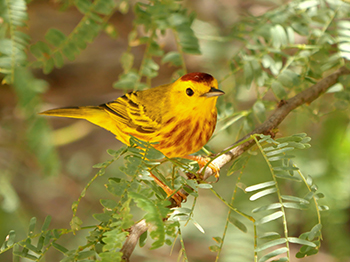
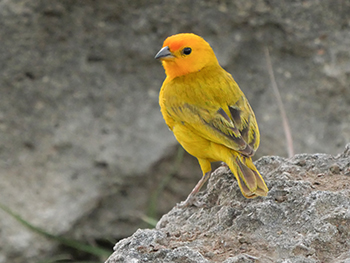
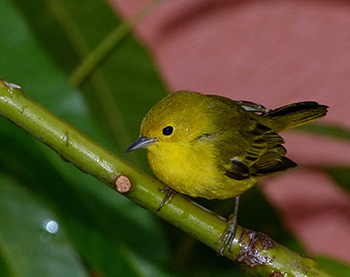
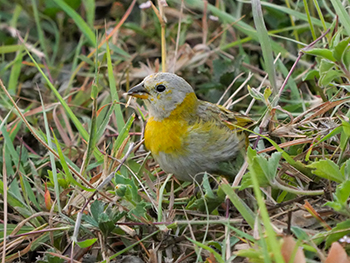
First of all, the two species differ in size. At 14 centimetres, the Saffron Finch is considerably larger than the 12-centimeter-long Yellow Warbler, or Gele zanger as it’s called in Dutch. This may not always be easy to spot with the naked eye, as the bird hops past and you don’t have enough time to observe it closely. But the hopping itself provides a very important clue for the curious. The Saffron Finch is often found on the ground, on roadsides where grass has been regularly grown and mowed, and even on the beach. They can sometimes be found in quite large flocks. You’re unlikely to see a Yellow Warbler sitting on the ground for very long; the bird is known for not sitting still for a second and for constantly hopping from one spot to another, preferably in a tree. This difference in behaviour is closely related to the food the two species forage for. The Para di misa, which can’t sit still for a second, is an insect eater and is constantly searching for the next six-legged snack. Ants, flies, mosquitoes, caterpillars, beetles, and all sorts of other insects are on its menu, all prey that can move quite quickly themselves. For this, as a bird, you need not only excellent eyesight but also quick reactions. This is why these animals are so restless, and therefore quite difficult to photograph well. (They also occasionally eat nectar and fruit, but this is much less common on the menu). The Saffron Finch, on the other hand, is a seed eater, and if this bird finds a spot with plenty of grass tufts with seeds or a recently mown area with seeds on the ground, it will remain on the ground. They pick up seeds one after another, crack them open, and swallow the nutritious centre. This can happen quite quickly. So you can almost tell the species by this behaviour. But there are still situations where it remains difficult, such as when a yellow bird suddenly lands on your chair on the beach and then hops back and forth in the sand to pick things up. The best indication here is: if the bird sits still for a long time, it’s usually a Saffron Finch. If it constantly hops from one spot to another, it’s often a Para di misa.
Bill Shape and Colour of the Birds
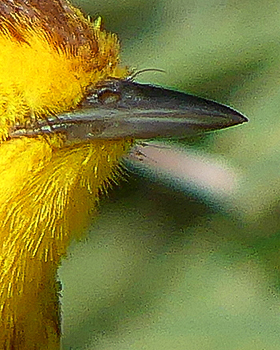
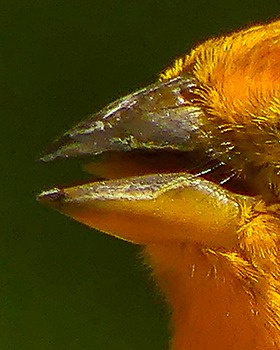
Because the food these two species eat is so different, their beaks are also different in shape. You can ALWAYS tell which species it is by the beaks. If the small yellow bird has a triangular beak that is dark gray on top and yellow on the underside, it’s the seed-eating Saffron Finch. If the beak is thin, pointed, and deep black, it’s a Para di misa.
Furthermore, the color of the two birds is significantly different. The Saffron Finch is saffron yellow in color and has a bright orange head the color of mango. This applies to both males and females. The young are brown with yellow patches. The Bananaquit is more curry yellow. The males also have dark red stripes on the chest and a dark red cap on the head. The females sometimes have finer dark red stripes on the chest but are otherwise uniformly yellow.
Other yellow birds: the Bananaquit

Another bird species found on our islands is the Bananaquit (Coereba flaveola). However, this one is very clearly distinguishable from the two species mentioned above because the Bananaquit has a black back, a black head with a white brow stripe, and a yellow belly. Incidentally, Bonaire has a different endemic subspecies of the Bananaquit than Aruba and Curaçao. Bonaire has the Coereba flaveola bonairensis, and Aruba and Curaçao have the Coereba flaveola uropygialis. Read more about these endemic subspecies here:
Other yellow birds: The Yellow oriole
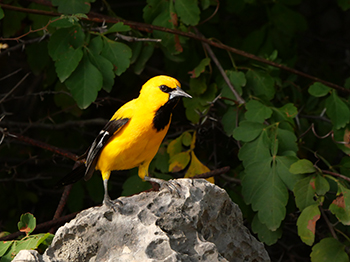
Another well known yellow bird of the ABC-islands is the Yellow Oriole (Icterus nigrogularis curasoensis, endemic subspecies for the ABC-islands), also called Trupial kachó in Papiamentu which can be translated into ‘The barking Trupial’, presumably because of its calls. This bird can in no way be confused with the former three species as this bird is about 21 cm long, much larger that all three former species.
Publications used:
- Boer, B. de, Newton, E. & Restall, R. 2012. Birds of Aruba, Curaçao and Bonaire. Ardea Christopher Helm, London.
- Pors-da Costa Gomez, M., Pors, L. 2021. Vogels van Curaçao. Book.
- Prins, T.G., Reuter, J.H., Debrot, A.O., Wattel, J. & Nijman, V. 2009. Checklist of the birds of Aruba, Curaçao and Bonaire, South Caribbean. Ardea 97: 137-268.
- Wells, J.V. & Wells, A.C. 2017. Birds of Aruba, Bonaire, and Curaçao: a site and field guide. 474pp. Cornell University Press.

Gele vogels op de ABC-eilanden – Bewaar en deel!
Er zijn van die vogels op onze eilanden die nog altijd voor veel verwarring zorgen als mensen vragen om identificatie ervan. Ondanks de vele boeken, online informatie en sociale media zijn er vogelsoorten die blijkbaar zoveel op elkaar lijken te lijken dat ze steevast de verkeerde naam krijgen en er bijna online oorlogen ontstaan in wie het gelijk wil hebben. In de praktijk gaat het meestal voornamelijk om de groep van de kleine gele vogels en de groep van de medium grote zwarte vogels. In dit artikel besteden we aandacht aan de gele broedvogels die te vinden zijn op de eilanden met vergelijkende foto’s. Om te bewaren en door te geven.
Twee vogelsoorten die regelmatig door elkaar worden gehaald
Twee kleine gele vogels die wel heel regelmatig voor opschudding zorgen op sociale media zijn de Gele zanger of Para di misa ((Sethopaga petechia) en de Saffraanvink (Sicalis flaveola). In eerste oogopslag allebei geel en klein en daarom in de praktijk blijkbaar heel moeilijk om ze uit elkaar te houden, als zijn er wel degelijk significante verschillen tussen de 2 soorten die ervoor zorgen dat je in een oogopslag kunt zien om welke soort het gaat. Daarom zetten we beide soorten naast elkaar met foto’s om de verschillende extra duidelijk te tonen.
Verschillen tussen Para di misa en de Saffraanvink
Om te beginnen verschillen de 2 soorten in grootte van elkaar. De Saffraanvink is namelijk met 14 centimeter een stukje groter dan de 12 centimeter lange Para di misa of Gele zanger zoals het dier in het Nederlands heet. Wellicht is dat met het blote oog niet altijd goed te zien, als het dier langs hipt en je niet genoeg tijd geeft om uitgebreid te observeren. Maar in het hippen ligt al een heel belangrijk aanknopingspunt voor nieuwsgierigen. De Saffraanvink is namelijk heel vaak op de grond te vinden, op bermen langs de weg waar gemaaid is, in velden waar regelmatig gras groeit en wordt gemaaid en zelfs op het strand. Dan zijn ze soms in best wel grote groepen te vinden. Een Gele zanger of Para di misa zul je niet zo snel heel lang op de grond zien zitten, het diertje staat erom bekend geen seconde stil te zitten en continue van de ene naar de andere plek in het liefst een boom te springen. Dit verschil in gedrag heeft nauw te maken met het voedsel dat de twee soorten zoeken. De geen seconden stil zittende Para di misa is een insectenneter en is continue op zoek naar het volgende 6-potige hapje. Mieren, vliegen, muggen, rupsen, kevers en allerlei andere insecten staan op het menu en dit is allemaal prooi dat zelf ook redelijk snel kan bewegen. Dan moet je als vogel niet alleen heel goed kunnen zien, maar ook snel kunnen reageren. En dat is de reden waarom deze dieren zo onrustig zijn, en dus ook best moeilijk om bijvoorbeeld goed op de foto te zetten. (ze eten trouwens ook wel eens nectar en vruchtjes, maar dit staat veel minder vaak op het menu). De Saffraanvink daarentegen is een zaadeter, en als deze vogel een plek vindt waar veel graspluimen met zaad staan of een plek waar net gemaaid is en er zaad op de grond ligt, dan blijft de vogel op de grond zitten. Ze pikken de een na het andere zaad op, kraken het open en slikken het voedzame centrum door. Dat kan best heel snel. Je kunt dus al bijna aan dit gedrag zien om welke soort het gaat. Maar er zijn dan alsnog situaties waarbij het moeilijk blijft, zoals wanneer er ineens een geel vogeltje op je stoel op het strand landt en daarna in het zand heen en weer hipt om dingen op te pikken. De beste indicatie is hier dan toch; zit het diertje langere tijd stil dan gaat het in de meeste gevallen om een Saffraanvink. Hipt het constant van de ene naar de plek dan gaat het vaak om de Para di misa.
Vorm van de snavels en kleur van de vogels
Doordat het voedsel dat deze twee soorten eten zo verschillend is, zijn ook de snavels verschillende van vorm. Aan de snavels kun je ALTIJD zien om welke soort het gaat. Heeft het kleine gele vogeltje een driehoekige snavel dat donkergrijs is aan de bovenkant en geel aan de onderkant dan gaat het om de zaadetende Saffraanvink. Is de snavel dun, puntig en diepzwart van kleur dan gaat het om de Para di misa.
Daarnaast is ook de kleur van beide vogels significant anders. De Saffraanvink is saffraangeel van kleur en heeft een fel oranje kop met de kleur van mango. Dat geldt voor zowel de mannetjes als de vrouwtjes. De jongen zijn bruin met gele patches. De Para di misa is meer kerriegeel van kleur. De mannetjes hebben daarnaast donkerrode strepen op de borst en een donkerrood kapje op de kop. De vrouwtjes hebben soms wat fijnere donkerrode strepen op de borst maar zijn verder egaal geel.
Andere gele vogels: de Suikerdiefjes
Een andere vogelsoort die op onze eilanden te vinden is, is het Suikerdiefje, Barika hel of Bananaquit (Coereba flaveola) . Deze is echter heel duidelijk te onderscheiden van de bovenstaande twee soorten omdat het Suikerdiefje een zwarte rug heeft met een zwarte kop met witte wenkbrauwstreep, en een geel buikje. Overigens vindt je op Bonaire een andere endemische ondersoort van het Suikerdiefje dan op Aruba en Curaçao. Op Bonaire vindt je de Coereba flaveola bonairensis en op Aruba en Curaçao de Coereba flaveola uropygialis. Lees meer over deze endemische ondersoorten hier:
Andere gele vogels: De Trupial kachó
Een andere bekende gele vogel van de ABC-eilanden is de Gele trupiaal (Icterus nigrogularis curasoensis, een endemische ondersoort voor de ABC-eilanden), ook wel de Trupial kachó genoemd in het Papiaments. Dit kan vertaald worden als de blaffende trupiaal, waarschijnlijk vanwege de geluiden dat de dieren kunnen maken. Deze soort kan niet met de voorgaande drie soorten worden verward aangezien de Gele trupiaal maar liefst 21 cm groot is, veel groter dan de voorgaande 3 soorten.
Gebruikte publicaties:
- Boer, B. de, Newton, E. & Restall, R. 2012. Birds of Aruba, Curaçao and Bonaire. Ardea Christopher Helm, London.
- Pors-da Costa Gomez, M., Pors, L. 2021. Vogels van Curaçao. Book.
- Prins, T.G., Reuter, J.H., Debrot, A.O., Wattel, J. & Nijman, V. 2009. Checklist of the birds of Aruba, Curaçao and Bonaire, South Caribbean. Ardea 97: 137-268.
- Wells, J.V. & Wells, A.C. 2017. Birds of Aruba, Bonaire, and Curaçao: a site and field guide. 474pp. Cornell University Press.