This post is also available in: Dutch (below)
Kenepa spiritu, guayaba baster, Palo di Boneiru or Palu di veneno (Casearia tremula)
As soon as the rainy season begins and these trees begin to grow at an accelerated pace, and the older plants begin to produce flowers and fruit, questions about this topic explode online. Since a love of greenery often comes through the stomach, the question of which plant it is is almost always related to whether the fruits are edible. Because the accompanying photos often don’t lead to a good identification, with answers ranging from medlar to avocado, the best advice is to avoid eating anything growing in the garden that is unknown until a clear identification has been made.
Be careful!
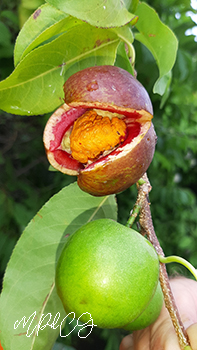
This is a good example of where caution is paramount. The Kenepa di spiritu (as it is called on Curaçao), Palo/Palu di Boneiru (as it is called on Aruba and Bonaire) or Casearia tremula is an inconspicuous plant that can grow into a reasonable-sized tree, sometimes reaching about 5 meters in height. The plant has elongated leaves that are somewhat leathery and taper quite sharply at the tip. These bright green leaves are not hairy but do have a very slight serration along the edges and are attached to a thin green stem. Especially when the weather gets drier, the tree looks a bit sad because the leaves droop. The flowers are completely inconspicuous. Small clusters in the leaf axils contain tiny white flowers, 1.5 cm in diameter, which are frequently visited by a wide range of insects, including bees, various butterfly species, and even some fly species. The fruit is the most striking feature of this plant. They are as round as a manzaliña (manchineel) apple but can grow much larger, with some plants even producing fruits with a diameter of 5 to 6 centimeters. They look like small green apples and remain green for a relatively long time. At some point, the fruit’s skin will turn dark red, after which it bursts open, revealing 3 to 4 valves (of the skin) with a bright red interior and white flesh.
Fruit: Spherical, fleshy fruit, 3-3.5 centimeters in diameter, opening with 3-4 valves. The valves are thick, the exterior is dark purple-green, and the interior of the skin is white, with red and white flesh and a kind of orange pulp in which the seeds hang. The pulp unfolds, leaving the seeds hanging by thin orange threads.

The whole thing looks exceptionally tasty, but the plant’s name likely gives a clue as to its edibility. The names Palu di venenu (translated as Poison tree) and Kenepa spiritu (translated as Ghost kenepa) suggest that eating these fruits can have dire consequences. This plant, which most likely spread to the Caribbean from South America, is also considered poisonous in other Caribbean countries. However, few studies have been conducted on the toxicity of the plant and fruit, or to what extent they can actually be fatal. There is often some truth in the use of these indigenous names, as consumption can lead to intestinal problems, hallucinations, or, more seriously, death. Locally, there is a strong reaction to the question of whether these beautiful fruits are edible. It is noteworthy that several bird species, such as the Caribbean mockingbird, enjoy eating the fruits. However, the advice remains to leave the plants to the birds and, above all, not to experiment with their edibility.
English name: Jumbie guava
Papiamentu/Papiamento name: Guyaba baster (Curaçao, Bonaire), Palo di Boneiru (Aruba), Palu di Boneiru (Bonaire), Kenepa spiritu (Curaçao), Palu di veneno.
Scientific name: Casearia tremula
Family: Salicaceae (willow family)
Occurrence (ABC islands): Aruba, Bonaire and Curaçao (all native)
Publications used:
- Proosdij, A.S.J. van 2012. Arnoldo’s Zakflora: Wat in het wild groeit en bloeit op Aruba, Bonaire en Curaçao. 318 pp. Walburg Pers, Zutphen.
- Plants of the world online
- Dutch Caribbean Species Register
- Plantiary.com
- Wikipedia

Planten met een waarschuwing: Casearia tremula
Kenepa spiritu, guayaba baster, Palo di Boneiru of Palu di venenu (Casearia tremula)
Zodra de regentijd begint en deze boompjes in versneld tempo gaan groeien en de wat oudere planten bloemen gaan krijgen en vruchten, dan barsten de vragen online hierover los. Aangezien liefde voor groen veelal door de maag gaat is de vraag om welke plant het gaat bijna altijd wel verbonden met de vraag of de vruchten eetbaar zijn. Omdat de foto’s die erbij worden geplaatst vaak niet tot goede identificatie lijden, met antwoorden variërend van mispel tot avocado, is het beste advies om alles dat in de tuin groeit en onbekend is bij voorbaat niet in de mond te stoppen totdat er een eenduidige identificatie is.
Wees voorzichtig!
Dit is een goed voorbeeld waar voorzichtigheid een belangrijk uitganspunt is. De Kenepa di spiritu (zoals het op Curaçao wordt genoemd, Palo/Palu di Boneiru (zoals het op Aruba and Bonaire wordt genoemd) of Casearia tremula is een weinig opvallend plantje dat kan uitgroeien tot een redelijk boompje van soms een meter of 5 hoog. De plant heeft langwerpige bladeren die een beetje leerachtig aandoen en redelijk spit toelopen aan het uiteinde. Deze heldergroene bladeren zijn niet behaard maar hebben wel een hele lichte karteling aan de randen en ze zitten aan een dun groen steeltje. Vooral als het weer wat droger wordt dan ziet het boompje er ietwat triestig uit omdat de bladeren gaan hangen. De bloemen zijn totaal onopvallend. Kleine trosjes in de bladoksel waarin kleine 1,5 cm in doorsnede witte bloemetjes zitten die druk bezocht worden door een breed scala aan insecten waaronder bijen, verschillende vlindersoorten en ook bepaalde vliegensoorten. De vrucht is het meest opvallende van deze plant. Die zijn namelijk zo rond als een manzaliña appeltje maar kunnen veel groter worden waarbij aan sommige planten zelfs vruchten zitten met een doorsnede van 5 tot 6 centimeter. Ze zien er uit als kleine groene appeltjes en blijven relatief lang groen. Op gegeven moment zal de kleur van de schil van de vrucht donkerrood gaan kleuren waarna de vrucht openbarst en 3 tot 4 kleppen (van de schil) met aan de binnenkant een felle rode kleur, wit vruchtvlees
Vrucht: Vrucht bolvormig, vlezig, 3-3.5 centimeter in doorsnede, openend met 3-4 kleppen, de kleppen dik, de buitenkant donker paars-groen, de binnenzijde van de schil wit, met rood en wit vruchtvlees en een soort oranje moes waarin de zaden hangen. Het moes ontvouwt zich waardoor de zaden aan dunne oranje draden hangen.
Het hele gebeuren ziet er bijzonder smakelijk uit maar de naam van de plant geeft allicht een indicatie over de eetbaarheid ervan. Palu di venenu (vertaald als gifboom) en Kenepa spiritu (vertaald als spookkenepa) suggereren dat het eten van deze vruchten tot de meest vreselijke resultaten kunnen lijden. Ook in andere Caribische landen staat deze plant, die hoogstwaarschijnlijk vanuit Zuid Amerika naar het Caribisch gebied is verspreid, als giftig te boek. Echter, er zijn weinig onderzoeken gedaan naar de toxiciteit van de plant en vrucht en in hoeverre deze daadwerkelijk dodelijk kan zijn. Vaak zit er een kern van waarheid in het gebruik van dit soort inheemse namen, waarbij gebruik kan lijden tot darmproblemen, hallucinaties of ernstiger met de dood tot gevolg. Lokaal reageert men dan ook zeer heftig op de vraag of deze prachtige vruchten eetbaar zijn. Bijzonder is daarbij te noemen dat verschillende vogelsoorten de vruchten graag eten, zoals de Caribische spotlijster. Het advies luidt echter nog steeds, om de planten aan de vogels over te laten en vooral niet te gaan experimenteren met de eetbaarheid ervan.
Nederlandse naam: Geelhout
Papiamentse naam: Guyaba baster (Curaçao, Bonaire), Palo di Boneiru (Aruba), Palu di Boneiru (Bonaire), Kenepa spiritu (Curaçao), Palu di veneno.
Wetenschappelijke naam: Casearia tremula
Familie: Salicaceae (wilgenfamilie)
Voorkomen (ABC eilanden): Aruba, Bonaire en Curaçao (inheems)
Gebruikte publicaties:
- Proosdij, A.S.J. van 2012. Arnoldo’s Zakflora: Wat in het wild groeit en bloeit op Aruba, Bonaire en Curaçao. 318 pp. Walburg Pers, Zutphen.
- Plants of the world online
- Dutch Caribbean Species Register
- Plantiary.com
- Wikipedia