This post is also available in: Dutch (below)
There are birds on our islands that still cause a lot of confusion when people ask for their identification. Despite the abundance of books, online information, and social media, some bird species are apparently so similar that they are consistently misnamed, practically creating online wars over who wants to be right. In practice, this usually involves the group of small yellow birds and the group of medium-sized black birds. In this article, we focus on the black breeding birds found on the islands, with comparative photos. To save and share whenever the discussion starts again.
Three Bird Species Regularly Confused and a fourth that is also black!
There are 3 black bird species and one brown-black bird species on the island that can be seen on land all year round and also breed on the island. They are always confused with each other, and as soon as a black bird is seen, it is usually immediately identified as Chuchubi pretu (black mockingbird). 9 out of 10 times, this is an incorrect identification.
The True Chuchubi pretu or Groove-billed Ani (Crotophaga sulcirostris)
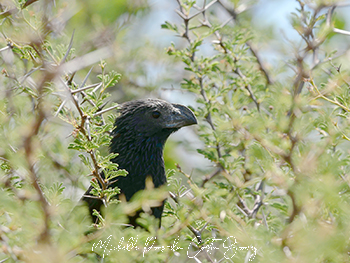
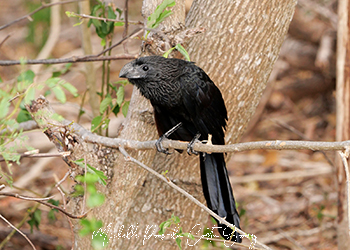
The True Chuchubi pretu is a bird usually seen in places where low scrub can be found, or open grassy land with many insects such as grasshoppers and crickets. There are two characteristic features of this bird: the very thick, grooved beak that covers a large part of the head, and the very long, thin tail with which the animal balances as it searches for fat, plump insects among branches and grass. In addition, these birds have black beady eyes and, at 30 cm in length, are by far the largest of the three. They can sometimes be seen in gardens, but they prefer peace and quiet. Therefore, if you see a black bird on the beach, in the parking lot at the gas station or supermarket, or in the city, I can almost guarantee that it is absolutely not a Chuchubi pretu!
The Shiny Cowbird or Para vakero lustroso (Molothrus bonariensis)
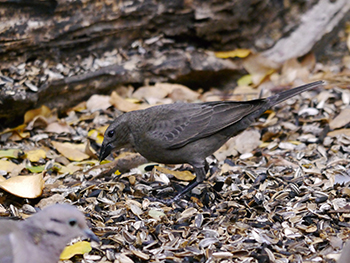
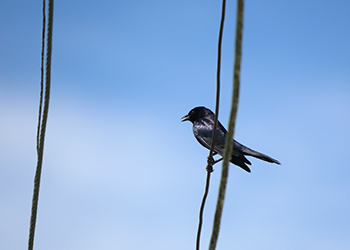
The Shiny Cowbird is a relative newcomer to the island, first spotted in the late 1990s and likely arrived as a cage bird on ships and was released. This has caused quite a few problems on the ABC islands, as these birds are brood parasites. They lay their eggs in the nests of other birds. The rapidly developing chicks then throw out the actual eggs of the nest’s owners, which is why you often see the Trupial kachó, or yellow oriole, flying with a brown chick, among others. It is not their own child. These birds are about 19 centimeters long, very slender in build, and the males are glassy purple-blue while the females are brown. They are therefore about the same size as a trupial kachó. These black birds also have a black eye, as well as an almost triangular beak.
The Carib Grackle or Zenata karibeño (Quiscalus lugubris)
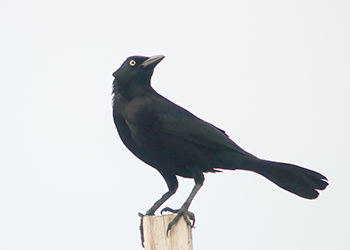
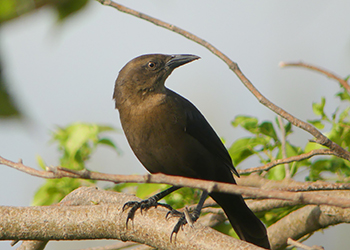
Another addition to the island, of which it is still unclear whether they arrived naturally or were introduced by humans, is the Carib Grackle. These are the black birds most commonly found on beaches and in parking lots. They are deep black birds standing proudly upright with a fan-shaped tail and piercing light eyes. That is also immediately the most striking feature of them, besides the melodious sounds they make. These are about 25 centimetres long, about the same size as the orange trupial. The Mòfi or Blackfaced grassquit.
The Black-faced grassquit (Melanospiza bicolor)
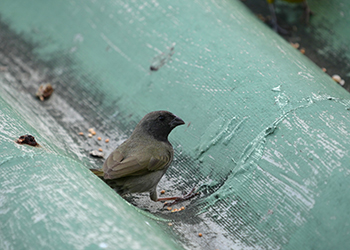
In addition to the sooty black bird species mentioned above, there is another native breeding bird species of which at least the male is also quite black in color; the so-called Mòfi or Blackfaced grassquit, a small finch about 10 centimeters long that mainly eats seeds. This species cannot be confused with the other three species, but is named in this article due to its color!

Drie vogelsoorten die regelmatig door elkaar worden gehaald, en een vierde die ook nog eens zwart is!
Er zijn op het eiland 3 zwarte vogelsoorten en één bruinzwarte vogelsoort die het hele jaar door te zien zijn op het land en ook broeden op het eiland. Ze worden altijd door elkaar gehaald, en zodra men een zwarte vogel ziet wordt het dan ook meestal direct aangewezen als Chuchubi pretu (zwarte Chuchubi). 9 van de 10 keer is dit een foute identificatie.
De echte Chuchubi pretu of Groefsnavelani
De echte Chuchubi pretu of Groefsnavelani is een vogel die je meestal ziet op plekken waar laag struikgewas te vinden, of open grasachtig land met veel insecten als sprinkhanen en krekels. Er zijn twee karakteristieke kenmerken aan deze vogel, de hele dikke gegroefde snavel die een groot deel van de kop beslaat en de hele lange dunne staart waarmee het dier balanceert als het tussen takken en gras op zoek is naar dikke vette insecten. Daarnaast hebben deze vogels zwarte kraaloogjes en zijn met 30 cm lengte verreweg de grootste van de 3. Ze zijn wel eens in tuinen te zien, maar houden toch meer van rust en stilte. Zie je daarom een zwarte vogel op het strand, op de parkeerplaats bij het benzinestation of de supermarkt of in de stad, dan kan ik bijna garanderen dat het absoluut geen Chuchubi pretu is!
De Shiny cowbird of Glanskoevogel
De Shiny cowbird of Glanskoevogel is een relatieve nieuwkomer op het eiland, eind jaren 90 van de vorige eeuw voor het eerst gespot en waarschijnlijk als kooivogel meegekomen met schepen en losgelaten. En dat heeft op de ABC-eilanden toch redelijk wat problemen opgeleverd aangezien deze vogels broedparasieten zijn. Ze leggen hun eieren in de nesten van andere vogels. De zich snel ontwikkelende kuikens gooien dan de echte eieren van de eigenaren van het nest eruit en dat is de reden waarom je onder andere de Trupial kachó of gele troepiaal vaak ziet vliegen met een bruin jong. Het is niet hun eigen kind. Deze vogel zijn ongeveer 19 centimeter lang, heel slank in postuur, en de mannen glazen paarsblauw terwijl de vrouwen bruin zijn. Ze hebben dus ongeveer even groot als een trupiaal kachó. Ook deze zwarte vogels hebben een zwart oog, en daarnaast een bijna driehoekige snavel.
De Carib grackle of Caribische troepiaal
Een andere additie op het eiland, waarvan het nog altijd niet duidelijk is of ze op natuurlijke wijze zijn gearriveerd of door de mens zijn binnengebracht, is de Carib grackle of de Caribische troepiaal. Dit zijn de zwarte vogels die je het meeste op stranden en parkeerplaatsen aantreft. Het zijn fier rechtop staande diepzwarte vogels met een waaier als staart en indringende lichte ogen. Dat is ook meteen het meest opvallende aan ze, naast de melodieuze geluiden die ze maken. Deze zijn ongeveer 25 centimeter lang, ongeveer even groot als de oranje troepiaal.
De Mòfi of Maskergrondvink
Naast de hierboven genoemde roetzwarte vogelsoorten is er nog een inheemse broedvogelsoort waarvan in ieder geval het mannetje ook behoorlijk zwart gekleurd is; de zogenaamde Mòfi of Maskergrondvink, een klein vinkje van ongeveer 10 centimeter lang dat vooral zaad eet. Deze soort is niet te verwarren met de andere drie soorten, maar door de kleur toch benoemd in dit artikel!