This post is also available in: Dutch (below)
Carib Grackles (Quiscalus lugubris) are a relatively new bird species on the islands of Aruba, Curaçao, and Bonaire. On Curaçao, the species was first recorded in 1975 in the St. Michiel salt marsh (eBird.org), but no sighting has been officially recorded for the island since then, as it was not included in Professor Dr. Voous’s extensive bird book from 1983. Subsequently, the bird species was officially recorded again for the first time in 2002 and 2003 in the tall palm and mangrove trees along the road next to the former Holiday Beach, and the street which was then called Emancipatie Boulevard. On Aruba, the first report of the birds can be traced back to 1975 at Spaans Lagoen by the same observer who had also seen the bird on Curaçao. It is unclear whether that was a one-off sighting or if the birds had already established themselves on the island by then. It can be read in Voous’s book, however, that the species was introduced to Aruba, which implies that multiple individuals could be found there. On Bonaire, the species was first spotted in 1992 in Washington Slagbaai Park, but according to Voous, the species was an infrequent visitor from South America to the island.
Locations
Anyone visiting the ABC islands now will see that the black birds can now be spotted practically everywhere in human-influenced environments. Places where food is abundant, such as the parking lots of fast-food restaurants (in Saliña on Curaçao, in the center of Oranjestad on Aruba, and in Kralendijk on Bonaire), at hotels, gas stations, and beaches. Any location with beautiful large palm trees or mangrove trees makes for an excellent nesting area, and where food is in abundance thanks to garbage cans, it is even better.
Appearance
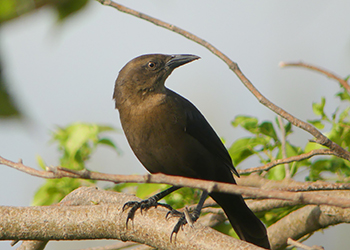
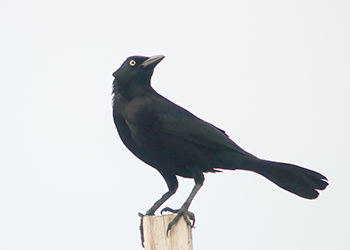
The males are glossy blue-black in color, and the females are a much duller brown. Both have light eyes, with the male having a very striking white eye. It is important not to confuse these birds with other black birds found on the island, such as the Groove-billed Anis or the invasive Shiny Cowbird. (see also this post: Black Birds on the ABC Islands – Save & share! – Caribbean Footprint)
Courtship
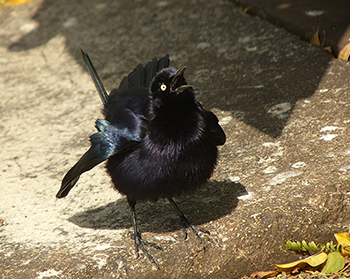
During the breeding season, which varies by location but can essentially be year-round, the males will do everything they can to ensure that the coveted female is choses them. Several males sometimes literally fight for her attention. The seduction of the females includes a very elaborate dance in which the male puffs up his feathers, lowers himself onto his legs several times, and moves up and down, while simultaneously performing a particularly melodious song. This ritual of puffing up feathers, moving, and singing is repeated several times to show the female what he has to offer. Since the birds live in groups, several males sometimes stand in front of a female, hopping and singing, all doing their utmost to win her over. However, it is still the female who ultimately decides who is most worthy of her attention.
Publications used:
- Voous, K.H. Prof. Dr. Birds of the Netherlands Antilles. 1983. De Walburg pers.
- Boer, B. de, Newton, E. & Restall, R. 2012. Birds of Aruba, Curaçao and Bonaire. Ardea Christopher Helm, London.
- Pors-da Costa Gomez, M., Pors, L. 2021. Vogels van Curaçao. Book.
- Prins, T.G., Reuter, J.H., Debrot, A.O., Wattel, J. & Nijman, V. 2009. Checklist of the birds of Aruba, Curaçao and Bonaire, South Caribbean. Ardea 97: 137-268.
- Wells, J.V. & Wells, A.C. 2017. Birds of Aruba, Bonaire, and Curaçao: a site and field guide. 474pp. Cornell University Press.
- www.ebird.org

Een dansje voor mevrouw Caribische troepiaal
Carib Grackles of Caribische troepialen (Quiscalus lugubris) zijn een relatief nieuwe vogelsoort op de eilanden Aruba, Curaçao en Bonaire. Op Curaçao is de soort voor het eerst geregistreerd in 1975 in de saliña van St. Michiel (eBird.org) maar is daarna geen waarneming officieel geregistreerd voor het eiland aangezien deze niet is opgenomen in het extensieve vogelboek van Professor Dr. Voous uit 1983. Hierna zijn is de vogelssoort voor heet eerst weer officieel opgetekend in de jaren 2002 en 2003 in de hoge palmbomen en mangrovebomen langs de weg naast het toenmalige Holiday Beach en wat toen de Emancipatie Boulevard heette. Op Aruba is de eerste melding van de vogels terug te vinden in 1975 te Spaans Lagoen door dezelfde waarnemer als die de vogel ook op Curaçao had gezien. Het is niet duidelijk of dat een eenmalige waarneming was of dat de vogels zich toen al hadden gevestigd op het eiland. Wel is te lezen in het boek van Voous dat de soort is geïntroduceerd op Aruba, en dat impliceert dat er meerdere individuen te vinden waren. Op Bonaire werd de soort voor het eerst in 1992 gespot in Washington Slagbaai Park maar volgens Voous was de soort een niet frequent voorkomende gast uit Zuid Amerika op het eiland.
Locaties
Wie de ABC-eilanden nu bezoekt zal zien dat de zwarte vogels nu praktisch overal op, door de mens beinvloede, omgevingen te spotten zijn. Plekken waar er voedsel in overvloed is, zoals de parkeerplaatsen van fastfoodrestaurants (op Curaçao in Saliña, op Aruba in het centrum van Oranjestad en in Kralendijk in Bonaire), bij hotels, benzinestations en stranden. Alle locaties waar mooie grote palmen staan of mangrovebomen vormen een prima nestgebied, en waar voedsel in overdaad is dankzij de kliko’s is het alleen maar beter.
Uiterlijk
De mannetjes zijn glanzend blauwzwart van kleur en de vrouwtjes veel saaier bruin. Beide hebben lichte ogen, waarbij de man een zeer opvallend wit oog heeft. Het is belangrijk deze vogels niet te verwarren met andere zwarte vogels die op het eiland voorkomen zoals de Groefsnavel ani’s of de invasieve Glanskoevogel of Shiny cowbird. (zie ook deze post: Black Birds on the ABC Islands – Save & share! – Caribbean Footprint)
Baltsen
In de broedtijd, dat varieert per locatie maar kan in weze het hele jaar door, zullen de mannetjes er alles aan doen om ervoor te zorgen dat de keuze van het felbegeerde vrouwtje op hun valt. Verschillende mannen vechten dan soms letterlijk voor haar attentie. Het verleiden van de wijfjes is dan inclusief een zeer uitgebreide dans waarbij de man zijn veren opblaast, zich meerdere keren door de pootjes laat zakken en op en neer beweegt. Ondertussen een bijzonder melodieus lied ten gehore brengend. Dit ritueel van veren opblazen, bewegen en zingen wordt meerdere keren herhaald om het vrouwtje te tonen wat hij in huis heeft. Aangezien de vogels in groepen leven, staan er soms meerdere mannen voor een vrouwtje te hupsen en te zingen. Allemaal hun uiterste best doend om haar te veroveren. Het is echter nog altijd het wijfje dat uiteindelijk besluit wie haar attenties het meest waard is.
Gebruikte publicaties
- Voous, K.H. Prof. Dr. Birds of the Netherlands Antilles. 1983. De Walburg pers.
- Boer, B. de, Newton, E. & Restall, R. 2012. Birds of Aruba, Curaçao and Bonaire. Ardea Christopher Helm, London.
- Pors-da Costa Gomez, M., Pors, L. 2021. Vogels van Curaçao. Book.
- Prins, T.G., Reuter, J.H., Debrot, A.O., Wattel, J. & Nijman, V. 2009. Checklist of the birds of Aruba, Curaçao and Bonaire, South Caribbean. Ardea 97: 137-268.
- Wells, J.V. & Wells, A.C. 2017. Birds of Aruba, Bonaire, and Curaçao: a site and field guide. 474pp. Cornell University Press.
- www.ebird.org