This post is also available in: Dutch (below)
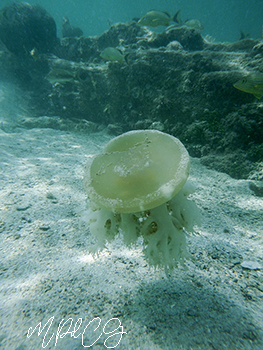
Anyone who has ever walked along the Jan Kok salt pans or other inland waters on the island of Curaçao, other than the Schottegat, has surely seen the Upside-down jellyfish. These jellyfish lie literally upside down, with their tentacles pointing upwards, in shallow water. And there is a good reason for this. The jellyfish have a symbiotic relationship with a type of single-celled algae that grows inside the jellyfish’s tentacles. These algae need sunlight to live and grow and form part of the food that this jellyfish species consumes. There are two different species of upside-down jellyfish to be found in the Caribbean: the Common Upside-down jellyfish (Cassiopea frondosa) and the Mangrove upside-down jellyfish (Cassiopea xamachana). They both look slightly different, although even here it is difficult for the untrained eye to tell them apart. The Common Upside-down jelly is often found in sandy inland waters, while the Mangrove Upside-down jelly, as the name suggests, is often found in inland bays with mangroves where there is a muddy bottom.
English name: Upside-down jellyfish
Papiamentu name: –
Scientific name: genus Cassiopea
Family: Cassiopeidae (upside-down jellyfish)
Occurrence (ABC islands): Aruba, Bonaire and Curaçao
Publications used:
- Humann, Paul. 1993. Reef creature identification – Florida- Caribbean- Bahamas.
- World Register of Marine Species
- Wikipedia
- Dutch Caribbean Species Register
- https://invasions.si.edu/nemesis/species_summary/51760

Mangrovekwal / Upside-down jellyfish
Wie wel eens wandelt langs de zoutpannen van Jan Kok of langs andere binnenwateren op het eiland Curaçao, behalve het Schottegat, heeft vast de Upside-down jellyfish wel eens gezien. Deze kwallen liggen letterlijk ondersteboven, met de tentakels omhoog, in ondiep water. En daar is een goede reden voor. De kwallen hebben namelijk een symbiotische relatie met een soort eencellige alg die in de tentakels van de kwallen groeien. Deze algen hebben zonlicht nodig om te kunnen leven en groeien en vormen een deel van het voedsel die deze kwallensoort tot zich neemt. Er zijn twee verschillende soorten upside-down jellyfish te vinden in het Caribisch gebied, de gewone Upside-down jelly of (Cassiopea frondosa) en de Mangrove upside-down jelly (Cassiopea xamachana). Ze zien er beiden iets verschillend uit, alhoewel het ook hier voor het ongeoefende oog moeilijk is ze uit elkaar te houden. De gewone Upside-down jelly is vaak te vinden in zanderige binnenwateren terwijl de Mangrove Upside-down jelly, zoals de naam als zegt vaak te vinden is in binnenbaaien met mangroven waar een modderige bodem is.
Nederlandse naam: Mangrovekwal/ Cassiopeia/ Schijfkwallen
Papiamentse naam: –
Wetenschappelijke naam: genus Cassiopea
Familie: Cassiopeidae
Voorkomen (ABC eilanden): Aruba, Bonaire en Curaçao
Gebruikte publicaties:
- Humann, Paul. 1993. Reef creature identification – Florida- Caribbean- Bahamas.
- World Register of Marine Species
- Wikipedia
- Dutch Caribbean Species Register
- https://invasions.si.edu/nemesis/species_summary/51760