This post is also available in: Dutch (below)
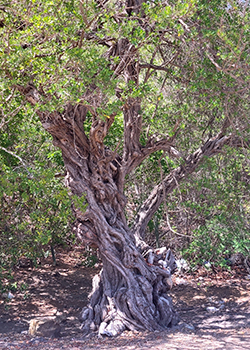
The Buttonwood is a tree species that has become part of the landscaping in various neighbourhoods on all three islands of Aruba, Bonaire and Curacao, as well as in the city centres and along the coast on beaches and in walking areas. The famous Fofoti trees of Aruba, are also Buttonwoods. Anyone on Curaçao walking along Koredor or through the streets of Punda will have regularly walked past these trees and even stood beneath them without realizing it. The same applies for various trees that can be found in Kralendijk.
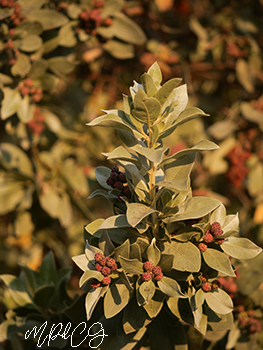
It is not surprising that this tree species is widely used in landscaping on our islands, and incidentally on other islands in the Caribbean as well, because it is considered an evergreen species that requires little water to survive, is salt-loving (allowing it to grow easily along the coast and in saline calcareous soils), and also possesses an irregular growth form that adds character to garden landscaping. Two variants of this tree species are used on Aruba, Bonaire and Curaçao: the ‘ordinary’ green Conocarpus erectus with fleshy, smooth leaves, and the silver-grey variant with soft, hairy leaves, which bears the name Conocarpus erectus var. Sericeus. It is not surprising that the Buttonwood tolerates saline soils and salty water so well, as it is also considered the species that is an integral part of the mangrove ecosystem in tropical regions such as the ABC-islands, and especially in a well-developed mangrove system.
Mangrove species sequence
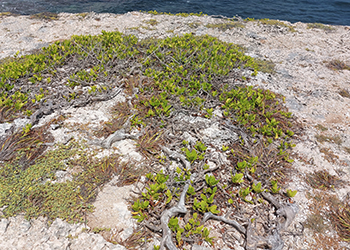
If you approach a coastal mangrove forest from the sea, the first mangrove species you will encounter is the Red mangrove, Mangel tan in Papiamentu on Curaçao or Mangel tam om Aruba and Bonaire (Rhizophora mangle). This species is easily recognizable by the long stilt roots on which it stands with its ‘feet’ in the water. Behind this mangrove species, you will find the Black mangrove or Mangel blanku in Papiamentu on Bonaire and Curaçao/ Mangel preto on Aruba (*White mangrove* in Dutch*) (Aviccenia germinans), which is recognizable by the ‘snorkel’ roots or taproots sticking out of the ground. The third mangrove species is the White mangrove, also known as Mangel blanku in Papiamentu on Bonaire and Curaçao and as Mangel on Aruba (Laguncularia racemosa), a tree that lacks characteristic root adaptations since this species occurs in the dry part of the mangrove forest. This species is the last member of the mangrove forest positioned inland, together with the Buttonwood. The Buttonwood is also often called the Mangel blanku and is known as Fofoti on Aruba, but is actually a completely different species.
Flowers
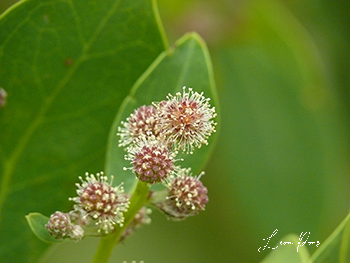
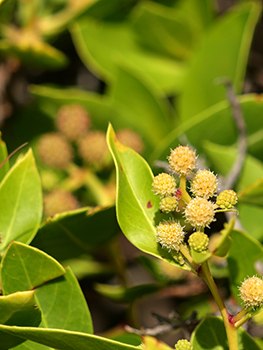
The flowers of the Buttonwood are very characteristic. The small flowers are greenish-white in colour and sit together on a round flower head that is approximately one centimetre in diameter. After fertilization, this sphere subsequently develops into a small fruit that is somewhat reminiscent of a small, round pine cone. The flowers are frequently visited by all kinds of bees and wasps, as well as various butterflies. In addition, various bird species feast on the calorie-rich nectar and protein-rich pollen. The chain of mangrove trees, of which the Buttonwood is also a part, is very important in the natural protection of the coastal strip, a second layer of protection after the coral reef. In addition, mangroves serve as a kind of filter for water coming from the hinterland. When it rains, this water, along with all polluting elements such as mud (sediments) and nutrients, flows into the sea via channels that end in inland waters. If a healthy mangrove forest stands there, the trees filter out the sediments and other pollution with their roots, so that the rainwater enters the sea as clean as possible. And the coral reefs appreciate that.
English name: Buttonwood
Papiamentu/Papiamento name: Fofoti (Aruba), Mangel blanku (Bonaire, Curaçao)
Scientific name: Conocarpus erectus
Family: Combretaceae
Occurrence (ABC islands): native on Aruba, Bonaire and Curaçao
Publications used:
- Proosdij, A.S.J. van 2012. Arnoldo’s Zakflora: Wat in het wild groeit en bloeit op Aruba, Bonaire en Curaçao. 318 pp. Walburg Pers, Zutphen.
- Freitas J.A. de 1996. De Inheemse bomen van de Benedenwindse eilanden (Cura,cao, Bonaire en Aruba). Uitgave Carmabi.
- Dutch Caribbean Species Register
- The Online Flora of Curaçao
- Plants of the World Online
- Useful Tropical Plants
- Wikipedia

Buttonwood (Conocarpus erectus)
De Buttonwood is een boomsoort dat deel is geworden van de landscaping in verschillende wijken op de ABC-eilanden en ook in de binnenstad en langs de kust op stranden en wandelgebieden. De beroemde Fofoti bomen van Aruba zijn ook Buttonwoods. Wie op Curaçao langs Koredor wandelt, of door de straten van Punda zal geregeld langs deze bomen zijn gewandeld en er zelfs onder hebben gestaan zonder het te beseffen. Hetzelfde geldt voor veel bomen in de binnenstad van onder andere Kralendijk op Bonaire. Het is niet vreemd dat deze boomsoort veel wordt gebruikt in de landscaping op onze eilanden, en trouwens ook op andere eilanden in het Caribisch gebied, want het is een soort die wordt beschouwd als een groenblijver die weinig water nodig heeft om te overleven, daarnaast ook zoutminnend is waardoor het makkelijk groeit langs de kust en in zouthoudende kalkbodems en ook nog eens een grillige groeivorm heeft die karakter geeft in de landscaping van een tuin. Er worden op Aruba, Bonaire en Curaçao 2 varianten gebruikt van deze boomsoort, de ‘gewone’ groene Conocarpus erectus met vlezige gladde bladeren en de zilvergrijze variant met de zachte behaarde bladeren dat de naam Conocarpus erectus var. Sericeus draagt.
Het is niet vreemd dat de Buttonwood zo goed tegen zoute bodems en zoutig water kan, want het wordt ook beschouwd als de soort die onlosmakelijk deel uitmaakt van het mangrove-ecosysteem in tropische gebieden zoals Curaçao en vooral in een goed ontwikkeld mangrove systeem.
Mangrove sequentie
Benader je een mangrovebos aan de kust vanuit zee dan is de eerste mangrovesoort die je zult tegenkomen de Rode mangrove, Mangel tan op Curaçao en Mangel tam op Aruba en Bonaire (Rhizophora mangle). Deze soort is heel herkenbaar aan de lange steltwortels waarop hij met zijn ‘voetjes’ in het water staat. Achter deze mangrovesoort vindt je vervolgens de Black mangrove of Mangel blanku op Bonaire en Curaçao en Mangel preto op Aruba (Witte mangrove in het Nederlands) (Aviccenia germinans), die herkenbaar is aan de ‘snorkel’ worteltjes of penwortels die uit de grond steken. De derde mangrove soort is de White mangrove, ook Mangel blanku op Curaçao en Bonaire en Mangel op Aruba (Laguncularia racemosa), een boom die geen karakteristieke aanpassingen aan de wortels heeft aangezien deze soort voorkomt op het droge deel van het mangrovebos. Deze soort is de hekkensluiter van het mangrovebos tezamen met de Buttonwood. De Buttonwood wordt ook vaak de Mangel blanku genoemd, maar is dus een volstrekt andere soort. Op Aruba heet het Fofoti.
Bloemen
De bloemen van de Buttonwood zijn zeer karakteristiek. De kleine bloemen zijn groenig wit van kleur en zitten samen op een rond bloemenhoofdje dat ongeveer een centimeter is diameter is. Deze bol ontwikkelt zich vervolgens na de bevruchting tot een vruchtje dat een klein beetje doet denken aan een klein rond dennenappeltje. De bloemen worden druk bezocht door allerlei soorten bijen en wespen en ook door verschillende vlinders. Daarnaast doen verschillende vogelsoorten zicht tegoed aan het calorie-rijke nectar en de eiwitrijke stuifmeel.
De keten van mangrovebomen waar ook de Buttonwood deel van uitmaakt, is zeer belangrijk in de natuurlijke bescherming van de kuststrook, een tweede bescherming na het koraalrif. Daarnaast dienen mangroven als een soort filter voor water dat van het achterland komt. Regent het, dan stroom dit water met alle vervuilende elementen als modder (sedimenten) en nutriënten naar de zee via rooien die eindigen in binnenwateren. Als daar een gezond mangrovebos staat filteren de bomen met hun wortels de sedimenten en overige vervuiling eruit, zodat het regenwater zo schoon mogelijk in zee terecht komt. En dat vinden de koraalriffen weer prettig.
Nederlandse naam: –
Papiamentse naam: Fofoti (Aruba), Mangel blanku (Bonaire, Curaçao)
Wetenschappelijke naam: Conocarpus erectus
Familie: Combretaceae
Voorkomen (ABC eilanden): Aruba, Bonaire en Curaçao (inheems)
Gebruikte publicaties:
- Proosdij, A.S.J. van 2012. Arnoldo’s Zakflora: Wat in het wild groeit en bloeit op Aruba, Bonaire en Curaçao. 318 pp. Walburg Pers, Zutphen.
- Freitas J.A. de 1996. De Inheemse bomen van de Benedenwindse eilanden (Cura,cao, Bonaire en Aruba). Uitgave Carmabi.
- Dutch Caribbean Species Register
- The Online Flora of Curaçao
- Plants of the World Online
- Useful Tropical Plants
- Wikipedia