This post is also available in: Dutch (below)
Various species of sphinx moths can be found on Aruba, Bonaire, and Curaçao. The most well-known species is the large Giant Gray Sphinx, whose caterpillars cause great panic every year because they strip Frangipani trees in gardens bare, much to the annoyance of tree owners (READ MORE ABOUT THIS SPECIES HERE: What is this caterpillar…? – Caribbean Footprint ). The characteristics of the sphinx or hawk moth family are striking. Despite the family name in Dutch, which calls these animals butterflies, the animals are classified as moths. However, this does not mean that all species in this family are active in the evening hours; there are plenty of species that can also be found during the day. An example of a diurnal hawk moth species is the so-called Hummingbird moth or Clavipes sphinx, which can also be found on Bonaire and Curaçao during certain periods (no sightings are known on Aruba yet). Sphinx moths generally have a fairly thick body that tapers to a point and relatively narrow wings. The caterpillars are often very brightly coloured and possess the characteristic body feature from which the family’s name is derived: a hardened spine on the posterior segment of the body that points upwards and resembles an arrow.
Description of the Fig sphinx moth
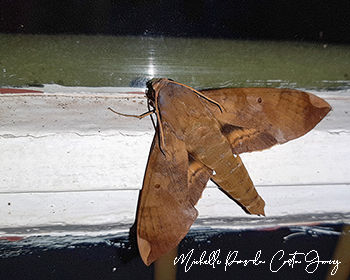
The Fig sphinx (Pachylia ficus) is usually not very numerous on the islands and is typically found during the rainy season when the adult animals are attracted to artificial light in the evening hours. At that time, it is also easy to see how large the animals can grow. An average Fig sphinx can reach 13.6 centimeters from wingtip to wingtip. They are coffee-brown in color with two striking lighter spots on the upper wings that are also clearly visible when the animal is sitting on the wall with its wings closed. Should the moth have its wings slightly open, a flame-like pattern can be seen on the underwings, but usually, you will not be able to see this.
Also spotted on Curaçao 120 years ago
The species was first recorded off Curaçao approximately 120 years ago and can still be found there today. The name itself indicates the host plant for this moth species: fig trees. In practice, it appears that the caterpillars survive perfectly well on the introduced and popular garden tree, the Ficus benjamin. However, in the wild, we also have a native tree belonging to the Ficus family that serves perfectly well as a natural host plant: the Ficus brittonii, also known as the Mahok di mondi on Bonaire and Curaçao or as Mahawa on Aruba. A fairly rare tree in the island’s mondi. The adult moths feed on nectar from various evening-blooming plants and are known for their preference for the nectar of various orchids.
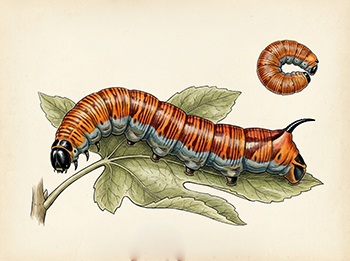
Based on reports on iNaturalist, the species has been observed on all three islands: Aruba, Bonaire, and Curaçao. However, online information regarding this is inconsistent, and official biodiversity databases have not yet been updated, with the species only recorded for Curaçao. Additionally, the species occurs in large parts of South and Central America, extending through North America. The photo shows an adult animal with a small part of the underside of the wing visible, and next to it is a drawing of the caterpillars of this species.
English name: Fig Sphinx moth
Papiamentu name: Barbulètè gabilán sigá
Scientific name: Pachylia ficus
Family: Sphingidae (hawk moths)
Occurrence (ABC islands): Aruba, Curaçao, Bonaire
Publications used:
- Debrot, A.O. & Miller, J.Y. 2004. Butterflies and moths of Curaçao, Aruba and Bonaire. 1-100. CARMABI Foundation, Willemstad.
- Groenen, F. 2025. The moths of Bonaire, with a preliminary checklist for the Dutch ABC islands (Lepidoptera). Nederlandse Faunistische Mededelingen 64: 301-332.
- Arnoldo Broeders, M. Fr. 1967. Handleiding tot het gebruik van inheemse en ingevoerde planten op Aruba, Bonaire en Curaçao. Uitgave Boekhandel ,,St.-Augustinus” – Curaçao.
- Proosdij, A.S.J. van 2012. Arnoldo’s Zakflora: Wat in het wild groeit en bloeit op Aruba, Bonaire en Curaçao. 318 pp. Walburg Pers, Zutphen.
- iNaturalist
- Dutch Caribbean Species Register
- Fig sphinx Pachylia ficus (Linnaeus, 1758) | Butterflies and Moths of North America
- Species Pachylia ficus – Fig Sphinx – Hodges#7841 – BugGuide.Net
- Wikipedia

Mottensoort: Fig Sphinx (Pachylia ficus)
Op Aruba, Bonaire en Curaçao zijn verschillende soorten pijlstaartvlinders te vinden. De meest bekende soort is de grote Giant Gray Sphinx waarvan de rupsen elk jaar voor grote paniek zorgen, omdat ze de Frangipani bomen in tuinen kaalvreten, tot grote ergernis van de boomeigenaren (LEES HIER MEER OVER DEZE SOORT: What is this caterpillar…? – Caribbean Footprint). De eigenschappen van de familie van de sphinxen of pijlstaartvlinders zijn opvallend. De dieren worden ondanks de naam van de familie gerekend tot de motten. Dat wil overigens niet zeggen dat alle soorten in deze familie in de avonduren actief zijn; er zijn genoeg soorten die ook overdag te vinden zijn. Een voorbeeld van een overdag vliegende pijlstaartvlindersoort is de zogenaamde Kolibrievlinder of Clavipes sphinx, die in bepaalde perioden ook te vinden is op Bonaire en Curaçao (er zijn nog geen waarnemingen bekend op Aruba). Pijlstaartmotten hebben doorgaans een vrij dik lijf dat puntig toeloopt en relatief smalle vleugels. De rupsen zijn vaak heel fel gekleurd en hebben de karakteristieke lichaamseigenschap waar de naam van de familie van afgeleid is: een verharde stekel op het achterste segment van het lichaam die omhoog steekt en lijkt op een pijl.
Omschrijving
De Fig sphinx is meestal niet heel talrijk op de eilanden, en wordt meestal in het regenseizoen gevonden als de volwassen dieren op kunstlicht afkomen in de avonduren. Dan is ook goed te zien hoe groot de dieren kunnen worden. Een gemiddelde Fig sphinx kan 13,6 centimeter worden van vleugeltip tot vleugeltip. Ze zijn koffiebruin van kleur met twee opvallende lichtere vlekken op de bovenvleugels die ook goed te zien zijn als het dier met gesloten vleugels op de muur zit. Mocht de mot de vleugels iets open hebben, dan is er een vlammend patroon te zien op de ondervleugels, maar meestal zul je dit niet kunnen zien.
Ook 120 jaar geleden gesport op Curaçao
De soort is ongeveer 120 jaar geleden voor het eerst opgetekend voor Curaçao en is ook nu nog terug te vinden. De naam geeft al aan wat de waardplant is voor deze mottensoort: ficusbomen. Uit de praktijk blijkt dat de rupsen prima overleven op de geïntroduceerde en populaire tuinboom, de Ficus benjamin. Echter, in het wild hebben we ook een inheemse boom die tot de familie van de Ficus behoort en prima kan dienen als natuurlijke waardplant: de Ficus brittonii ook wel de Mahok di mondi genoemd op Bonaire en Curaçao en Mahawa op Aruba. Een vrij zeldzame boom in de mondi van het eiland. De volwassen dieren eten nectar van verschillende in de avond bloeiende planten en staan bekend om hun voorliefde voor de nectar van verschillende orchideeën.
De soort is gezien de meldingen op iNaturalist op alle drie de eilanden waargenomen, zowel op Aruba, Bonaire als Curaçao dus. De informatie hierover online strookt echter niet met elkaar en op officiele biodiversiteits databases is dit nog niet bijgewerkt en staat de soort alleen opgetekend voor Curaçao. Daarnaast komt de soort ook voor in grote delen van Zuid- en Midden-Amerika tot en met Noord-Amerika. Op de foto is een volwassen dier te zien waarvan een klein deel van de ondervleugel te zien is, en daarnaast is er een tekening van de rupsen van deze soort.
Nederlandse naam: –
Papiamentse naam: Barbulètè gabilán sigá
Wetenschappelijke naam: Pachylia ficus
Familie: Sphingidae (pijlstaarten)
Voorkomen (ABC eilanden): Aruba, Curaçao, Bonaire
Gebruikte publicaties:
- Debrot, A.O. & Miller, J.Y. 2004. Butterflies and moths of Curaçao, Aruba and Bonaire. 1-100. CARMABI Foundation, Willemstad.
- Groenen, F. 2025. The moths of Bonaire, with a preliminary checklist for the Dutch ABC islands (Lepidoptera). Nederlandse Faunistische Mededelingen 64: 301-332.
- Arnoldo Broeders, M. Fr. 1967. Handleiding tot het gebruik van inheemse en ingevoerde planten op Aruba, Bonaire en Curaçao. Uitgave Boekhandel ,,St.-Augustinus” – Curaçao.
- Proosdij, A.S.J. van 2012. Arnoldo’s Zakflora: Wat in het wild groeit en bloeit op Aruba, Bonaire en Curaçao. 318 pp. Walburg Pers, Zutphen.
- iNaturalist
- Dutch Caribbean Species Register
- Fig sphinx Pachylia ficus (Linnaeus, 1758) | Butterflies and Moths of North America
- Species Pachylia ficus – Fig Sphinx – Hodges#7841 – BugGuide.Net
- Wikipedia