This post is also available in: Dutch (below)
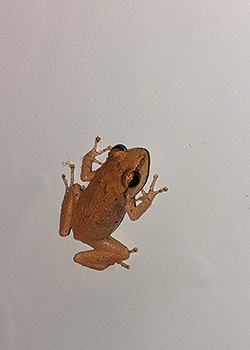
Some people absolutely hate them, while others love them. Whistling frogs leave no one entirely unmoved. I myself count myself among the enthusiasts of these amphibians, who, when it is humid, cheerfully whistle all night long. I also miss them when they are completely silent during the dry season. The Coqui whistling frog or Johnstone’s whistling frog (Eleutherodactylus johnstonei) is a non-native amphibian that was introduced to our islands relatively recently. Naturally, the frog species occurs on the Lesser Antilles arc, but it was transported along by humans and introduced to countries such as Venezuela. From there, the animals were introduced to Curaçao, Aruba, and Bonaire.
The little frogs, that are barely about 3 centimetres long, are mainly found in gardens and are actually almost never seen or heard outside urban areas. This is, of course, due to the delightfully humid conditions we create in gardens by constantly watering garden plants—for example, through drip systems—and the use of exotic plants in which the animals feel quite at home. The whistlers in the species are the males. Like true ventriloquists, they produce the sound using a kind of sound sac that they fill with air and then expel again with a ‘whistling’.
So those you hear whistling are actually the males. The sound they produce can be difficult to find, but it is designed to impress the females. The females are virtually silent.
Whistling frogs do not need stagnant water for reproduction. The eggs hatch into tiny mini-frogs that are already so developed that they do not need a tadpole stage. And that is, of course, very convenient in a climate where stagnant water is absolutely not a given.
READ MORE about this species in the book “Zoogdieren, reptielen & amfibieën van Aruba. Curaçao & Bonaire”, (in Dutch), available at www.veldshop.nl in the Netherlands or on Curaçao at Bruna Curaçao, Landhuis Bloemhof and Mensing’s Caminada and on Bonaire at Bruna Bonaire.
English name: Johnstone’s whistling frog/ Antilles whistling frog
Papiamentu name: Coqui/ Kokí
Scientific name: Eleutherodactylus johnstonei
Family: Eleutherodactylidae (direct-developing frogs)
Occurrence (ABC islands): Aruba, Bonaire, Curaçao (introduced on all three)
Publications used:
- Buurt, G. van & Debrot, A.O. 2012. Exotic and invasive terrestrial and freshwater animal species in the Dutch Caribbean. 1-37. IMARES, Wageningen.
- Pors-da Costa Gomez, M., Pors, L. 2025. Zoogdieren, reptielen & amnfibieën van Aruba, Curaçao & Bonaire. Book.
- Buurt, G. van 2001. De amfibieën en reptielen van Aruba, Curaçao en Bonaire. 119 pp. Gerard van Buurt, Curaçao.
- Buurt, G. van 2023. Amphibians of Aruba, Curaçao, and Bonaire. In: The Conservation and Biogeography of Amphibians in the Caribbean. 524-537
- Buurt, G. van, Invasive Alien Species in Aruba, Curaçao and Bonaire; Introduction pathways, population establishment and environmental impacts. November 24, 2024. (Invasive Alien Species in Aruba, Curaçao and Bonaire: Introduction pathways, population establishment and environmental impacts – Caribbean Footprint)
- Dutch Caribbean Species Register
- Wikipedia

De Fluitkikker (Eleutherodactylus johnstonei)
Sommige mensen hebben er een bloedhekel aan en anderen zijn er dol op. De Fluitkikkers laten niemand geheel onberoerd. Zelf hoor ik bij de liefhebbers van deze amfibieën, die als het vochtig is, vrolijk de hele nacht aan het fluiten zijn. Ik mis ze ook als ze zich in de droge tijd in het geheel niet laten horen. De Coqui – fluitkikker is een niet-inheemse amfibie die relatief kort geleden op ons eiland is binnengebracht. Van nature komt de kikkersoort voor op de kleine Antillenboog, maar is met transport van mensen meegezeuld en geïntroduceerd in landen als Venezuela. Van daar uit zijn de dieren weer geïntroduceerd op Curaçao, Aruba en Bonaire.
De kikkertjes, die amper een centimeter of 3 lang zijn, zitten voornamelijk in tuinen en zijn eigenlijk bijna nooit buiten de bebouwde kom te zien of horen. Dat komt natuurlijk door de heerlijke vochtige omstandigheden die we creëren in tuinen door telkens water te geven aan de tuinplanten, door bijvoorbeeld dripsystemen, en het gebruik van exotische planten waar de dieren zich aardig in thuis voelen.
De fluiters in de soort zijn de mannen. Als ware buiksprekers produceren ze het geluid met een soort geluidszak die ze vullen met lucht en dan weer ‘fluitend’ eruit persen.
Degenen die je hoort fluiten zijn eigenlijk de mannetjes. Het geluid dat ze produceren kan moeilijk te vinden zijn, maar is ontwikkeld om de vrouwtjes te imponeren. De vrouwen zijn nagenoeg stil.
Fluitkikkers hebben geen stilstaand water nodig voor hun voortplanting. Uit de eieren komen kleine minikikkertjes die al meteen zodanig ontwikkeld zijn dat ze geen kikkervisjes stadium nodig hebben. En dat is natuurlijk heel makkelijk in een klimaat waar stilstaand water absoluut geen gegeven is.
LEES MEER over deze soort in het boek “Zoogdieren, reptielen & amfibieën van Aruba. Curaçao & Bonaire”, verkrijgbaar op www.veldshop.nl in Nederland of op Curaçao bij Bruna Curaçao, Landhuis Bloemhof en Mensing’s Caminada en op Bonaire bij Bruna Bonaire.
Nederlandse naam: Fluitkikker
Papiamentse naam: Coqui, Kokí
Wetenschappelijke naam: Eleutherodactylus johnstone
Familie: Eleutherodactylidae
Voorkomen (ABC eilanden): Aruba, Bonaire en Curaçao (geïntroduceerd)
Gebruikte publicaties:
- Buurt, G. van & Debrot, A.O. 2012. Exotic and invasive terrestrial and freshwater animal species in the Dutch Caribbean. 1-37. IMARES, Wageningen.
- Pors-da Costa Gomez, M., Pors, L. 2025. Zoogdieren, reptielen & amnfibieën van Aruba, Curaçao & Bonaire. Book.
- Buurt, G. van 2001. De amfibieën en reptielen van Aruba, Curaçao en Bonaire. 119 pp. Gerard van Buurt, Curaçao.
- Buurt, G. van 2023. Amphibians of Aruba, Curaçao, and Bonaire. In: The Conservation and Biogeography of Amphibians in the Caribbean. 524-537
- Buurt, G. van, Invasive Alien Species in Aruba, Curaçao and Bonaire; Introduction pathways, population establishment and environmental impacts. November 24, 2024. (Invasive Alien Species in Aruba, Curaçao and Bonaire: Introduction pathways, population establishment and environmental impacts – Caribbean Footprint)
- Dutch Caribbean Species Register
- Wikipedia