This post is also available in: Dutch (below)
When a bird is producing the next generation, several factors play a role in achieving a successful cycle, resulting in healthy adult chicks. In addition to choosing a good partner—important for a healthy genetic line—and, in species that handle raising the young jointly, good brooding behavior when caring for the young, the home in which the eggs are to be laid is of great importance. First of all, you must find a good location for that nest—a location that is relatively safe and where you can securely attach a nest. The Yellow oriole (Icterus nigrogularis curasoensis) is one that chooses the most bizarre spots, just above a highway, or at the very tip of a high, hanging branch. That seems like an unfortunate location, but the birds usually choose their branch very carefully. Not only must the twig be thin, but also sturdy and flexible. So that it bends with the wind but does not break, and thin enough that predators like rats cannot reach it without suddenly falling out of the tree. Sometimes the bird chooses a spot with several of those thin twigs, which are then painstakingly woven together with a long strand of sturdy grass.
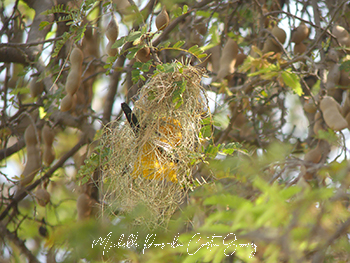
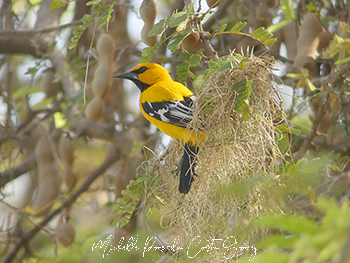
Anyone who takes the time to closely observe the entire construction process cannot help but be amazed time and again. For it is truly incredible what such a small bird accomplishes with a few strands of grass, two little legs, a beak, and a belly. The legs to hold the strands and keep them in place, the beak to weave with, and the belly—not least importantly—to create the right fit in the hanging nest. In this round chamber, feathers and leaves are then laid out, forming a soft bed for the eggs and later the little chicks.
The nest is often so sturdy that, after use by the yellow oriole, it is recycled by other birds such as the Saffron finch or the more common (Venezuelan) Troupial. A work of art on repeat.
English name: Yellow oriole
Papiamentu/Papiamento name: Trupial kachó (B, C), Gonsalito (A)
Scientific name: Icterus nigrogularis curasoensis (endemic subspecies)
Family: Icteridae (New World blackbirds)
Occurrence (ABC islands): native and endemic subspecies on Aruba, Bonaire and Curaçao
Publications used:
- Boer, B. de, Newton, E. & Restall, R. 2012. Birds of Aruba, Curaçao and Bonaire. Ardea Christopher Helm, London.
- Pors-da Costa Gomez, M., Pors, L. 2021. Vogels van Curaçao. Book.
- Prins, T.G., Reuter, J.H., Debrot, A.O., Wattel, J. & Nijman, V. 2009. Checklist of the birds of Aruba, Curaçao and Bonaire, South Caribbean. Ardea 97: 137-268.
- Wells, J.V. & Wells, A.C. 2017. Birds of Aruba, Bonaire, and Curaçao: a site and field guide. 474pp. Cornell University Press.
- Debrot, A.O. 2006. Preliminary checklist of extant and fossil endemic taxa of the ABC-Islands, Leeward Antilles. 29pp.
- Dutch Caribbean species register

Vogel gedrag: Een kunstwerk met 2 poten
Wanneer een vogel bezig is met het produceren van de volgende generatie zijn er verschillende factoren die een rol spelen om een succesvolle cyclus, met als gevolg volwassen gezonde jongen, te realiseren. Naast het kiezen van een goede partner, belangrijk voor een gezonde genetische lijn, en bij soorten die de opvoeding gezamenlijk aanpakken, ook een goed broedgedrag bij het verzorgen van de jongen, is het huis waarin de eieren moeten worden gelegd van groot belang. Als eerste moet je namelijk een goede locatie vinden voor dat nest, een locatie dat relatief veilig is en waar je een nest goed kan bevestigen. De Trupial kachó of Gele troepiaal (Yellow oriole) (Icterus nigrogularis curasoensis), is er een die de meest maffe plekken uitkiest, net boven een autoweg, of aan het uiterste puntje van een hangende hoge tak. Dat lijkt een niet zo gelukkige locatie, maar de vogels kiezen hun tak meestal heel zorgvuldig uit. Niet alleen moet de twijg dun zijn, maar ook stevig en flexibel. Zodat het mee buigt met de wind maar niet breekt, en dun genoeg dat rovers als ratten, er niet bij kunnen zonder pardoes uit de boom te vallen. Soms kiest de vogel een plek met verschillende van die dunne twijgen die dan met veel pijn en moeite aan elkaar worden geweven met een lange sliert stevig gras.
Wie de tijd neemt om het hele bouwproces goed te observeren kan niet anders dan van de ene in de andere verbazing te vallen. Want het is werkelijk ongelooflijk wat zo’n kleine vogel voor elkaar krijgt met wat slierten gras, 2 pootjes, een snavel en een buik. De pootjes om de slierten vast te houden en op hun plek te houden, de snavel om mee te weven en de buik, niet het minst belangrijk, om de goede pasvorm te creëren in het hangende nest. In deze ronde kamer worden dan veertjes en bladeren gelegd die een zacht bedje vormen voor de eieren en later de kleine kuikens.
Het nest is vaak zo stevig dat het na gebruik door de Gele troepiaal wordt gerecycled door andere vogels zoals de Saffraanvink of de gewone Oranje trupiaal. Een kunstwerk on repeat.
Nederlandse naam: Gele troepiaal
Papiamentse naam: Trupial kachó (B, C), Gonsalito (A)
Wetenschappelijke naam: Icterus nigrogularis curasoensis (endemische ondersoort)
Familie: Icteridae (troepialen)
Voorkomen (ABC eilanden): Aruba, Bonaire en Curaçao (inheems, en endemische ondersoort)
Gebruikte publicaties:
- Boer, B. de, Newton, E. & Restall, R. 2012. Birds of Aruba, Curaçao and Bonaire. Ardea Christopher Helm, London.
- Pors-da Costa Gomez, M., Pors, L. 2021. Vogels van Curaçao. Book.
- Prins, T.G., Reuter, J.H., Debrot, A.O., Wattel, J. & Nijman, V. 2009. Checklist of the birds of Aruba, Curaçao and Bonaire, South Caribbean. Ardea 97: 137-268.
- Wells, J.V. & Wells, A.C. 2017. Birds of Aruba, Bonaire, and Curaçao: a site and field guide. 474pp. Cornell University Press.
- Debrot, A.O. 2006. Preliminary checklist of extant and fossil endemic taxa of the ABC-Islands, Leeward Antilles. 29pp.
- Dutch Caribbean Species Register