This post is also available in: Dutch (below)
Insects are always in the picture on the islands. Whether it concerns ‘annoying’ insects near the lamp or an unexpected beauty suddenly sitting in the garden. Ladybugs usually belong to the latter category.
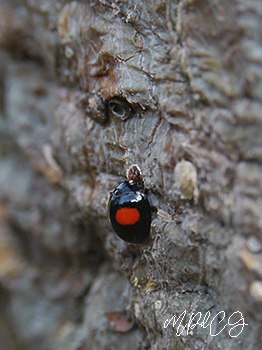
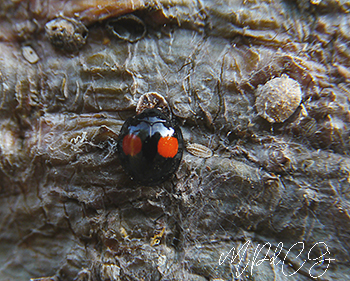
Aruba, Bonaire, and Curaçao are home to various species of lady bugs, or lady beetles although most people do not really recognize them. Somehow, the reaction to spotting a ladybird or ladybug always results in a mouth-open response and great amazement. There are solid green ladybugs, solid orange ones, but there are also those with spots. Like the Cactus lady beetle or Two-stabbed cactus lady beetle. Not a weird name, if you look closely at the photo. The black insects, about 4 millimetres long, have two striking round blood-red spots. There is one on each wing cover.
The lady beetle in the photo was photographed on a monumental Bonchi kabai tree (Erythrina velutina). Only after a closer look at the photos on the computer did it become clear to us that the animal in question was feeding on another type of insect known as a scale insect. These scale insects, with a soft body covered by a hard shell or shield designed to protect the creature from drying out and from predators, can constitute a significant nuisance. So much so that entire garden centres and even agricultural lands struggle with an infestation of these insects. And that is when these types of ladybugs are deployed to keep the infestations in check.
Cacti also have scale insects, and the most well-known is the cochineal insect. In the past, this insect was cultivated on Curaçao on Nopal cacti, a type of leaf cactus with very few spines. The insects were collected, dried, and ground up, and this substance was processed into the very famous carmine red dye that is still used today in various products, including food. Incidentally, there are also other scale insect species that live on cacti, and this entire group is therefore on the menu of the cactus ladybug. Alongside other scale insects found on the Bonchi kabai.
Predators
Lady beetles are, despite their charming name, predators. They are predators that have animal food on their menu and actively hunt. And that is the reason why various countries are deploying (native and non-native) ladybugs on a large scale to rid themselves of insect pests that can endanger the harvest of a variety of crops.
The Cactus lady beetle is found from North America to the northern part of South America, and as such, it is not surprising that the animal also occurs on our islands, although you will have to keep your eyes focussed to spot it. For the time being, the species has been recorded on Bonaire and Curaçao. Lady beetles have a life cycle consisting of an egg stage, a larval stage, a pupal stage in which they transform into the adult ladybug, and the adult stage. The animals themselves are rarely on the menu of predators such as birds or lizards, as the insects are said to have a very unpleasant taste.
Other species recorded on the islands: Tiny critters: Spotless Lady Beetle – Caribbean Footprint, Tiny critters: Six-spotted zigzag ladybird – Caribbean Footprint
English name: Cactus Lady beetle
Papiamentu name: –
Scientific name: Chilocorus cacti
Family: Coccinellidae (ladybugs)
Occurrence (ABC islands): Bonaire, Curaçao
Publications used:
- Species Chilocorus cacti – Cactus Lady Beetle – BugGuide.Net
- Colijn, E.O., Beentjes, K.K., Butôt, R., Miller, J.A., Smit, J.T., Winter, A.J. de, Hoorn, B. van der 2019. A catalogue of the Coleoptera of the Dutch Antilles. Tijdschrift voor Entomologie 162: 67-186.
- Vorst, O., Colijn, E.O. & Felix, R. 2025. An updated checklist of the beetles of Bonaire (Coeloptera). Nederlandse Faunistische Mededelingen 64: 215-257.
- Dutch Caribbean Species Register
- iNaturalist

Kleine beestjes: Cactus lieveheersbeestje (Chilicorus cacti)
Insecten zijn telkens in the picture op de eilanden. Of het nu gaat om ‘hinderlijke’ insecten bij de lamp of een onverwachte schoonheid die ineens in de tuin zit. Lieveheersbeestjes horen meestal bij de laatste categorie.
Aruba, Bonaire en Curaçao kennen verschillende soorten lieveheersbeestjes, alhoewel de meeste mensen ze niet echt (her)kennen. Op de een of andere manier is de reactie op het spotten van een ladybird of lieveheersbeestje altijd goed voor een reactie met een open mond en grote verbazing. Er zijn egaal groene lieveheersbeestjes, egaal oranje, maar er zijn er ook met stippen. Zoals de Cactus ladybird of Two-stabbed cactus ladybird. Geen gekke naam, als je de foto goed bekijkt. De zwarte, ongeveer 4 millimeter lange, insecten, hebben twee opvallende ronde bloedrode stippen. Op beide dekvleugels zit er één.
Het lieveheersbeestje op de foto is gefotografeerd op een monumentale Bonchi kabai boom (Erythrina velutina). Pas na nader bekijken van de foto’s op de computer werd ons duidelijk dat het diertje in kwestie aan het eten was, van een ander soort insect dat bekend staat als een schildluis. Deze schildluizen, een zacht lijf met daaroverheen een harde schaal of schild dat het beest moet beschermen tegen uitdroging en tegen predatoren, kunnen een behoorlijke plaag vormen. Zodanig zelfs dat hele tuinkwekerijen en zelfs landbouwgronden te kampen hebben met overlast van deze insecten. En dan worden er dit soort lieveheersbeestjes ingezet om de plagen in toom te houden.
Ook cactussen hebben schildluis en de meest bekende is wel de cochenilleluis. Deze luis werd in het verleden op Curaçao gekweekt op de Nopalcactussen, een soort bladcactus met heel weinig stekels. De luizen werden verzameld, gedroogd en vermalen en dit goedje werd verwerkt tot de zeer bekende karmijnrode kleurstof die ook nu nog wordt verwerkt in verschillende producten waaronder voedsel. Er zijn overigens ook andere schildluissoorten die ook op cactussen zitten, en deze hele groep staat dan ook op het menu van het cactus lieveheersbeestje. Naast andere schildluizen die op de Bonchi kabai zitten.
Rovers
Lieveheersbeestjes zijn, ondanks de lieftallige naam, rovers. Het zijn predatoren die dierlijk voedsel op hun menu hebben staan en ook actief jagen. En dat is de reden waarom verschillende landen op grote schaal (inheemse en uitheemse) lieveheersbeestjes inzetten om zich te ontdoen van insectenplagen die de oogst in gevaar kunnen brengen.
Het Cactuslieveheersbeestje komt voor van Noord Amerika tot het noordelijke deel van Zuid Amerika en als zodanig is het dus niet vreemd dat het dier ook op onze eilanden voorkomt, al zul je je ogen goed open moeten houden om het te zien. Vooralsnog is de soort geregistreerd op Bonaire en op Curaçao.
Lieveheersbeestjes hebben een levenscyclus dat bestaat uit een fase waarin ze in het ei zitten, een fase dat ze als larve door het leven gaan, een popfase waarin ze transformeren tot het lieveheersbeestje en de fase van volwassenheid. Zelf staan de dieren nauwelijks op het menu van predatoren als vogels of hagedissen aangezien de insecten heel vies schijnen te smaken.
Andere soorten die op de eilanden zijn geregistreerd: Tiny critters: Spotless Lady Beetle – Caribbean Footprint, Tiny critters: Six-spotted zigzag ladybird – Caribbean Footprint
Nederlandse naam: Cactus lieveheersbeestje
Papiamentse naam: –
Wetenschappelijke naam: Chilocorus cacti
Familie: Coccinellidae (lieveheersbeestjes)
Voorkomen (ABC eilanden): Bonaire en Curaçao
Gebruikte literatuur:
- Species Chilocorus cacti – Cactus Lady Beetle – BugGuide.Net
- Colijn, E.O., Beentjes, K.K., Butôt, R., Miller, J.A., Smit, J.T., Winter, A.J. de, Hoorn, B. van der 2019. A catalogue of the Coleoptera of the Dutch Antilles. Tijdschrift voor Entomologie 162: 67-186.
- Vorst, O., Colijn, E.O. & Felix, R. 2025. An updated checklist of the beetles of Bonaire (Coeloptera). Nederlandse Faunistische Mededelingen 64: 215-257.
- Dutch Caribbean Species Register
- iNaturalist