This post is also available in: Dutch (below)
The taxonomic family Bombyliidae, also known as the Bee flies, is a family of flies whose species are generally very hairy and have a woolly appearance. The family consists of various genera, including the genus Geron, which includes about 180 species worldwide. This genus is also known as the Needle nose flies in English.
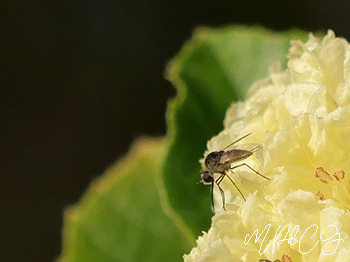
At first glance, these animals look very much like mosquitoes, but they can be found on a wide variety of flowers where they suck up nectar with their needle-like snout. They do not bite or suck blood. This is because, despite their appearance, these animals do not belong to the mosquito family at all, but rather to the fly family. They belong to the genus Geron, which in turn belongs to the family of the so-called bee flies (Bombyliidae).
These woolly-looking fly-like insects feed on nectar and pollen from various types of flowers. On Aruba, Bonaire, and Curaçao, you can find them on the flowers of the Beyisima (Coralita, Antigonon leptopus), the Basora pretu (Varronia curassavica), the Karawara di mondi (Cordia dentata), and various small flowers that grow wild in the mondi. They are very important pollinators in the island’s ecology because they ensure that various wild plants can reproduce.
It is unclear exactly which species of Geron is shown in the photo. The individual species present on the islands have not yet been identified.
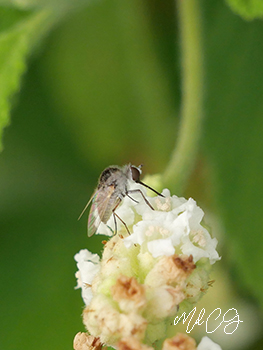
It is known that the larvae of bee flies (Bombyliidae) parasitize other insects. The females lay their eggs on other insects or in the nests of other insects, after which the larvae parasitize the adult animals or the larvae of the host. How exactly this works is hardly known because the family as a whole has been little studied. Therefore, on Aruba, Bonaire, and Curaçao, we do not know which species the larvae parasitize, or what exactly the life cycle of these animals is. A mystery, then, but one we need not be afraid of, because these insects do not sting and do not need blood from a human host.
English name: Needle Nose fly sp.
Papiamentu name: –
Scientific name: Genus Geron
Family: Bombyliidae (Bee-flies)
Occurrence (ABC islands): Aruba, Bonaire, Curaçao
Publications used:
- V.J. Kalkman, J. Sarpong, J. van Blerk & J. van der Ploeg. (2025). Bonaire Estafette Expeditie, an inventory of the terrestrial invertebrates of Bonaire. Nederlandse Faunistische Mededelingen, 64, 1–21.
- Smit, John T. & van der Beek, Jordy & d’Oliveira, Micha & de Bree, Elias & Wieringa, J.J. & Boeken, M. & Fernhout, T.B. & Mekkes, J.-J & Reinboud, Weia & Steenis, Wouter & Zeegers, Theo. (2025). Flies recorded on Bonaire in 2022-2023 (Diptera). 64. 259- 300. 10.15468/dtary9).
- Dutch Caribbean Species Register
- Genus Geron – BugGuide.Net
- Proosdij, A.S.J. van 2012. Arnoldo’s Zakflora: Wat in het wild groeit en bloeit op Aruba, Bonaire en Curaçao. 318 pp. Walburg Pers, Zutphen.
- Wikipedia

Kleine beestjes: Needle nose flies (Geslacht Geron)
De taxonomische familie Bombyliidae ook wel de Wolzwevers genaamd is een vliegenfamilie waarvan de soorten in het algemeen zeer behaard zijn en er wollig uitzien. De familie bestaat weer uit verschillende geslachten waaronder het geslacht Geron, waar zo’n 180 soorten wereldwijd onder vallen. Deze genus of geslacht wordt ook wel in het Engels de Needle nose flies genoemd.
Deze dieren lijken op het eerste gezicht heel veel op muggen maar zijn te vinden op een breed scala aan bloemen waar ze met de naaldachtige snuit nectar opzuigen. Ze prikken niet en zuigen geen bloed. Dat komt omdat deze dieren ondanks hun uiterlijk geheel niet tot de familie van de muggen behoren, maar dus tot de familie van de vliegen. Ze horen bij het geslacht Geron dat weer hoort tot de familie van de zogenaamde wolzwevers (Bombyliidae) of ‘bee flies’ zoals ze in het Engels worden genoemd.
Deze wollig uitziende vlieg-achtigen voeden zich met nectar en stuifmeel van verschillende soorten bloemen. Op Aruba, Bonaire en Curaçao kun je ze vinden op de bloemen van de Beyisima (Coralita, Antigonon leptopus), de Basora pretu (Varronia curassavica), de Karawara di mondi (Cordia dentata) en verschillende kleine bloemetjes die in het wild in de mondi groeien. Het zijn hele belangrijke bestuivers in de ecologie van het eiland omdat ze zorgen dat verschillende wilde planten zich kunnen voortplanten.
Het is onduidelijk om welke soort het op de foto precies gaat. De op de eilanden aanwezige individuele soorten zijn nog niet in kaart gebracht.
Van de wolzwevers (Bombyliidae) is bekend dat de larven parasiteren op andere insecten. De vrouwtjes leggen hun eieren op andere insecten of in de nesten van andere insecten waarna de larven parasiteren op de volwassen dieren of de larven van de gastheer. Hoe dat precies werkt is nauwelijk bekend omdat de familie als geheel weinig onderzocht is. Op Aruba, Bonaire en Curaçao weten we dan ook niet op welke soort(en) de larven parasiteren, en wat precies de levenscyclus is van deze dieren. Een mysterie dus, maar wel één waar we niet bang voor hoeven zijn, omdat deze insecten dus niet prikken en geen bloed nodig hebben van een menselijke gastheer.
Nederlandse naam: –
Papiamentse naam: –
Wetenschappelijke naam: geslacht Geron
Familie: Bombyliidae (Wolzwevers)
Voorkomen (ABC eilanden): Aruba, Bonaire, Curaçao
Gebruikte literatuur:
- V.J. Kalkman, J. Sarpong, J. van Blerk & J. van der Ploeg. (2025). Bonaire Estafette Expeditie, an inventory of the terrestrial invertebrates of Bonaire. Nederlandse Faunistische Mededelingen, 64, 1–21.
- Smit, John T. & van der Beek, Jordy & d’Oliveira, Micha & de Bree, Elias & Wieringa, J.J. & Boeken, M. & Fernhout, T.B. & Mekkes, J.-J & Reinboud, Weia & Steenis, Wouter & Zeegers, Theo. (2025). Flies recorded on Bonaire in 2022-2023 (Diptera). 64. 259- 300. 10.15468/dtary9).
- Dutch Caribbean Species Register
- Genus Geron – BugGuide.Net
- Proosdij, A.S.J. van 2012. Arnoldo’s Zakflora: Wat in het wild groeit en bloeit op Aruba, Bonaire en Curaçao. 318 pp. Walburg Pers, Zutphen.
- Wikipedia