This post is also available in: Dutch (below)
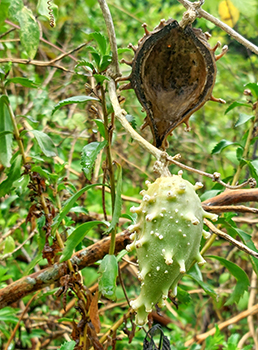
Even in the generally dry month of July, fruits can be found in the ABC-islands’ nature, although they are mainly found in places where moisture remains in the soil for a longer period. Limestone terraces, for instance, are a good example of this. In this rock, water collects in small reservoirs at various points. Plants growing on this rock have an intricate root pattern that grows through the porous rock in search of these reservoirs. This does not mean that these plants never shed their leaves or die, as there is, of course, a limit to the available water. However, this vegetation will remain green and bear flowers and fruit much longer than the vegetation growing on volcanic basalt. When the weather is favourable, plants like the Maripampun (A,C) or Maripòmpun (B,C) (Matelea rubra) still have leaves and certainly green fruit. The characteristic pear-shaped fruits, which have spike-like protrusions, are edible and on Curaçao they were also cultivated in the past for food production. The fruit was stewed, but first it had to be peeled and soaked in water with salt for some time to extract the milky substance inside and neutralize it.
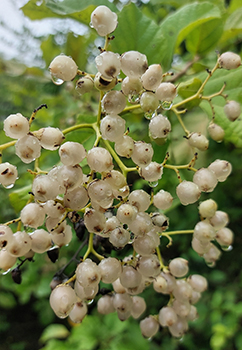
Near dams and in places where a wooded environment ensures the soil remains moist for extended periods, you can also find the swollen fruits of the Karawara di mondi (C), Cawara blanco (A) or Kohara (B) (Cordia dentata) in the month of July. If they are green, they are not yet ripe; ripe fruits look like white, glassy berries. These berries are also edible, although not many people find them particularly tasty. The flesh is very slimy and, while sweetish, can leave a bitter aftertaste. It also feels as if your mouth is drying out. There is a hard pit in the center. Birds love these berries, and the Ala blanka or Bare-eyed pigeon, in particular, has a tendency to feast on them when they are ripe. A large quantity of the berries can have an intoxicating effect on the birds. They become disoriented and appear drunk. In the past, the flower clusters of the tree were used to keep drinking water fresh, and the small fruits were not only eaten but also used as glue for making kites.
English name: –
Papiamentu/Papiamento name: Maripampun (A,C), Maripòmpun (B,C)
Scientific name: Matelea rubra
Family: Apocynaceae (dogbane family)
Occurrence (ABC islands): native on Aruba, Bonaire and Curaçao
English name: White manjack
Papiamentu/Papiamento name: Karawara di mondi (C), Cawara blanco (A), Kohara (B)
Scientific name: Cordia dentata
Family: Cordiaceae
Occurrence (ABC islands): native on Aruba, Bonaire and Curaçao
Publications used:
- Proosdij, A.S.J. van 2012. Arnoldo’s Zakflora: Wat in het wild groeit en bloeit op Aruba, Bonaire en Curaçao. 318 pp. Walburg Pers, Zutphen.
- van Buurt, Gerard. 2014. Caquetío words in Papiamentu/ Some names of animals and plants in Papiamentu. (download here: Book to download: Caquetío words in Papiamentu/ Some names of animals and plants in Papiamentu – Gerard van Buurt – Caribbean Footprint
- Dutch Caribbean Species Register
- The Online Flora of Curaçao
- Plants of the World Online
- Useful Tropical Plants
- Wikipedia

Titbits: De natuur in juli – Wilde Vruchten in juli
Ook in de veelal droge maand juli zijn er in de natuur van de ABC-eilanden vruchten te vinden, al zijn ze vooral te vinden op de plekken waar er wat langer vocht te vinden is in de bodem. Kalk terrassen zijn daar bijvoorbeeld een goed voorbeeld van. In dit gesteente blijft namelijk op verschillende plekken water staan in kleine reservoirs. Planten die op dit gesteente groeien hebben een ingewikkeld wortelpatroon dat door het poreuze gesteente heen groeit op zoek naar dit soort reservoirs. Dat wil niet zeggen dat deze planten nooit hun bladeren laten vallen of afsterven, want er is natuurlijk een limiet aan het beschikbare water. Maar wel zal deze vegetatie veel langer groen blijven en bloemen en vruchten dragen als de vegetatie die op de vulkanische basalt groeit. Als het weer gunstig is hebben ook planten als de Maripampun (A,C) of Maripòmpun (B,C) (Matelea rubra) nog blaadjes en zeker groene vruchten. De karakteristieke peervormige vruchten die stekvormige uitstekels hebben zijn eetbaar en werden in het verleden ook wel geweekt voor de voedselproductie. De vrucht werd gestoofd, maar eerst moest het geschild worden en enige tijd in water met zout worden gelegd om de melkachtige substantie die erin zit eruit te weken en als zodanig te neutraliseren.
Vlakbij dammen en op plekken waar een bosrijke omgeving ervoor zorgt dat de bodem langere tijd vocht blijft kun je in de maand juli ook de opgezwollen vruchten vinden van de Karawara di mondi (C), Cawara blanco (A) or Kohara (B) (Cordia dentata). Zijn ze groen dan zijn ze nog niet rijp, rijpe vruchten zien eruit als witte glazige bessen. Ook deze bessen zijn eetbaar, al zijn er niet veel mensen die ze echt heel lekker vinden. Het vruchtvlees is namelijk zeer slijmerig en is dan wel zoetig maar kan ook een wrange nasmaak achterlaten. Het voelt daarbij alsof je mond uitdroogt. In het midden zit een harde pit. Vogels zijn dol op deze bessen, en vooral de Ala blanka of Naaktoogduif heeft er een handje van om zich er flink tegoed aan te doen als ze rijp zijn. Een veelvoud aan de bessen kan een bedwelmende werking hebben op de vogels. Ze zijn dan gedesoriënteerd en lijken dronken. In het verleden werden de bloemtrossen van de boom gebruikt om drinkwater fris te houden en werden de vruchtjes niet alleen gegeten maar ook gebruikt als lijm bij het maken van vliegers.
Nederlandse naam: –
Papiamentse naam: Maripampun (A,C), Maripòmpun (B,C)
Wetenschappelijke naam: Matelea rubra
Familie: Apocynaceae (maagdenpalmfamilie)
Voorkomen (ABC eilanden): Aruba, Bonaire en Curaçao (inheems)
Nederlandse naam: –
Papiamentse naam: Karawara di mondi (C), Cawara blanco (A), Kohara (B)
Wetenschappelijke naam: Cordia dentata
Familie: Cordiaceae
Voorkomen (ABC eilanden): Aruba, Bonaire en Curaçao (inheems)
Gebruikte literatuur:
- Proosdij, A.S.J. van 2012. Arnoldo’s Zakflora: Wat in het wild groeit en bloeit op Aruba, Bonaire en Curaçao. 318 pp. Walburg Pers, Zutphen.
- van Buurt, Gerard. 2014. Caquetío words in Papiamentu/ Some names of animals and plants in Papiamentu. (download here: Book to download: Caquetío words in Papiamentu/ Some names of animals and plants in Papiamentu – Gerard van Buurt – Caribbean Footprint
- Dutch Caribbean Species Register
- The Online Flora of Curaçao
- Plants of the World Online
- Useful Tropical Plants
- Wikipedia