This post is also available in: Dutch (below)
This article was published in Antilliaans Dagblad on Tuesday June 16, 2026
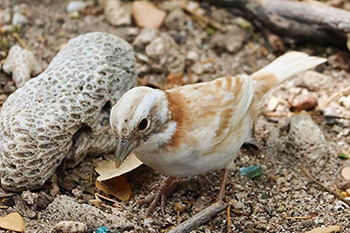
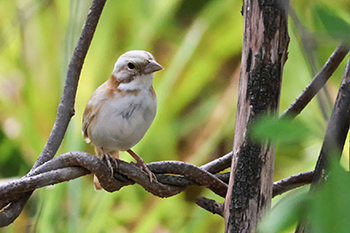
A few weeks ago, we wrote about the subject of leucism (Read it HERE: Biology: Leucism in the animal world – Caribbean Footprint). With photos of a recently observed leucistic Chuchubi or Tropical Mockingbird near Landhuis San Nicolas on Curaçao, photos of leucistic Chuchubis on Bonaire, and a leucistic Barika hel or Bananaquit on Curaçao, we illustrated this unusual color anomaly on our islands. A few days later, a series of photos by photographer Tom Lacroix appeared on the Facebook page Curaçao Nature Photography of a particularly light-colored Chonchorogai or Rufous-collared sparrow taken at the beach of Porto Marie on Curaçao; a leucistic Chonchorogai or Rufous-collared sparrow (Zonotrichia capensis insularis).
In summary, leucism is not a genetic mutation, but an abnormality in the pigment cells that leads to reduced pigmentation and can affect all types of pigments. Due to the abnormality in the aforementioned pigment cells, they do not develop properly, resulting in a complete or only partial loss of colour in the skin, fur, feathers, or scales of vertebrates. Mammals, birds, reptiles, amphibians, and fish can therefore all exhibit this phenomenon. The abnormality in the pigment cells does not affect the eyes, meaning that organisms with leucism have normally coloured eyes, rather than red ones as is the case with albinism.
As mentioned previously, leucism can manifest in various ways. In certain cases, organisms with leucism have only a few colourless spots on the skin, scales, or feathers (sometimes even just one white feather, for example) alongside the normal colours of the species, while in other cases, the individual is completely uncoloured. This is because leucism involves defects in the pigment cells themselves. These cells either do not develop properly during embryonic growth, or they produce less pigment. The condition can affect all types of pigmentation, including not only melanin but also the pigments responsible for other colours, such as red, orange, and yellow. As a result, white spots can develop in both the dark and light colour zones of the animals.
What is special about the Chonchorogai in question is that while some dark colors are visible on the head, the rest of the body is cream-white. The normal orange-brown markings are also intact.

Leucisme 2: een leucistische Roodkraaggors
Een aantal weken schreven we over het onderwerp leucisme (Lees HIER: Biology: Leucism in the animal world – Caribbean Footprint). Met foto’s van een recent waargenomen leucistische Chuchubi of Tropische spotlijster nabij Landhuis San Nicolas op Curaçao, foto’s van leucistische Chuchubi’s op Bonaire en een leucistische Barika hel of Suikerdiefje op Curaçao illustreerden we toen deze bijzondere kleurafwijking op onze eilanden. Enkele dagen later verscheen er een serie foto’s van fotograaf Tom Lacroix op de Facebook pagina Curaçao Nature Photography van een bijzonder licht gekleurde Chonchorogai of Roodkraaggors die gemaakt was bij het strand van Porto Marie op Curaçao; een leucistische Chonchorogai (Zonotrichia capensis insularis).
Leucisme is samengevat geen genetische mutatie, maar een afwijking in de pigmentcellen die leidt tot verminderde pigmentatie en die invloed kan hebben op alle typen pigmenten. Door de afwijking in de genoemde pigmentcellen ontwikkelen ze zich niet goed, wat zorgt voor een volledig of slechts gedeeltelijk kleurverlies in de huid, vacht, veren of schubben bij gewervelde dieren. Zowel zoogdieren, vogels, reptielen, amfibieën als vissen kunnen dit verschijnsel dus hebben. De afwijking in de pigmentcellen is daarbij niet van toepassing op de ogen, waardoor organismen met leucisme normaal gekleurde ogen hebben, en geen rode zoals dat bij albinisme wel het geval is.
Zoals in het vorige artikel ook geschreven, kan leucisme zich op verschillende manieren uiten. In bepaalde gevallen hebben organismen met leucisme slechts enkele kleurloze vlekken op de huid, schubben of veren (soms zelfs maar 1 witte veer bijvoorbeeld) naast de gewone kleuren die de soort heeft, en in andere gevallen is het individu volledig ongekleurd. Dit komt omdat het bij leucisme gaat om defecten in de pigmentcellen zelf. Deze cellen ontwikkelen zich ofwel niet goed tijdens de embryonale groei, of ze produceren minder pigment. De aandoening kan allerlei soorten pigmentatie aantasten, naast melanine ook de pigmenten die zorgen voor andere kleuren, waaronder rood, oranje en geel. Daardoor kunnen er witte vlekken in zowel de donkere als lichte kleurzones van dieren ontwikkelen.
Het bijzondere bij de Chonchorogai in kwestie is dat er wel wat donkere kleuren te zien op de kop maar dat de rest van het lijf roomwit van kleur is. Ook de normale oranjebruine tekening is intact.