This post is also available in: Dutch (below)
This article was published in Antilliaans Dagblad on Tuesday May 26, 2026
Humans identify animal species based on the habitat in which they occur, the behaviour of the animals in question, the sounds they produce, the shapes the animals have, and the colours they display. At a quick glance, the registration of colour is even one of the most important factors by which most people classify animals. Think of seeing a bird. Even if the bird in question flies past very quickly, but you see a deep orange colour in a fraction of a second and you are on either one of the 3 islands, Aruba, Bonaire or Curaçao, you will immediately conclude that it was an (Venezuelan) trupial. But sometimes nature tricks us, and suddenly there is an individual that has a different coloration, causing us to wonder what we actually saw. That is what recently happened to Willemijn Riedijk at Landhuis San Nicolas on Curaçao.
A Strange Bird
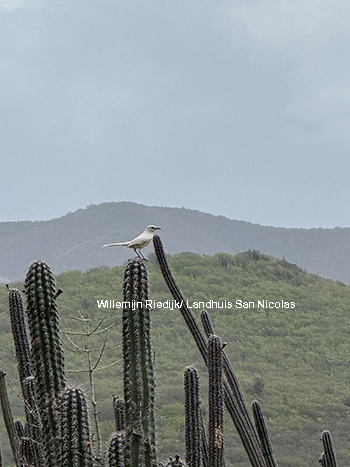
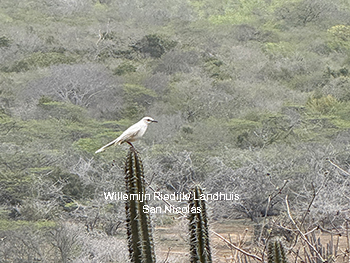
Last week, a message arrived on the Bird Watching Curaçao Facebook page containing a series of photos and videos of a peculiar-looking bird at Landhuis San Nicolas on the island of Curaçao, asking what special species this was. As can be seen in the photos and video in this article, it was a cream-colored, almost white bird with a long tail, dark legs, a dark beak, and brown eyes. Anyone paying attention to the shape of the bird and mentally comparing it to the known local bird shapes stored in the brain will immediately think of a Chuchubi or a Tropical Mockingbird (Mimus gilvus rostratus). But then doubt sets in, as the colour is absolutely not right. Tropical mockingbirds are silver-grey in colour with a dark grey Zorro mask around the eyes, dark grey wing feathers, and a tail with dark grey patterns and white tips. Not the this cream-white colour with hardly any dark markings. And yet, the animal in the photo is indeed a Chuchubi, albeit with a colour anomaly. The next conclusion might then be that this particular individual is perhaps an albino, a bird lacking pigment. However, the animal does indeed have markings and, moreover, the most important characteristic: normally coloured brown eyes instead of red eyes, as is usually the case with albino individuals. So, not an albino, but what then?
In nature, various colour abnormalities can occur in animals, including birds. Albinism is indeed one of them, but an even more common abnormality is so-called leucism; an abnormality in the pigment cells that leads to reduced pigmentation and can affect all types of pigments.
Albinism versus Leucism
Albinism is caused by a genetic mutation that prevents pigment production (melanin) in an organism’s cells, causing it to stop completely. This results in an absence of pigment in the skin, hair, scales, feathers, and eyes, creating an organism that is entirely ‘white’ with red eyes due to the underlying blood vessels showing through in the iris. However, not all albino individuals have completely red eyes.
It is a phenomenon that can occur in both mammals and other vertebrates, such as birds. In certain cases, humans specifically breed animals with this genetic mutation to produce pure white individuals with red eyes. Examples include the white rabbits with red eyes or the white hamsters with red eyes that are popular in pet shops. However, these albino animals usually do not live long, even in captivity, because people often fail to take sufficient account of the limiting factors affecting these animals. For instance, they often have problems with their eyes and vision and are sensitive to sunlight.
Leucism, on the other hand, is not so much a genetic mutation, but rather a condition that causes reduced pigmentation. The pigment cells do not develop properly, resulting in a complete or only partial loss of colour in the skin, fur, feathers, or scales. This does not apply to the pigments in the eyes, and therefore organisms with leucism have eyes with a normal colour. In the case of the Chuchubi at San Nicolas, therefore, ordinary brown eyes, just like all Chuchubis.
Leucism can manifest itself in various ways. Sometimes an organism with leucism has only a few colourless spots on the skin, scales, or feathers (sometimes even just one white feather, for example) alongside the normal colours of the species, and in other cases, the individual is completely uncoloured. This is because leucism involves defects in the pigment cells themselves. These cells either do not develop properly during embryonic growth, or they produce less pigment. The condition can affect all types of pigmentation, including not only melanin but also the pigments responsible for other colours, including red, orange, and yellow. As a result, white spots can develop in both the dark and light colour zones of animals.
Leucism on Curaçao and Bonaire
The photos of the leucistic Chuchubi at Landhuis San Nicolas on Curaçao can be considered quite unique, in the sense that it is rare for a leucitic bird of this species to be spotted and captured on the island. The animal’s coloration is striking, not only to observant people but also to predators targeting birds. There are few predators on the island that have a Tropical mockingbird on their menu. Apart from feral cats, these are mainly birds of prey such as the migrating Merlin and Peregrine Falcon, and perhaps a local American Kestrel. In practice, therefore, animals with leucism will stand out more because they have lost their camouflage colour and pattern and can thus easily fall prey to predators. The Chuchubi, a fairly vocal and visually prominent bird species, will likely not suffer much disadvantage from its colour variation.
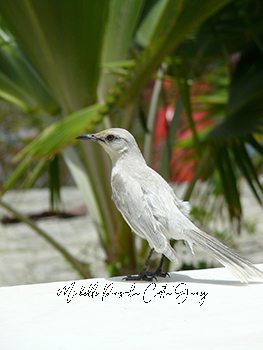
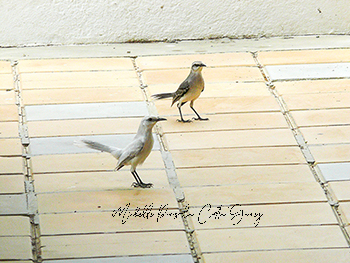
I previously spotted leucistic Caribbean mockingbirds myself on the sister island of Bonaire. In the vicinity of Mangazina di Rei, the culturally rich hotspot in the village of Rincon, an almost pure white Chuchubi with normally colored eyes sat next to his partner, a normally colored Chuchubi (see photo). That was in 2014. A few years later, when we were there again, the group of leucistic Chuchubis had expanded to about 4 (that we were able to count). I am curious whether the group has expanded further by 2026 and whether there are more individuals flying around with this special color variation.
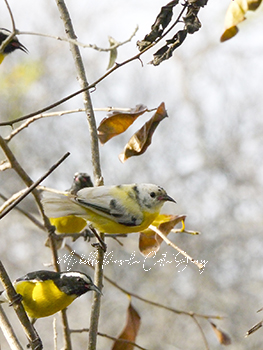
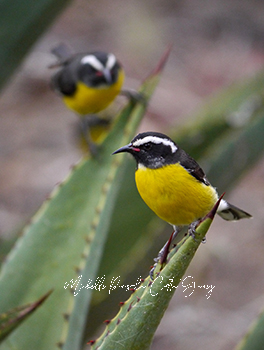
Another bird species on Curaçao in which color anomalies are regularly observed and which is also frequently photographed is the Bananaquit or Barika hel (Coereba flaveola uropygialis on Curaçao and Aruba and the Coereba flaveola bonairensis on Bonaire)). These busy, agile birds normally have a characteristic black ‘coat’—the back and wings are black—and a yellow belly. But in locations where large groups gather, for example where a lot of sugar is used for feeding, birds have been spotted that do have the beautiful yellow belly, but no black coat. The back and wings are then either completely white, white-spotted, or white with a few black spots. Otherwise, the eye colour is exactly the same as that of the ‘normally’ coloured birds, and the beak and legs also have the normal colour. These are also leucistic Bananaquits with pigment cells that have not developed properly. It is striking that these special animals are mainly seen in places where refined sugar is fed frequently and for prolonged periods. This addictive substance is not only unhealthy for humans. Birds also develop health problems from eating excessive sugar. A number of conditions that birds can get from eating this include obesity, liver disorders, cardiovascular diseases, and deficiencies in vitamins and minerals that can lead to (birth) defects. The advice is therefore always not to feed birds sugar, no matter how tasty they find it. If you want to feed them, presenting naturally sweet fruit is best. Think of bananas, (water)melon, and mango (overripe fruit is also fine), and above all, most importantly: multiple bowls of fresh drinking water. To drink from and bathe in.
With many thanks to Willemijn Riedijk of Landhuis San Nicolas for the photos of the leucistic Chuchubi on Curaçao.
Do you also have a question about the local nature or a special photo you would like an explanation for? Then email it to us at info@caribbeanfootprint.com.

Biologie: Leucisme in het dierenrijk
Dit artikel werd gepubliceerd in het Antilliaans Dagblad op dinsdag 26 mei 2026.
De mens identificeert diersoorten aan de hand van het habitat waarin ze voorkomen, het gedrag van de dieren in kwestie, de geluiden die ze produceren, de vormen die de dieren hebben en de kleuren die ze vertonen. In een snelle oogopslag is de registratie van kleur zelfs een van de belangrijkste factoren waarop mensen dieren indelen. Denk aan het zien van een vogel. Zelfs als de vogel in kwestie heel snel langs vliegt, maar je ziet in een fractie van een seconde een dieporanje kleur en je bent op een van de drie eilanden Aruba, Bonaire of Curaçao, dan zal je direct concluderen dat het een oranje Troepiaal was. Maar soms fopt de natuur ons en is er ineens een individu dat totaal anders gekleurd is, waardoor we ons gaan afvragen wat we nou hebben gezien. Dat overkwam Willemijn Riedijk bij Landhuis San Nicolas op Curaçao onlangs.
Een vreemde vogel
Afgelopen week kwam op de Facebookpagina van Bird Watching Curaçao een message binnen met een serie foto’s en filmpjes van een bijzonder uitziende vogel bij Landhuis San Nicolas op Curaçao, met de vraag welke bijzondere soort dit was. Zoals te zien op de foto’s in dit artikel ging het om een crèmekleurige, bijna witte vogel met een lange staart, donkere poten, een donkere snavel en bruine ogen. Wie op de vorm van de vogel let en dit mentaal vergelijkt met de in de hersenen opgeslagen bekende vogelvormen, zal direct denken aan een Chuchubi of een Caribische spotlijster (Mimus gilvus rostratus). Maar dan slaat de twijfel toe, want de kleur klopt absoluut niet. Chuchubi’s zijn zilvergrijs van kleur met een donkergrijs zorro-masker rondom de ogen, donkergrijze vleugelpennen en een staart met donkergrijze patronen en witte uiteinden. Niet de kleur roomwit met nauwelijks donkere markeringen. En toch is het dier op de foto wel degelijk een Chuchubi, met een kleurafwijking.
De volgende conclusie zou dan kunnen zijn dat dit bijzondere individu wellicht een albino is, een vogel die geen pigment heeft. Het dier heeft echter wel degelijk een tekening en daarbij nog het belangrijkste kenmerk: normaal gekleurde bruine ogen in plaats van rode ogen, zoals dat bij albino-individuen meestal voorkomt. Geen albino dus, maar wat dan wel?
In de natuur kunnen verschillende kleurafwijkingen voorkomen bij dieren, waaronder vogels. Albinisme is daar inderdaad één van, maar een nog veel meer voorkomende afwijking is het zogenaamde leucisme; een afwijking in de pigmentcellen die leidt tot verminderde pigmentatie die invloed kan hebben op alle typen pigmenten.
Albinisme versus Leucisme
Albinisme wordt veroorzaakt door een genetische mutatie die ervoor zorgt dat er geen pigmentproductie (melanine) in de cellen van een organisme plaatsvindt en dus volledig stopt. Dat resulteert in een afwezigheid van pigment in de huid, het haar, de schubben, de veren en de ogen en dus een organisme dat helemaal ‘wit’ is met rode ogen door het doorschijnen van de onderliggende bloedvaatjes in de iris. Overigens hebben niet alle albino-individuen volledig rode ogen. Het is een fenomeen dat kan voorkomen bij zowel zoogdieren als andere gewervelde dieren zoals vogels. In bepaalde gevallen wordt er door de mens speciaal gefokt met dieren die deze genetische mutatie hebben om spierwitte individuen te produceren met rode ogen. Denk daarbij bijvoorbeeld aan de witte konijnen met rode ogen of de witte hamsters met rode ogen die populair zijn in petshops. Deze albino-dieren leven echter meestal niet lang, ook niet in gevangenschap, omdat men vaak te weinig rekening houdt met de limiterende factoren van deze dieren. Zo hebben ze vaak problemen met hun ogen en zicht en kunnen ze slecht tegen zonlicht.
Leucisme daarentegen is niet zozeer een genetische mutatie, maar een aandoening die zorgt voor verminderde pigmentatie. De pigmentcellen ontwikkelen zich niet goed, wat zorgt voor een volledig of slechts gedeeltelijk kleurverlies in de huid, vacht, veren of schubben. Dit geldt niet voor de pigmenten in de ogen, en daarom hebben organismen met leucisme ogen met een normale oogkleur. In het geval van de Chuchubi bij San Nicolas dus gewone bruine ogen, zoals alle Chuchubi’s dat hebben.
Leucisme kan zich op verschillende manieren uiten. Soms heeft een organisme met leucisme slechts enkele kleurloze vlekken op de huid, schubben of veren (soms zelfs maar 1 witte veer bijvoorbeeld) naast de gewone kleuren die de soort heeft, en in andere gevallen is het individu volledig ongekleurd. Dit komt omdat het bij leucisme gaat om defecten in de pigmentcellen zelf. Deze cellen ontwikkelen zich ofwel niet goed tijdens de embryonale groei, of ze produceren minder pigment. De aandoening kan allerlei soorten pigmentatie aantasten, naast melanine ook de pigmenten die zorgen voor andere kleuren, waaronder rood, oranje en geel. Daardoor kunnen er witte vlekken in zowel de donkere als lichte kleurzones van dieren ontwikkelen.
Leucisme op Curaçao en Bonaire
De foto’s van de leucistische Chuchubi bij Landhuis San Nicolas op Curaçao zijn best uniek te noemen in de zin dat het niet vaak voorkomt dat een leucistische vogel van deze soort op het eiland wordt gespot en vastgelegd. De kleur van het dier is opvallend, niet alleen voor oplettende mensen, maar ook voor roofdieren die het op vogels hebben gemunt. Er zijn weinig roofdieren op het eiland die een Caribische spotlijster op het menu hebben staan. Op verwilderde katten na, zijn dat vooral roofvogels zoals de migrerende Smelleken en Slechtvalk en wellicht een lokale Amerikaanse torenvalk. In de praktijk zullen dieren met leucisme dus meer opvallen doordat ze hun camouflagekleur en -patroon kwijt zijn en dus makkelijk ten prooi kunnen vallen aan rovers. Waarschijnlijk zal de Chuchubi, een redelijk luidkeels en visueel aanwezige vogelsoort, niet veel nadeel ondervinden van zijn kleurvariatie.
Eerder heb ik zelf leucistische Caribische spotlijsters gespot op zustereiland Bonaire. In de omgeving van Mangazina di Rei, de rijk culturele hotspot in het plaatsje Rincon, zat een bijna spierwitte Chuchubi met normaal gekleurde ogen naast zijn partner, een normaal gekleurde Chuchubi (zie foto). Dat was in 2014. Een aantal jaar later, toen we er weer waren, was de groep met leucistische Chuchubi’s uitgebreid naar een stuk of 4 (dat we hebben kunnen tellen). Ik ben benieuwd of de groep zich anno 2026 verder heeft uitgebreid en of er meer individuen rondvliegen met deze bijzondere kleurschakering.
Een andere vogelsoort op Curaçao waar regelmatig kleurafwijkingen bij worden geconstateerd en die ook regelmatig gefotografeerd, is het Suikerdiefje of Barika hel (Coereba flaveola uropygialis op Curaçao and Aruba and the Coereba flaveola bonairensis op Bonaire). Deze drukke, beweeglijke vogels hebben normaal een karakteristieke zwarte ‘jas’, de rug en vleugels zijn zwart, en een gele buik. Maar op locaties waar grote groepen samenkomen, bijvoorbeeld waar er met veel suiker wordt gevoerd, zijn er vogels gespot die wel de mooie gele buik hebben, maar geen zwarte jas. De rug en vleugels zijn dan of volledig wit, zijn witgestippeld of zijn wit met enkele zwarte stippen erin. De oogkleur is verder precies hetzelfde als de ‘normaal’ gekleurde vogels en ook de snavel en de poten hebben de normale kleur. Dit zijn ook leucistische Suikerdiefjes met pigmentcellen die zich niet goed hebben ontwikkeld. Het is opvallend dat deze bijzondere dieren vooral te zien zijn op plekken waar er veelvuldig en langdurig gevoerd wordt met geraffineerde suiker. Dit verslavende goedje is niet alleen voor mensen ongezond. Ook vogels krijgen gezondheidsproblemen van het eten van excessieve suiker. Een aantal aandoeningen die vogels hiervan kunnen krijgen zijn overgewicht, leveraandoeningen, hart- en vaatziekten en deficienties in vitaminen en mineralen die kunnen leiden tot (geboorte)afwijkingen. Het advies luidt daarom altijd om vogels niet te voeren met suiker, hoe lekker ze het ook vinden. Wil je ze voeren, dan is het presenteren van natuurlijk zoet fruit het beste. Denk aan bananen, (water)meloen en mango (overrijp fruit is ook prima), en vooral het allerbelangrijkste: meerdere bakken met vers drinkwater. Om van te drinken en in te badderen.
Met dank aan Willemijn Riedijk van Landhuis San Nicolas voor de foto’s van de leucistische Chuchubi op Curaçao.
Heeft u ook een vraag over de lokale natuur of een bijzondere foto waar u graag uitleg over krijgt? Mail die dan naar ons op info@caribbeanfootprint.com.