This post is also available in: Dutch (below)
The coast is always full of surprises. Whether it is beautiful views, wild waves, or treasures from the sea, there is always something to see, hear, smell, feel, and experience. We are always on the lookout for treasures from the sea that can be found in small pools or tidal pools. Spending hours observing and taking photos, and then enjoying the photos at home and searching for the stories behind the organisms we have found, is not an exception. Anyone visiting and strolling along the coast regularly can encounter a bright blue organism resembling a jellyfish after a period of change in wave and wind patterns: the Blue Button.
Tidal Pools
Various bays or inlets along the northern side of the islands are blessed with small beaches featuring limestone rocks, or at least a rim of limestone rocks and so-called ‘beach rock,’ behind which tidal pools remain. These are locations that flood at high tide and retain seawater when low tide. While the differences between high and low tide on the islands of Aruba, Bonaire, and Curaçao are not particularly large, the variations in sea level are sufficient to allow the pools to form. During the high tide period, not only does fresh seawater flow into the pools, but often all kinds of organisms are carried along with it, including seaweed, sargassum, and the eggs and larvae of all sorts of marine animals such as fish, anemones, and even coral. Larger organisms are also swept along by the water and sometimes remain behind in the pools or on the beach. Special organisms regularly wash ashore on the north coast, including the Portuguese Man-of-War (READ MORE Marine creatures: Portuguese Man’o War (Physalia physalis) – Caribbean Footprint), which can otherwise be found in our waters all year round but is mainly located in the sea off the northern coast of the islands. However, other organisms also wash ashore, such as the Common Purple Sea Snail (Janthina janthina – READ MORE Shells: Common purple snail – Caribbean Footprint) —a species of snail with a beautiful lilac shell that lets itself be blown across the sea by the wind with a kind of foam bubbles—and that can survive for a few days in the tidal pools.
Life in the Extreme
Because the tidal pools periodically fill with nutrient-rich seawater, they usually do not dry out. This fact, combined with the fact that the water in the pools is sometimes heated to extreme temperatures by the sun and can cool down considerably at night, creates mini-worlds of life in each individual pool. Small schools of fish, snails, crabs, hermit crabs, small corals, sponges, anemones, algae, nudibranchs, and the like survive in these places in an almost miraculous way. Anyone who takes a moment to systematically investigate the saltwater pools and observe what is going on will encounter not only wondrous organisms but, above all, the power of survival in locations that are not easy to access.
Not all organisms survive for extended periods in this environment. Sometimes organisms wash ashore, such as the aforementioned jellyfish, which hold out for a few hours to a few days before succumbing. Unfortunately, that is also the case with the Blue Button.
The Blue Button (Porpita porpita)
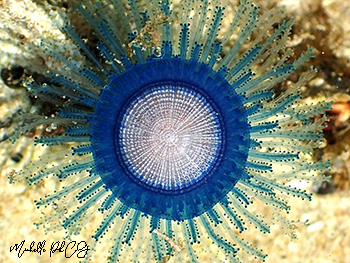
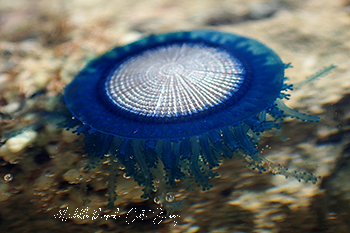
Usually, you practically stumble upon it by accident. An organism of about 2 cm in diameter does not stand out easily on a rugged little northern coast beach. Perhaps it is the color or the irregularity of patterns along the coast that makes the Blue Button suddenly stand out, but once you see the organism, you can’t stop looking. With its bright blue color, it is definitely not an inconspicuous sight.
The Blue Button has the scientific name Porpita porpita and is often lumped together with jellyfish due to its appearance. However, scientifically it is not considered a jellyfish but a so-called hydroid, also called a group of hydrozoan polyps. These are marine organisms found worldwide in practically all oceans, and each seemingly individual organism consists of a colony of hydroids.
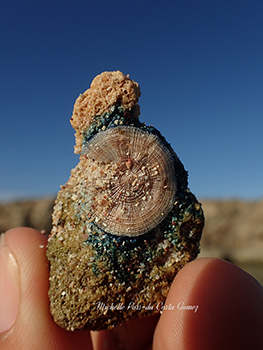
The organism can grow up to 5 cm in diameter, sometimes a little larger. It can easily be recognized by its silvery to golden brown floating organ in the middle, that is made of chitine and that will grow outwards by producing additional ‘rings’. The remnants of these ‘discs’ can be found regularly along the coast, stuck to debris, rocks and sargassum after the organism had died. Besides this float the bright blue tentacles are what truly makes the identification. Porpita porpita can be found in tropical and subtropical warm waters in the Caribbean, Atlantic, Pacific and also the Indian ocean and the Mediterranean.
Life at the surface
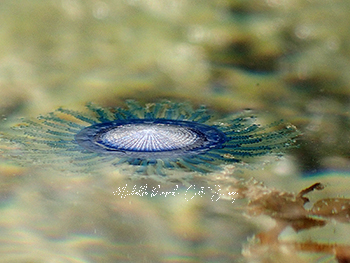
The Blue Button lives at the surface of the seawater and, as far as described, consists of two main parts: the part with which the organism floats, the silver to golden brown disc in the centre and which can be filled with gas to increase buoyancy, and the hydroid colony, which looks like the tentacles of a jellyfish. Each tentacle-like strand, in turn, has various branches with stinging cells at the ends, which cause the burning sensation upon contact. Unlike the Portuguese Man-of-War, the stinging cells of the Blue Button do not contain highly toxic substances, but can nevertheless cause skin irritation and a mild burning sensation.
The organism’s hydroids all have a function. Some are involved in digesting food, others in reproduction, and yet others in defense.
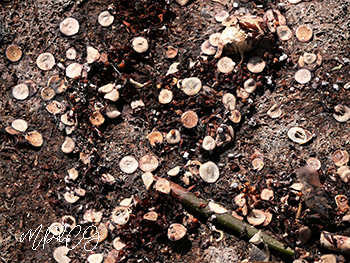
The organism floats on the water surface and moves along with the water current. The ‘scutellum’ is filled with gas, allowing it not only to float but also to be propelled by the wind. In this way, the animals sometimes wash up on the beach or into tidal pools, and then, in most cases, it is game over. The organism feeds on the larvae of crustaceans, plankton, and small lobsters, which it catches with its tentacles and then transfers to the mouthpart located beneath the floating ‘disc’. This mouthpart is also used to excrete waste products. The organisms themselves are also eaten by various species of snails and slugs, among others. When the Blue Button washes ashore and eventually dries out, small hermit crabs and other predators are also standing by to consume the edible components.
Hermaphrodite
The organisms are hermaphroditic, meaning they are both male and female. The hydroids responsible for reproduction release both eggs and sperm into the water. If an egg is fertilized, a larva hatches that must undergo metamorphosis to eventually become an individual polyp. When a polyp divides to form new (types of) polyps (somewhat comparable to the division of coral polyps when forming a coral colony), each with its own function, a Blue Button colony is created.
A Day at the Coast
With a little patience and perseverance, anyone can discover the most beautiful sea treasures along the coast of our island. And this is also a fun activity for children, provided, of course, that it is done responsibly. Unfortunately, traces of destruction can be seen in many places along the coast, as well as at the various bays. People who like to stack stones do so in places that cause these aforementioned pools to dry up completely or cease to form. As a result, a great diversity of life is lost. There are even more harmful consequences of this baffling ‘urge’ to stack stones, but I will address that another time. For now, I would say: head out to the coast this coming weekend and feast your eyes for a day. Leave only footsteps and take only pictures.
Did you know that the Blue Button is featured on the 100,- Caribbean guilder (XCG) bill that was launched a couple of years ago!. Check out the bank note on the back by clicking on the bank note image here: Banknotes 100CG. The inspiration of this image is based on a photo by Léon Pors, taken on Curaçao in 2016. The specific image is not included in this article!
English name: Blue button
Papiamentu name: –
Scientific name: Porpita porpita
Family: Porpitidae
Occurrence (ABC islands): Aruba, Bonaire and Curaçao
Publications used:
- Humann, Paul. 1993. Reef creature identification – Florida- Caribbean- Bahamas.
- World Register of Marine Species
- Wikipedia
- Oguchi K, Maeno A, Yoshida K, Yamamoto G, Kohtsuka H, Dunn CW. Zooid arrangement and colony growth in Porpita porpita. Front Zool. 2025 Jun 23;22(1):11. Zooid arrangement and colony growth in Porpita porpita – PMC
- Wakita, D., Murai, K., Yamamoto, G. et al. A neustonic hydrozoan Porpita porpita drifts for over a year. Sci Rep 16, 13766 (2026). https://doi.org/10.1038/s41598-026-49897-y
- Dutch Caribbean Species Register
- Little blue buttons’ long journey: Tiny sea creature Porpita porpita may live adrift at sea for years longer than previously thought

Schatten van de zee: de Blue button (Porpia porpita)
De kust is altijd goed voor verassingen. Of het nou prachtige uitzichten zijn, woeste golven of schatten uit de zee, er is altijd wat te zien, horen, ruiken, voelen en ervaren. Wij zijn altijd op zoek naar schatten uit de zee die op de kleine boka’s of in getijde poeltjes te vinden zijn. Uren bezig zijn met observeren en foto’s maken, en daarna thuis nagenieten van de foto’s en de verhalen bij de organismen zoeken die we hebben gevonden, is geen uitzondering. Wie de kust bezoekt en struint, komt na een periode van een verandering in golf en windpatronen regelmatig een felblauw organisme tegen dat op een kwalletje lijkt: de Blue Button.
Getijde poelen
Verschillende boka’s, of mondingen, langs de noordzijde van de eilanden zijn begenadigd met klein strandjes met kalkrotsen of althans een rand van kalkrotsen en zogenaamde ‘beach rock’ waarachter getijde poelen blijven staan. Dit zijn locaties die onderlopen wanneer het vloed is en waarin zeewater achterblijft als het eb is. Nu hebben we op de eilanden Aruba, Bonaire en Curaçao niet al te grote verschillen tussen eb en vloed, maar de verschillen in het zeewaterpeil zijn wel zodanig dat de poelen kunnen ontstaan. Tijdens de periode van vloed stroomt niet alleen vers zeewater in de poelen, vaak komen er ook allerlei organismen mee waaronder zeewier, sargassum en eieren en larven van allerhande zeedieren zoals vissen, anemonen en zelfs koraal. Ook grotere organismen worden meegesleept door het water en blijven soms achter in de poelen of op het strand.
Regelmatig spoelen er bijzondere organismen aan op de noordkust waaronder het Portugese Oorlogsschip (LEES HIER MEER: Marine creatures: Portuguese Man’o War (Physalia physalis) – Caribbean Footprint), die overigens het hele jaar door in onze wateren te vinden is maar zich voornamelijk in de zee aan de noordkust van het eiland bevinden. Maar ook andere organismen, zoals de Purperen zeezeiler (Janthina janthina, LEES HIER MEER: Shells: Common purple snail – Caribbean Footprint), een slakkensoort met een prachtige lila schelp dat zich met een soort schuimbellen door de wind over de zee laat waaien, spoelen aan en kunnen nog enkele dagen in de getijde poelen overleven.
Leven in het extreme
Omdat de poelen periodiek vollopen met voedselrijk zeewater, drogen ze meestal niet uit. Dit feit, gecombineerd met het gegeven dat het water in de poelen soms tot extreme temperaturen wordt verwarmd door de zon en ’s nachts behoorlijk kan afkoelen levert mini-wereldjes van leven op in elke afzonderlijk poel. Kleine scholen met vis, slakken, krabben, heremietkreeften, koraaltjes, sponsen, anemonen, algen, naaktslakken en zo nog het een ander overleven op deze plekken op bijna wonderbaarlijke wijze. Wie er even de tijd voor neemt om de zoutwater poelen systematisch te onderzoeken en observeren wat er allemaal gaande is, komt niet alleen wonderlijke organismen tegen maar vooral ook de kracht van overleving op locaties die niet al te makkelijk zijn.
Niet alle organismen overleven in deze omgeving voor langere tijd. Soms spoelen er organismen aan, zoals de eerder genoemde kwallen die het enkele uren tot enkele dagen volhouden en dan toch bezwijken. Helaas is dat met de Blue Button ook het geval.
De Blue Button (Porpita porpita)
Meestal loop je er per ongeluk praktisch tegenaan. Op een ruig noordkuststrandje valt een organisme van zo’n 2 cm in doorsnede niet snel op. Misschien is het de kleur of de onregelmatigheid in patronen langs de kust waardoor de Blue Button ineens opvalt, maar als je het organisme één keer ziet, dan kun je alleen maar blijven kijken. Met zijn helblauwe kleur is het geen onopvallende verschijning.
De Blue Button heeft de wetenschappelijke naam Porpita porpita en wordt vaak op een hoop gegooid met de kwallen, vanwege het uiterlijk. Maar wetenschappelijk wordt het niet als een kwal gezien maar als een hydroïdpoliep. Het zijn marine organismen die wereldwijd voorkomen in praktisch alle oceanen en elk ogenschijnlijk individueel organisme bestaat uit een kolonie van hydroïden.
Het organisme kan een diameter van 5 centimeter bereiken. Het is gemakkelijk te herkennen aan het zilverkleurige tot goudbruine drijvende orgaan (een schijf) in het midden, dat opgebouwd is uit chitine en dat naar buiten toe kan groeien door het aanmaken van nieuwe ringen. De resten hiervan worden regelmatig langs de kust gevonden, vastgeplakt aan puin, rotsen en zeewier nadat het organisme is gestorven. Naast dit drijvende orgaan zijn de felblauwe tentakels indicatief. Porpita porpita komt voor in tropische en subtropische warme wateren in het Caribisch gebied, de Atlantische Oceaan, de Stille Oceaan, de Indische Oceaan en de Middellandse Zee.
Leven aan de oppervlakte
De Blue Button leeft aan de oppervlakte van het zeewater en bestaat voor zover beschreven uit twee hoofdonderdelen, het deel waarmee het organisme drijft, de zilverkleurig tot goudbruine schijf in het midden en dat met gas kan worden gevuld om het drijvermogen te verhogen, en de hydroïden kolonie die eruit ziet als de tentakels van een kwal. Elke als tentakel uitziende streng heeft op diens beurt verschillende vertakkingen met aan de uiteinden de netelcellen, die zorgen voor het brandige gevoel bij aanraking. In tegenstelling tot het Portugese Oorlogsschip bevatten de netelcellen van de Blue Button geen enorm giftige substanties, maar kunnen desalniettemin wel zorgen voor huidirritatie en een licht branderig gevoel.
De hydroïden van het organisme hebben allemaal een functie. De een houdt zich bezig met voedsel verteren, de andere met voortplanting en weer een andere met verdediging.
Het organisme drijft aan het wateroppervlakte en mee met de stroming van het water en het ‘schildje; is gevuld met gas waardoor het niet alleen kan drijven maar ook door de wind kan worden voortgestuwd. Op deze wijze spoelen de dieren dus soms het strand op, of de getijde poelen in en dan is het in de meeste gevallen einde oefening. Het organisme voedt zich met de larven van schaaldieren, plankton en kleine kreeftjes die het vangt met de tentakels en vervolgens naar het monddeel dat zich onder het drijvende ‘schild’ bevindt. Dit monddeel wordt ook gebruikt om afvalstoffen uit te scheiden. Zelf worden de organismen ook opgevreten door onder andere verschillende soorten slakken en naaktslakken. Bij het aanspoelen en uiteindelijk opdrogen van de Blue Button staan ook kleine heremietkreeften en andere predatoren paraat om de eetbare bestanddelen te nuttigen.
Hermafrodiet
De organismen zijn hermafrodiet, zowel mannelijk als vrouwelijk dus. De hydroïden die belast zijn met de voorplanting laten zowel eieren als sperma los in het water. Als een eitje is bevrucht komt er een larve uit dat een metamorfose moet doorstaan om uiteindelijk een individueel poliepje te worden. Als een poliep zich deelt om nieuwe (typen) poliepen te vormen (een beetje vergelijkbaar met het delen van koraal poliepen bij het vormen van een koraal kolonie), elk met zijn eigen functie, ontstaat een Blue Button kolonie.
Een dagje kust
Iedereen kan met een beetje geduld en uithoudingsvermogen de mooiste zeeschatten ontdekken langs de kust van ons eiland. En ook voor kinderen is dit een leuke actviteit, mits het natuurlijk verantwoordelijk gebeurd. Helaas is op veel plekken langs de kust, en ook bij de verschillende boka’s sporen van sloop te zien. Mensen die graag stenen willen stapelen, doen dat op plekken waardoor deze bovengenoemde poeltjes geheel droog komen te liggen of niet meer ontstaan. En daarmee gaat een grote diversiteit aan leven verloren. Er zijn nog meer schadelijke gevolgen van deze verbijsterende ‘urge’ voor stapelen, maar daar zal ik een andere keer bij stilstaan. Voor nu zou ik zeggen, ga er het komende weekend lekker op uit naar de kust en kijk een dagje uw ogen uit. Leave only footsteps and take only pictures.
Wist je dat de Blue Button afgebeeld staat op het bankbiljet van 100 Caribische gulden (XCG) dat een paar jaar geleden is geïntroduceerd? Bekijk de achterkant van het bankbiljet door hier op de afbeelding te klikken: Banknotes 100CG. De inspiratie voor deze afbeelding komt van een foto van Léon Pors, genomen op Curaçao in 2016. De specifieke foto is niet in dit artikel opgenomen!
Nederlandse naam: Blue button / Blauwe knoop
Papiamentse naam: –
Wetenschappelijke naam: Porpita porpita
Familie: Porpitidae
Voorkomen (ABC eilanden): Aruba, Bonaire en Curaçao
Gebruikte publicaties:
- Humann, Paul. 1993. Reef creature identification – Florida- Caribbean- Bahamas.
- World Register of Marine Species
- Wikipedia
- Oguchi K, Maeno A, Yoshida K, Yamamoto G, Kohtsuka H, Dunn CW. Zooid arrangement and colony growth in Porpita porpita. Front Zool. 2025 Jun 23;22(1):11. Zooid arrangement and colony growth in Porpita porpita – PMC
- Wakita, D., Murai, K., Yamamoto, G. et al. A neustonic hydrozoan Porpita porpita drifts for over a year. Sci Rep 16, 13766 (2026). https://doi.org/10.1038/s41598-026-49897-y
- Dutch Caribbean Species Register
- Little blue buttons’ long journey: Tiny sea creature Porpita porpita may live adrift at sea for years longer than previously thought